All species › Woodpeckers and allies › Woodpeckers › Fernandina's Flicker
Fernandina's Flicker | Colaptes fernandinae
Cubaanse grondspecht | Carpintero churroso
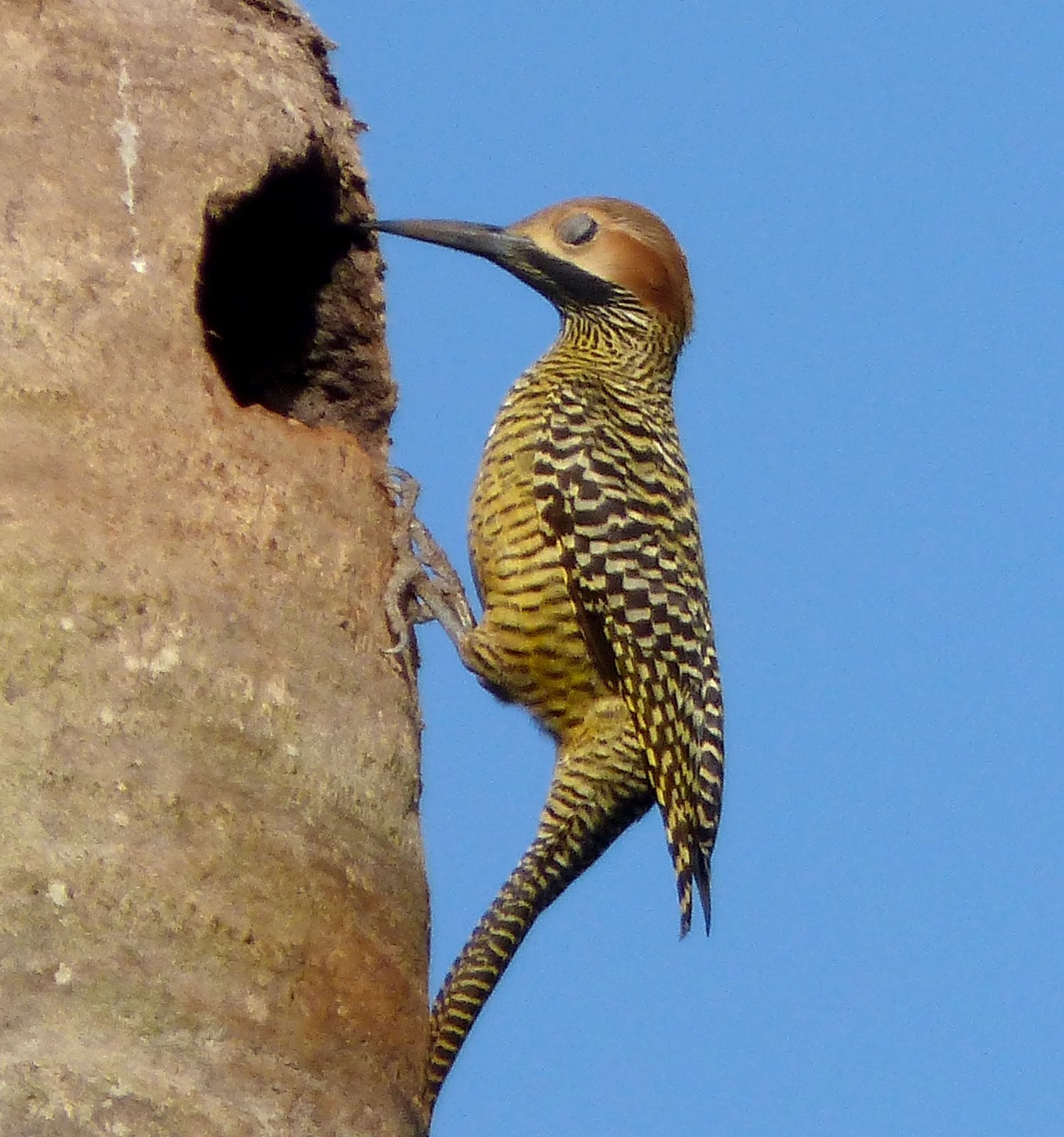
Fernandina's Flicker occurs only in Cuba and is among the rarest woodpeckers in the world. It lives in open palm savannas and does much of its feeding on the ground. In Cuba it is called carpintero churroso. The population is estimated at a few hundred birds, split across a number of separate areas.
Voice
Loud, repeated pik calls and series of wicka-wicka, similar to those of Northern Flicker but lower and hoarser; also a long series of rapid calls.
Recording: Diana Doyle — CC BY-NC-SA 4.0 · converted to mono · xeno-canto
Identification
33–35 cm. The entire plumage is yellowish-buff to tawny with dense, fine black barring; the head is cinnamon with fine dark streaks. There is no red at all. The underwings and the shafts of the flight and tail feathers are yellow. The bill is long and dark. The male has a black moustache; in the female it is barred black and white.
Confusion species
Northern Flicker Colaptes auratus, which can occur at the same sites in Cuba, has a grey crown with a red nape patch, a black breast crescent, spotted rather than barred underparts and a white rump. West Indian Woodpecker Melanerpes superciliaris is barred black and white on the back and has red on the head.
Habitat
Open palm savannas with scattered Copernicia and Sabal palms, marsh edges, seasonally flooded grassland and open dry woodland; also pastures with old palms. It feeds mainly on the ground on ants and their larvae, as well as other insects and seeds. It breeds from March to June in holes in dead palm trunks, sometimes in loose groups; the clutch is three to five eggs.
Where the bird is most at home, classified by the vegetation types of the Caribbean.





Range and movements
Only in Cuba, where it once occurred over much of the island but is now scattered across isolated sites in nine provinces, from Pinar del Río to Santiago de Cuba and Granma. The largest population lives in the Zapata Swamp in Matanzas; there are also important strongholds in Camagüey. The species does not occur outside Cuba.
- Resident
- dark = core range, pale = thinly spread
How and when to look
The area around Bermejas and other palm savannas in the Zapata Swamp are the best-known sites. Birds are most active early in the morning, on the ground or around nest holes in dead palms. Nest trees are best not approached during the breeding season.
Conservation status
Endangered (EN). The population is estimated at only a few hundred birds and is declining. Causes are the loss of palm savanna to agriculture and logging, the felling of dead palms used for nesting, and hurricane damage. Competition for nest holes also plays a part.
Scientific name
Colaptes fernandinae | Vigors, 1827
Vigors described the species in 1827 and placed it straight away in the genus where it still stands. The genus Colaptes was introduced in 1825 by Vigors. Colaptes is Greek kolaptēs 'chiseller', from kolaptō 'to peck, to chisel', after the hacking into wood. fernandinae honours José María Herrera y Herrera, second Count of Fernandina, a Cuban nobleman and sugar planter. The specimen the first description was based on came from near Havana, Cuba.