All species › Waterfowl › Ducks and geese › Gadwall
Gadwall | Mareca strepera
Krakeend | Ánade friso
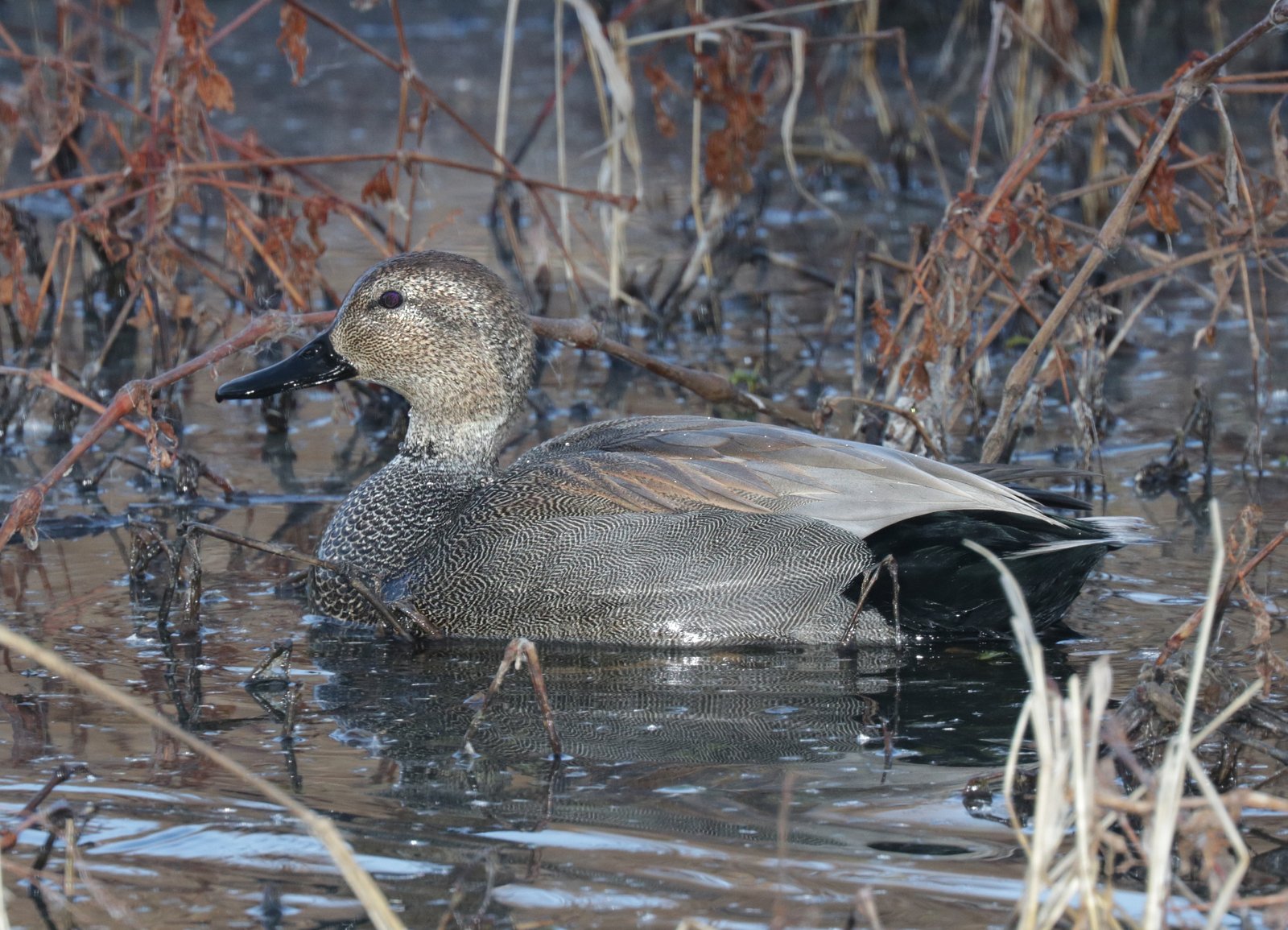
The Gadwall is a subdued grey-brown dabbling duck that only really catches the eye when it takes off and shows its white wing patch. In the Caribbean it is a scarce winter visitor from North America, mainly in the north of the island chain. In Cuba it is called pato gris.
Voice
The male gives a short, hoarse errp, often several times in succession, and a high whistle; the female quacks like a Mallard but higher and more nasal, in a descending kek-kek-kek. Largely silent in winter.
Recording: David Darrell-Lambert — CC BY-NC-SA 4.0 · converted to mono · xeno-canto
Identification
46–57 cm, slightly smaller and slimmer than a Mallard, with a steep forehead and a rather angular head. The male is grey, finely spotted and vermiculated on breast and flanks, with a plain black rear end and a dark bill; close up the pattern is finer than it looks at a distance. The female is mottled brown, with a thin dark bill with orange sides and a white belly. In flight both sexes show a small, sharply defined white patch on the inner wing, in the male bordered by black and chestnut. Juveniles resemble the female.
Confusion species
Female Mallard Anas platyrhynchos has a broader orange bill with a dark saddle, a blue speculum with white borders and no white wing patch. Female American Wigeon Mareca americana has a small blue-grey bill with a black tip, a greyer head and warm orange-brown flanks. The white wing patch and the black rear end of the male are distinctive in the region.
Habitat
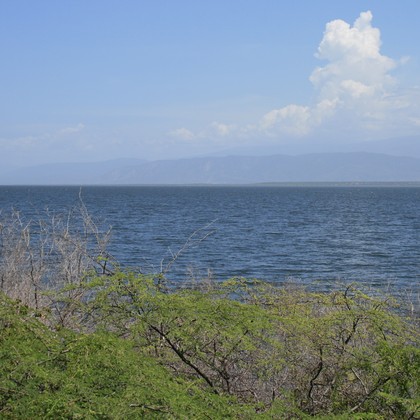
Fresh and brackish lakes, ponds, marshes with open water and lagoons, also reservoirs and sewage ponds. It dabbles in shallow water and feeds mainly on aquatic plants and their seeds. Usually among other ducks, especially American Wigeons and Blue-winged Teals.
Where the bird is most at home, classified by the vegetation types of the Caribbean.



Range and movements
A rare winter visitor to Cuba, and elsewhere in small numbers or irregularly in the Bahamas and the other Greater Antilles. Exceptional in the Lesser Antilles, Trinidad and Tobago and the ABC islands. Breeds in North America, chiefly on the interior prairies, and in Eurasia; American birds winter south to Mexico.
- Winter visitor (c. Apr–Sep)
- dark = core range, pale = thinly spread
How and when to look
Best looked for among flocks of American Wigeons and Blue-winged Teals on shallow freshwater lakes and wetlands in the north of the region. When a flock flushes, the white wing patch gives the species away at once.
Conservation status
Least Concern. In North America the species has increased over recent decades. In the Caribbean it is so scarce that little is known of trends; hunting and wetland loss affect it here as they do other wintering ducks.
Scientific name
Mareca strepera | (Linnaeus, 1758)
Linnaeus described the species in 1758 as Anas strepera; because it was later moved to another genus, the author and year stand in brackets. The genus Mareca was introduced in 1824 by Stephens. Mareca comes from the Portuguese marreco, a word for a small duck. strepera is Latin for 'noisy', from strepere 'to make a din', after the rattling call. The specimen the first description was based on came from Sweden.