All species › Waterfowl › Ducks and geese › Garganey
Garganey | Spatula querquedula
Zomertaling | Cerceta carretona
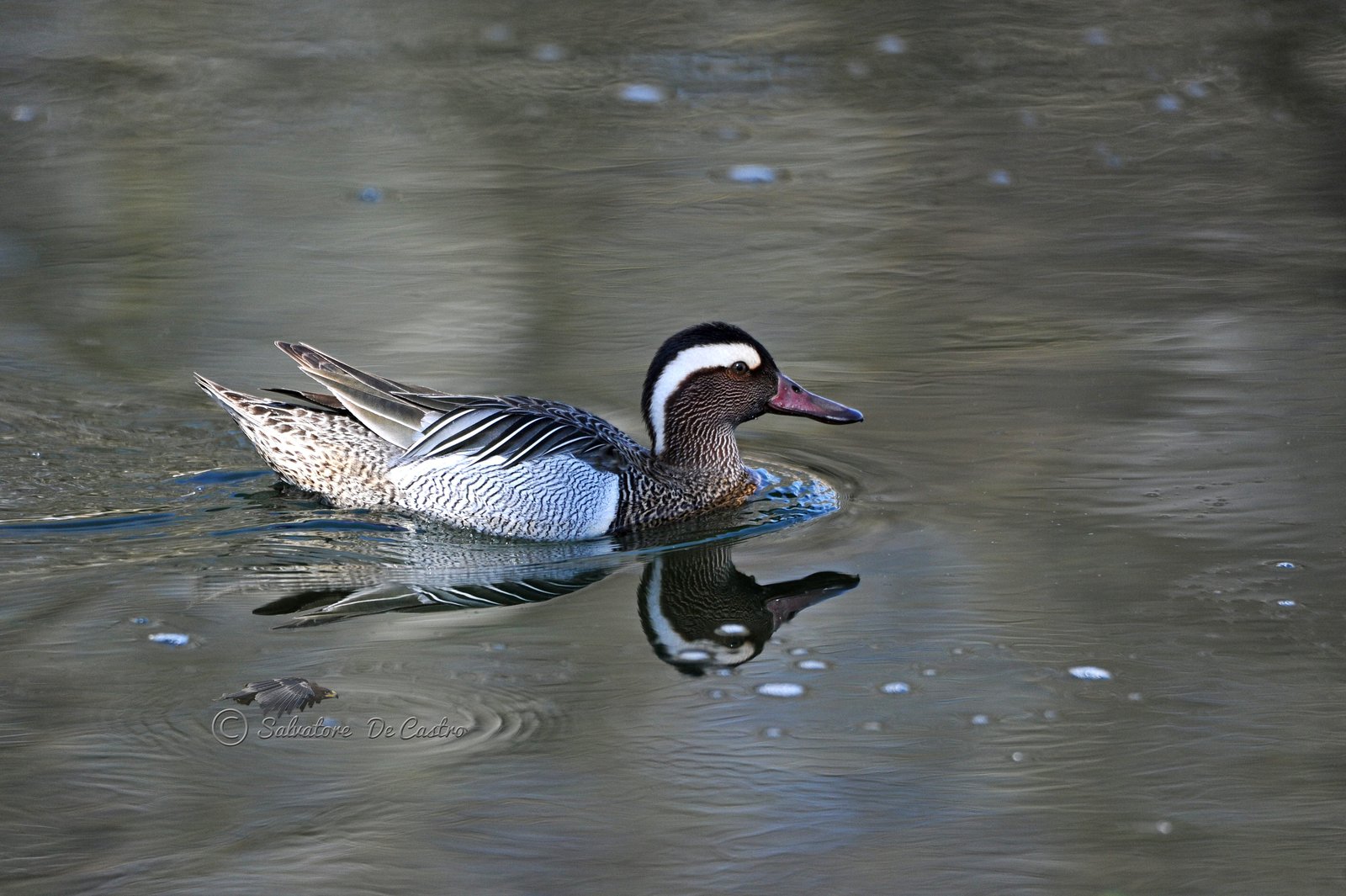
The Garganey is a small dabbling duck of Europe and Asia that is not native to the Caribbean and has been recorded only as a vagrant, mainly on the eastern islands. Because vagrants are often in female-like plumage, the species is often overlooked among Blue-winged Teal.
Voice
The drake gives a dry, rattling knerrr, like a fingernail drawn along a comb; the female a short, hoarse quack. Usually silent outside the breeding season.
Recording: Stanislas Wroza — CC BY-NC-SA 4.0 · converted to mono · xeno-canto
Identification
37–41 cm, a small teal with a fairly flat head and a straight dark bill. The breeding drake has a brown head with a broad white supercilium curving down to the nape, a brown breast, pale grey flanks and long, black-and-white striped scapulars. The female has a strongly marked head: a pale supercilium, a dark eye-stripe, a pale spot at the bill base, a dark bar across the cheek and a white throat. In flight the drake shows a pale blue-grey forewing, the female a grey-brown one, both with a green to brownish speculum between two white bars. Eclipse drakes resemble females but keep the pale forewing.
Confusion species
Female Blue-winged Teal Spatula discors has a less contrasting head, without the dark cheek bar and with a broken pale eye-ring, yellowish legs and a brighter blue forewing with a single white bar. Green-winged Teal Anas crecca is smaller, with a plainer head, a white line along the tail side and no pale forewing. Female Cinnamon Teal Spatula cyanoptera is warmer brown, with a plain face and a longer bill.
Habitat
Shallow freshwater marshes with sedges and reeds, flooded grassland, ponds and rice fields. It feeds by dabbling and while swimming at the surface, on seeds, aquatic plants and small invertebrates.
Where the bird is most at home, classified by the vegetation types of the Caribbean.



Range and movements
Vagrant. Recorded from Puerto Rico, Guadeloupe, Martinique and Barbados. Breeds in a broad band from western Europe to eastern Asia; winters in sub-Saharan Africa and in southern and southeastern Asia. Also a vagrant to North America.
How and when to look
Any flock of Blue-winged Teal on the eastern islands may hide one. In female-type birds the points to check are the dark cheek bar, the white throat and, in flight, the colour of the forewing and the two white bars bordering the speculum.
Conservation status
Least Concern. In the Caribbean a vagrant, with no established population.
Scientific name
Spatula querquedula | (Linnaeus, 1758)
Linnaeus described the species in 1758 as Anas Querquedula; because it was later moved to another genus, the author and year stand in brackets. The genus Spatula was introduced in 1822 by Boie. Spatula is Latin for 'spoon' or 'spatula', after the broad, spoon-shaped bill of the shoveler. querquedula is a Latin name for a small duck or teal, thought to imitate the bird's rattling call. The specimen the first description was based on came from Sweden.