All species › Waterfowl › Ducks and geese › Greater Scaup
Greater Scaup | Aythya marila
Topper | Porrón bastardo
The Greater Scaup is a northern diving duck that is not native to the Caribbean: there are only scattered records of vagrants, probably from the wintering population along the Atlantic coast of North America. Because it closely resembles the far commoner Lesser Scaup, every claim needs to be well documented.
Voice
Usually silent in winter. The female gives a harsh, deep karr, the courting drake soft whistled notes.
Recording: Andrew Spencer — CC BY-NC-SA 3.0 · converted to mono · xeno-canto
Identification
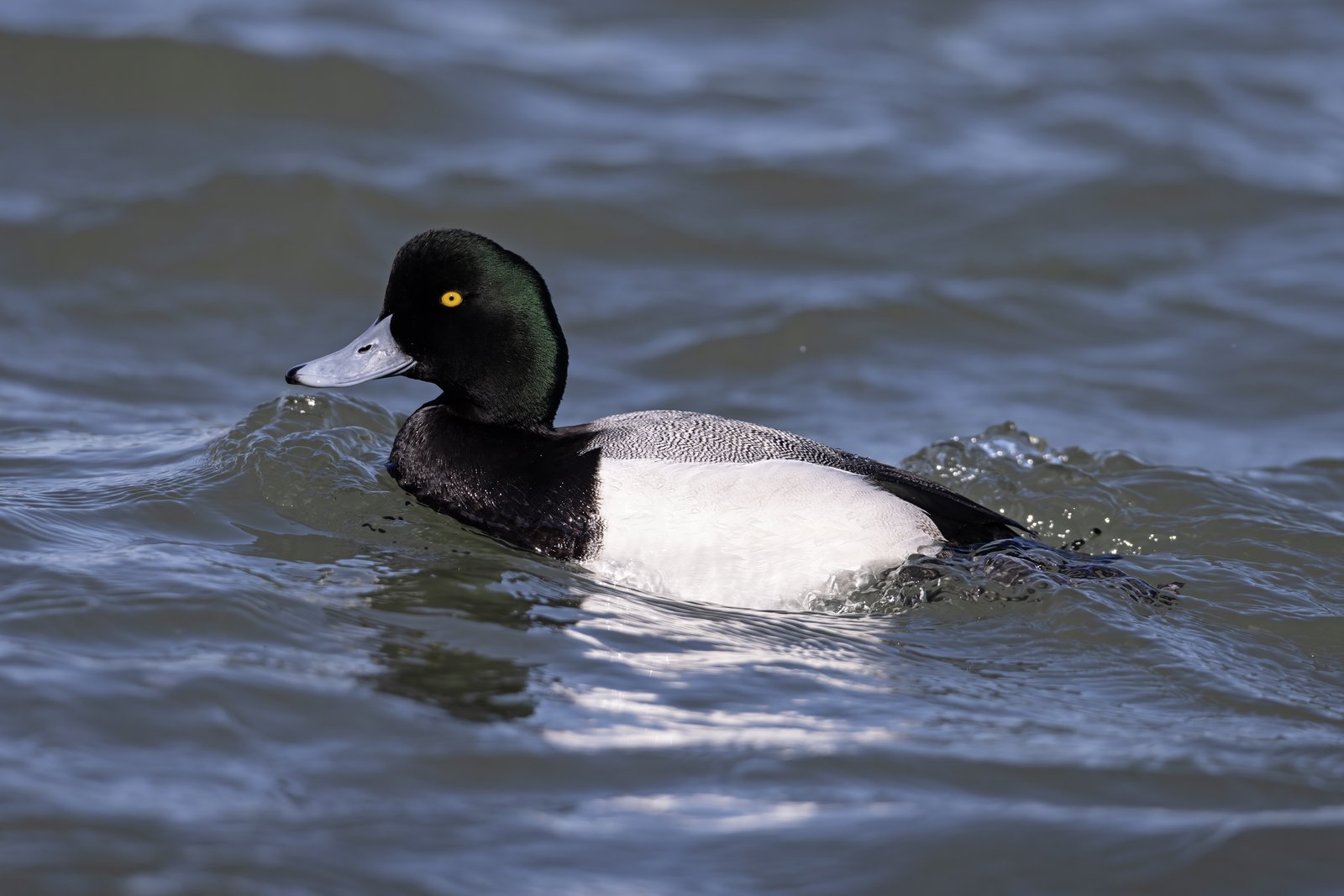
42–51 cm, larger and heavier than Lesser Scaup, with a round head without a peak and a broad bill with a fairly large black nail. The drake has a black head with a green gloss, black breast and stern, a pale grey, finely vermiculated back and bright white flanks. The eye is yellow. The female is brown with a greyish back and a broad white patch around the bill base; sometimes there is a pale patch on the ear coverts. In flight a broad white stripe runs across the secondaries and well onto the primaries.
Confusion species
Lesser Scaup Aythya affinis has a smaller head with a peak at the rear of the crown, a purple rather than green gloss, a narrower bill with a small nail and a slightly darker back; its white wing stripe is largely confined to the secondaries. Head gloss depends strongly on the light and is not decisive on its own. The drake Tufted Duck Aythya fuligula has a black back and a drooping crest; the female has a darker brown back and at most a narrow white edge at the bill.
Habitat
On the breeding grounds tundra and taiga lakes; in winter mainly sheltered coastal waters, bays and estuaries, less often fresh water. In the Caribbean to be expected on lagoons, coastal bays and larger ponds, often among Lesser Scaup.
Where the bird is most at home, classified by the vegetation types of the Caribbean.


Range and movements
Vagrant. Recorded from the Bahamas, Hispaniola (the Dominican Republic), Jamaica, Guadeloupe and Barbados; not confirmed for Cuba. Breeds around the pole in North America, Europe and Asia; winters along the coasts of North America, on the Atlantic side south to the southeastern United States, and in Europe and East Asia.
How and when to look
A candidate Greater Scaup among Lesser Scaup is best judged on head shape at rest and, on take-off, on the extent of the white wing stripe. Photographs of the head and the spread wing are essential for such a rarity.
Conservation status
Least Concern. In the Caribbean a vagrant, with no established population.
Scientific name
Aythya marila | (Linnaeus, 1761)
Linnaeus described the species in 1761 as Anas Marila; because it was later moved to another genus, the author and year stand in brackets. The genus Aythya was introduced in 1822 by Boie. Aythya is from Greek aithuia, an unidentified diving seabird mentioned by Aristotle and Hesychius. marila is Greek for 'charcoal embers' or 'coal dust'. The specimen the first description was based on came from Lapland.