All species › Waterfowl › Ducks and geese › Tufted Duck
Tufted Duck | Aythya fuligula
Kuifeend | Porrón moñudo
The Tufted Duck is a diving duck of Europe and Asia that is not native to the Caribbean and has been recorded only as a vagrant. Whether the birds cross the Atlantic directly or come via North America, where small numbers winter, is not known for individual records. Most records come from the eastern islands.
Voice
Usually silent outside the breeding season. The female gives a harsh, growling kerr-kerr; the courting drake a soft whistled gi-gi-gew.
Recording: Stanislas Wroza — CC BY-NC-SA 4.0 · converted to mono · xeno-canto
Identification
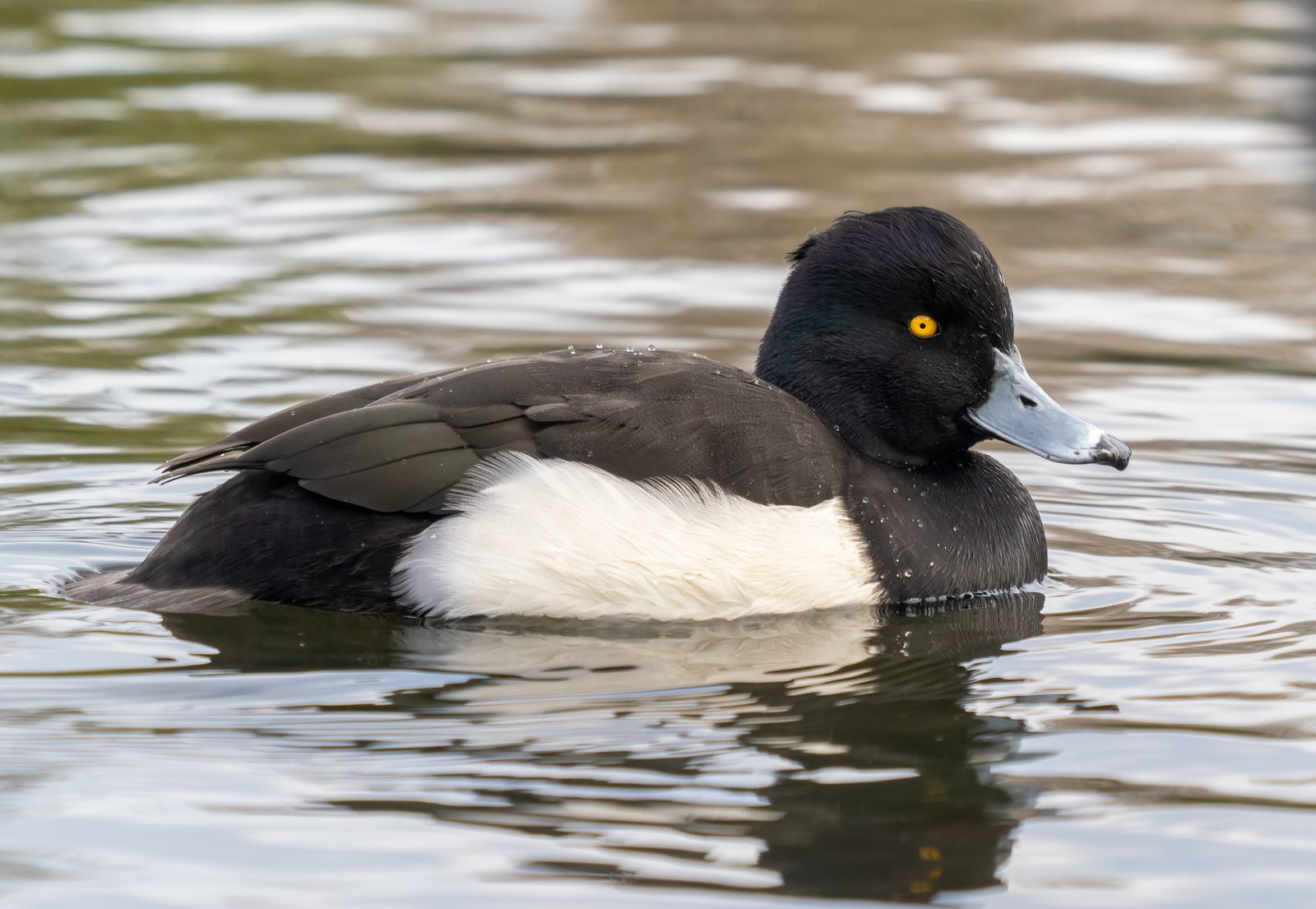
40–47 cm, a compact diving duck with a round head and a yellow eye. The drake is black with bright white flanks and a long, drooping crest on the nape; the head has a purplish gloss. The bill is blue-grey with a broad black tip. The female is dark chocolate-brown with paler brown flanks, a short tuft on the nape and sometimes a narrow white edge at the bill base or white undertail coverts. In flight a broad white stripe runs across the secondaries and primaries.
Confusion species
Ring-necked Duck Aythya collaris has an angular, peaked head instead of a crest, grey flanks with a white spur at the front and a white ring on the bill; in flight its wing stripe is grey. Drake Lesser Scaup Aythya affinis and Greater Scaup A. marila have a grey back; females of both have a broader and sharper white patch at the bill than a female Tufted Duck. Hybrids between Aythya species occur and can resemble a Tufted Duck.
Habitat
Fresh and brackish ponds, lagoons and lakes with open water. It dives mainly for molluscs such as mussels and snails, and for insect larvae and seeds. In the Caribbean to be expected among Lesser Scaup and Ring-necked Ducks.
Where the bird is most at home, classified by the vegetation types of the Caribbean.


Range and movements
Vagrant. Recorded from Puerto Rico, Guadeloupe and Barbados. Breeds in a broad band from Iceland and western Europe to eastern Siberia; winters in western and southern Europe, North Africa, and southern and eastern Asia. In North America a scarce but regular winter visitor, especially in the northeast and the Aleutians.
How and when to look
A bird with a drooping crest or a black back in a flock of Lesser Scaup or Ring-necked Ducks deserves a second look. Hybrids can be ruled out on bill pattern, head shape and crest length; photographs are essential.
Conservation status
Least Concern. In the Caribbean a vagrant, with no established population.
Scientific name
Aythya fuligula | (Linnaeus, 1758)
Linnaeus described the species in 1758 as Anas fuligula; because it was later moved to another genus, the author and year stand in brackets. The genus Aythya was introduced in 1822 by Boie. Aythya is from Greek aithuia, an unidentified diving seabird mentioned by Aristotle and Hesychius. fuligula combines Latin fuligo 'soot' and gula 'throat'. The specimen the first description was based on came from Sweden.