All species › Waterfowl › Ducks and geese › Comb Duck
Comb Duck | Sarkidiornis sylvicola
Amerikaanse knobbeleend | Pato crestudo
The Comb Duck is a large black-and-white duck of the tropical marshes of South America; the male carries a large black knob on the bill. In the Caribbean it is a rare vagrant to Trinidad, Aruba, Bonaire and Curaçao, which lie close to the mainland of Venezuela.
Voice
Mostly silent. At the nest and in display it gives soft hoarse grunts and hisses.
Recording: John V. Moore — CC BY-NC-SA 4.0 · converted to mono · xeno-canto
Identification
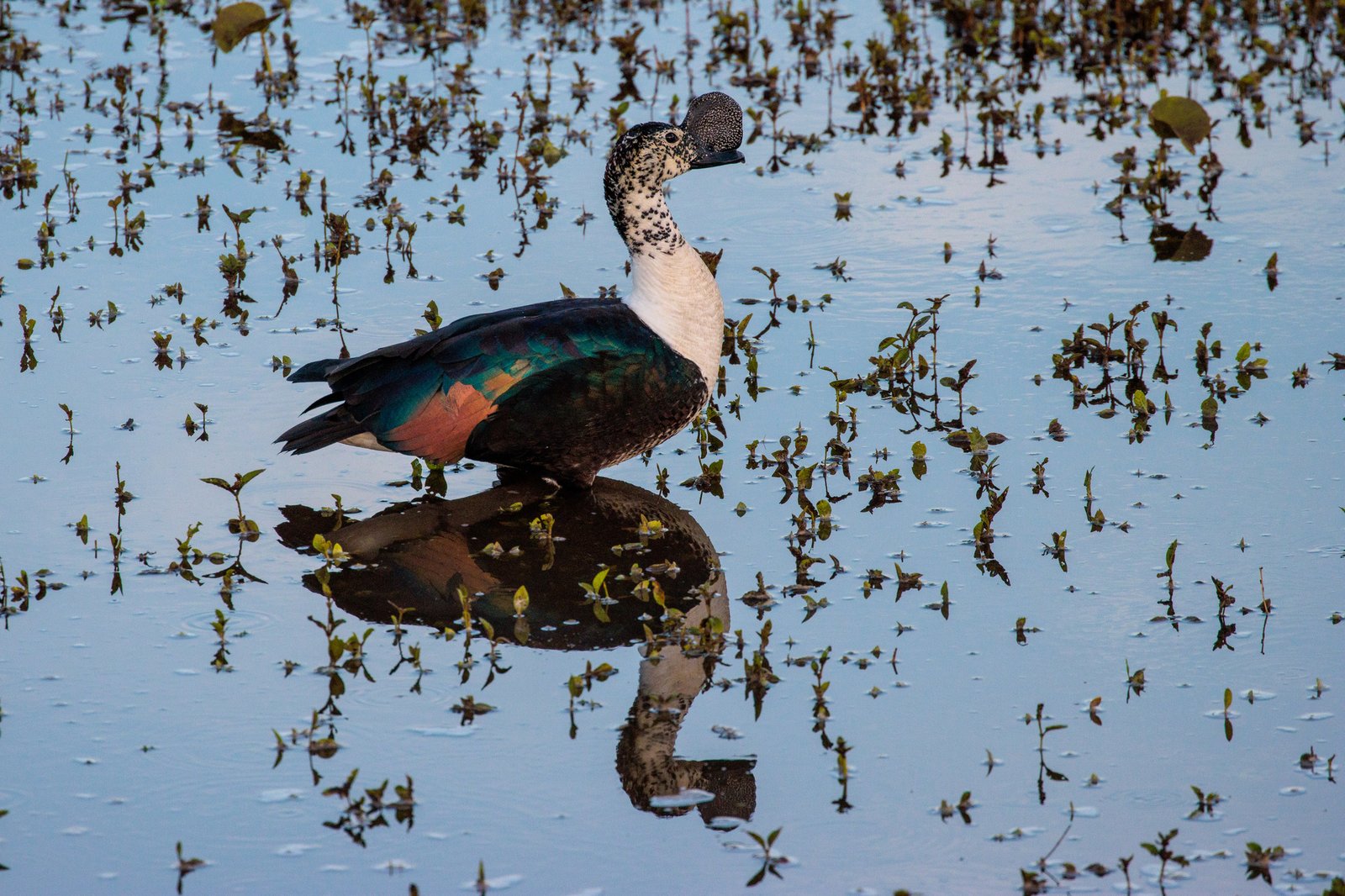
56–76 cm; the male is much larger than the female. The head and neck are white with fine black speckling and the underparts white. The upperparts are glossy black with a blue and green sheen; the flanks are black in the male, mid-grey in the female. The male has a large, flat black knob on the bill, largest in the breeding season; the female lacks it. In flight the wings are wholly dark and glossy, without white. Juveniles are browner and scaly and can recall Fulvous Whistling Duck at a distance.
Confusion species
Muscovy Duck Cairina moschata is also black and the male has a knob at the base of the bill, but it has a dark head and neck, dark underparts and large white patches on the forewing. Black-bellied Whistling Duck Dendrocygna autumnalis has a grey face, a red bill and a black belly. Knob-billed Duck Sarkidiornis melanotos of Africa and Asia, of which the American form was until recently treated as a subspecies, does not occur in the region.
Habitat
Freshwater marshes, flooded savanna, lakes and lagoons with open water and scattered trees, also rice fields. It grazes on land and in shallow water on seeds, grasses and aquatic plants. It nests in tree holes.
Where the bird is most at home, classified by the vegetation types of the Caribbean.



Range and movements
In the region known as a rare vagrant from Trinidad, Aruba, Bonaire and Curaçao. Outside the region in tropical and subtropical South America, from Colombia and Venezuela to Paraguay and northern Argentina, in numbers that vary with the rains.
How and when to look
A Comb Duck on Trinidad is most likely in the freshwater marshes and rice fields, among whistling ducks and other waterbirds.
Conservation status
Not threatened globally. In the Caribbean a rare vagrant.
Scientific name
Sarkidiornis sylvicola | Ihering & Ihering, 1907
Ihering & Ihering described the species in 1907 and placed it straight away in the genus where it still stands. The genus Sarkidiornis was introduced in 1838 by Eyton. Sarkidiornis comes from the Greek sarkidion, 'small piece of flesh', and ornis, 'bird' — for the fleshy knob on the male's bill. sylvicola is Latin for 'woodland-dweller', from silva 'woodland' and -cola 'dweller'. The specimen the first description was based on came from Iguape (São Paulo, Brazil) and Buenos Aires, Argentina.