All species › Passerines › Hispaniolan tanagers › Green-tailed Warbler
Green-tailed Warbler | Microligea palustris
Groenstaartzanger | Cigüita coliverde
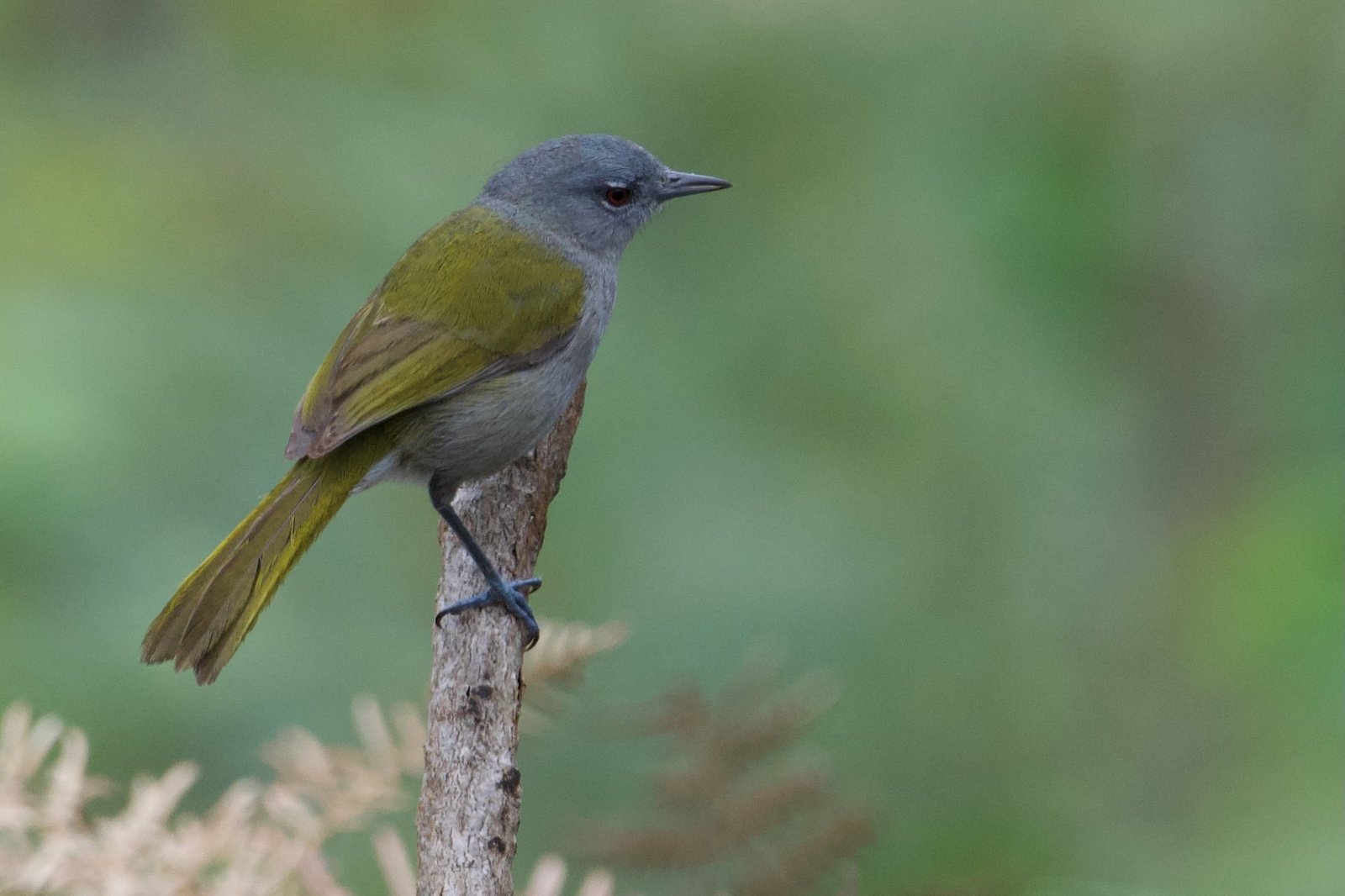
The Green-tailed Warbler is an inconspicuous grey and green bird of the understorey in Hispaniola. Like White-winged Warbler it was long placed with the wood-warblers, but it belongs to Phaenicophilidae, the family found only in Hispaniola. There are two subspecies: one in the mountains and one in the dry lowlands of the southwest. In the Dominican Republic it is called cigüita coliverde.
Voice
Short rasping and squeaky notes, which may run into an accelerating series of thin sip-sip-sip notes as a song.
Recording: Ross Gallardy — CC BY-NC-SA 4.0 · converted to mono · xeno-canto
Identification
12–14.5 cm, slim, with a long tail and a thin bill. Head and neck are grey, with white arcs above and below the eye and a red iris. The upperparts, wings and tail are olive-green, without wing bars or white patches. The underparts are pale grey, the belly whitish. The sexes are alike. The lowland subspecies vasta is paler overall and whiter below than the nominate form of the mountains.
Confusion species
White-winged Warbler Xenoligea montana has a white wing patch, a white supercilium above black lores and a shorter tail, and usually forages higher. Flat-billed Vireo Vireo nanus has white wing bars, a pale iris and a yellowish wash on the flanks. Female Black-throated Blue Warblers Setophaga caerulescens, winter visitors, are olive-brown with a pale supercilium and usually a white spot at the base of the primaries.
Habitat
The nominate form lives in montane broadleaf and pine forest with dense understorey, including thickets in clearings and along edges, up to about 2,900 m. The subspecies vasta inhabits semi-arid scrub and dry forest in the lowlands. It searches low in dense vegetation for insects and often joins mixed flocks.
Where the bird is most at home, classified by the vegetation types of the Caribbean.







Range and movements
Only in Hispaniola. The nominate form in the mountains of the Dominican Republic, such as the Cordillera Central, Sierra de Neiba and Sierra de Bahoruco, and to a lesser extent in the adjoining mountains of Haiti; almost the whole population lives on the Dominican side. The subspecies vasta in the lowlands of south-western Dominican Republic and on Beata Island. The species does not occur outside Hispaniola.
- Resident
- Winter visitor (c. Apr–Sep)
- dark = core range, pale = thinly spread
How and when to look
In the Sierra de Bahoruco the nominate form can be found in the mountains and the pale vasta in the dry lowlands near Pedernales. The birds stay in cover; they are best found by their calls and by checking the lowest level when a mixed flock passes.
Conservation status
Not threatened. The species is locally common, although numbers are thought to be declining through forest loss.
Scientific name
Microligea palustris | (Cory, 1884)
Cory described the species in 1884 as Ligea palustris; because it was later moved to another genus, the author and year stand in brackets. The genus Microligea was introduced in 1884 by Cory. Microligea is Greek mikros 'small' with Ligea, a wood-nymph (or Greek ligeia 'clear-voiced'); Cory used it in 1884 to replace his preoccupied name Ligea. palustris is Latin for 'of the marsh', from palus 'marsh' – a somewhat misleading name for a bird of scrub and forest. The specimen the first description was based on came from Villa Riva, Dominican Republic.