All species › Passerines › Hispaniolan tanagers › Black-crowned Palm-tanager
Black-crowned Palm-tanager | Phaenicophilus palmarum
Zwartkruinpalmtangare | Cuatro ojos coroninegro
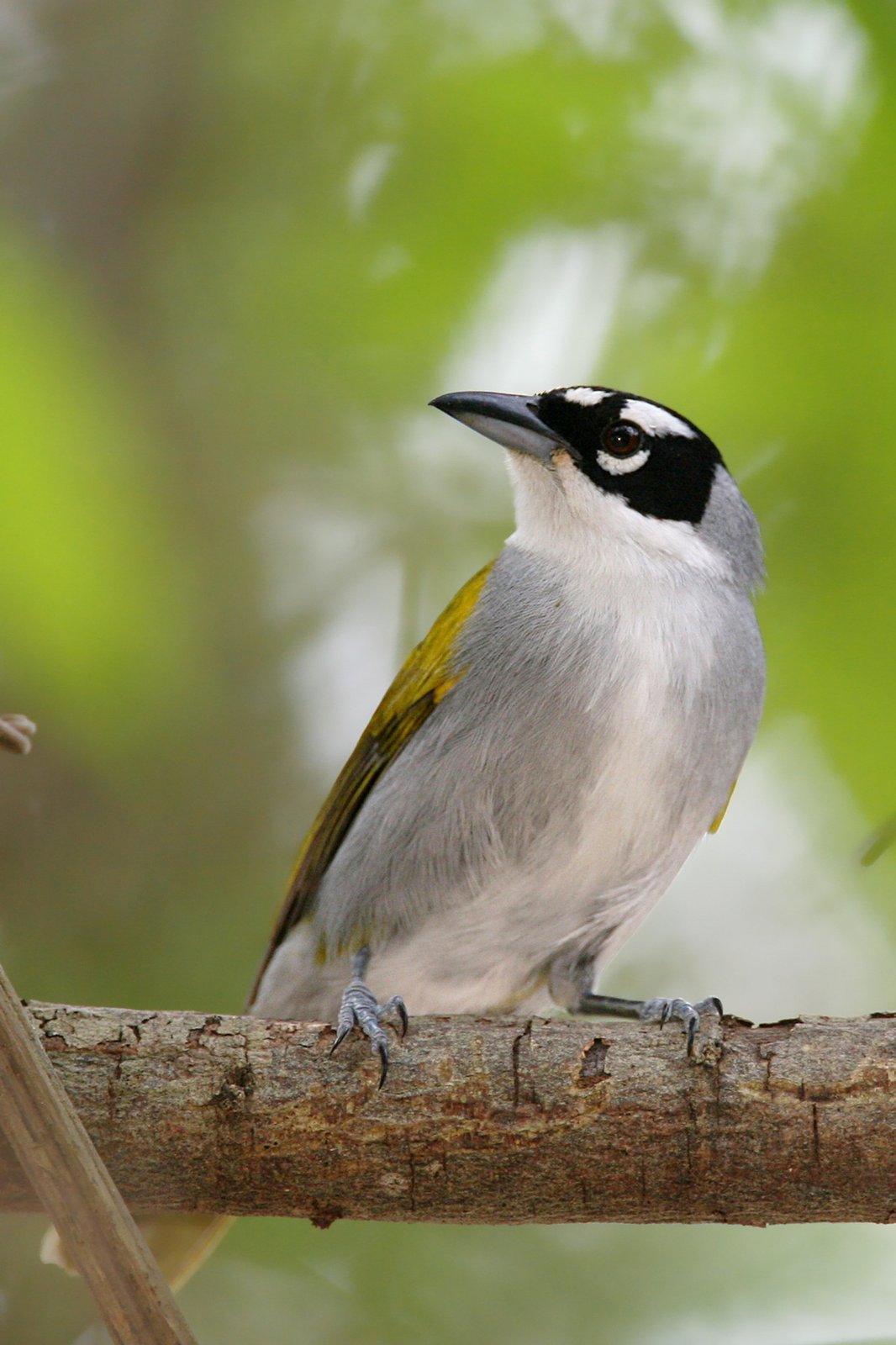
The Black-crowned Palm-tanager is one of the commonest birds in Hispaniola and one of the two palm-tanagers, which together with White-winged and Green-tailed Warblers make up the family Phaenicophilidae, found only on this island. Its Dominican name cuatro ojos, four eyes, refers to the white spots around the eye.
Voice
The song is a jumble of squeaky notes that grows louder, then fades and slows to short chit notes; in some areas with rasping, buzzy phrases. Calls include a nasal, buzzy note, a higher penetrating note and a low chep.
Recording: Lance A. M. Benner — CC BY-NC-SA 3.0 · converted to mono · xeno-canto
Identification
17–18 cm, robust, with a fairly heavy, pointed bill. The head is mostly black, with a white spot above the base of the bill, white spots around the red-brown eye and a thin white arc below it. The nape is grey, the upperparts and tail bright yellowish olive-green. Throat and centre of the breast are white, merging gradually into the grey flanks and belly. The sexes are alike. Immatures have a duller, dusky grey head and a buff-tinged throat.
Confusion species
Grey-crowned Palm-tanager Phaenicophilus poliocephalus of south-western Haiti has a grey crown, leaving the black restricted to a mask, and a white throat more sharply set off from the grey breast. Hybrids occur where the two meet. White-winged Warbler Xenoligea montana is much smaller, with a grey head and a white wing patch. Immatures with greyish heads are told from other species by size, bill and the white throat.
Habitat
Almost all forest types, from dry deciduous forest and thorn scrub to humid broadleaf forest, montane rainforest and pine forest, open and closed; also coffee plantations, yards, parks and gardens in villages and towns. From sea level to about 2,500 m, commonest below 2,000 m. It eats insects, fruit and seeds at all levels in the vegetation and is often the core of mixed flocks.
Where the bird is most at home, classified by the vegetation types of the Caribbean.







Range and movements
Only in Hispaniola. Throughout almost all of the Dominican Republic, including Saona Island, and in Haiti except the Tiburon Peninsula in the south-west, where Grey-crowned Palm-tanager occurs. Gonâve also holds Grey-crowned rather than this species. The species does not occur outside Hispaniola.
- Resident
- dark = core range, pale = thinly spread
How and when to look
Found in town parks, gardens and almost any forest in the Dominican Republic, often the first species to respond to a passing mixed flock. In south-western Hispaniola the colour of the crown and the edge of the white throat need careful checking.
Conservation status
Not threatened. The species is common throughout its range and the population is considered stable; it also does well in gardens and degraded forest remnants.
Scientific name
Phaenicophilus palmarum | (Linnaeus, 1766)
Linnaeus described the species in 1766 as Turdus palmarum; because it was later moved to another genus, the author and year stand in brackets. The genus Phaenicophilus was introduced in 1851 by Strickland. Phaenicophilus is Greek, from phoinix 'date palm' and philos 'lover': 'palm-lover'. palmarum is Latin for 'of the palms', after the species' fondness for palms. The specimen the first description was based on came from Hispaniola (originally given in error as 'Cayenne').