All species › Passerines › Hispaniolan tanagers › Grey-crowned Palm-tanager
Grey-crowned Palm-tanager | Phaenicophilus poliocephalus
Grijskruinpalmtangare | Cuatro ojos coronigrís
The Grey-crowned Palm-tanager is the south-western counterpart of Black-crowned Palm-tanager and lives mainly on the Tiburon Peninsula of Haiti and its offshore islands. The two palm-tanagers have been treated as one species and hybridise where they meet. With White-winged and Green-tailed Warblers they form the family Phaenicophilidae, found only in Hispaniola.
Voice
A long, melodious song and a call rendered as peee-u. Few recordings of this species are available.
No recording with a suitable Creative Commons licence is available for this species yet.
Identification
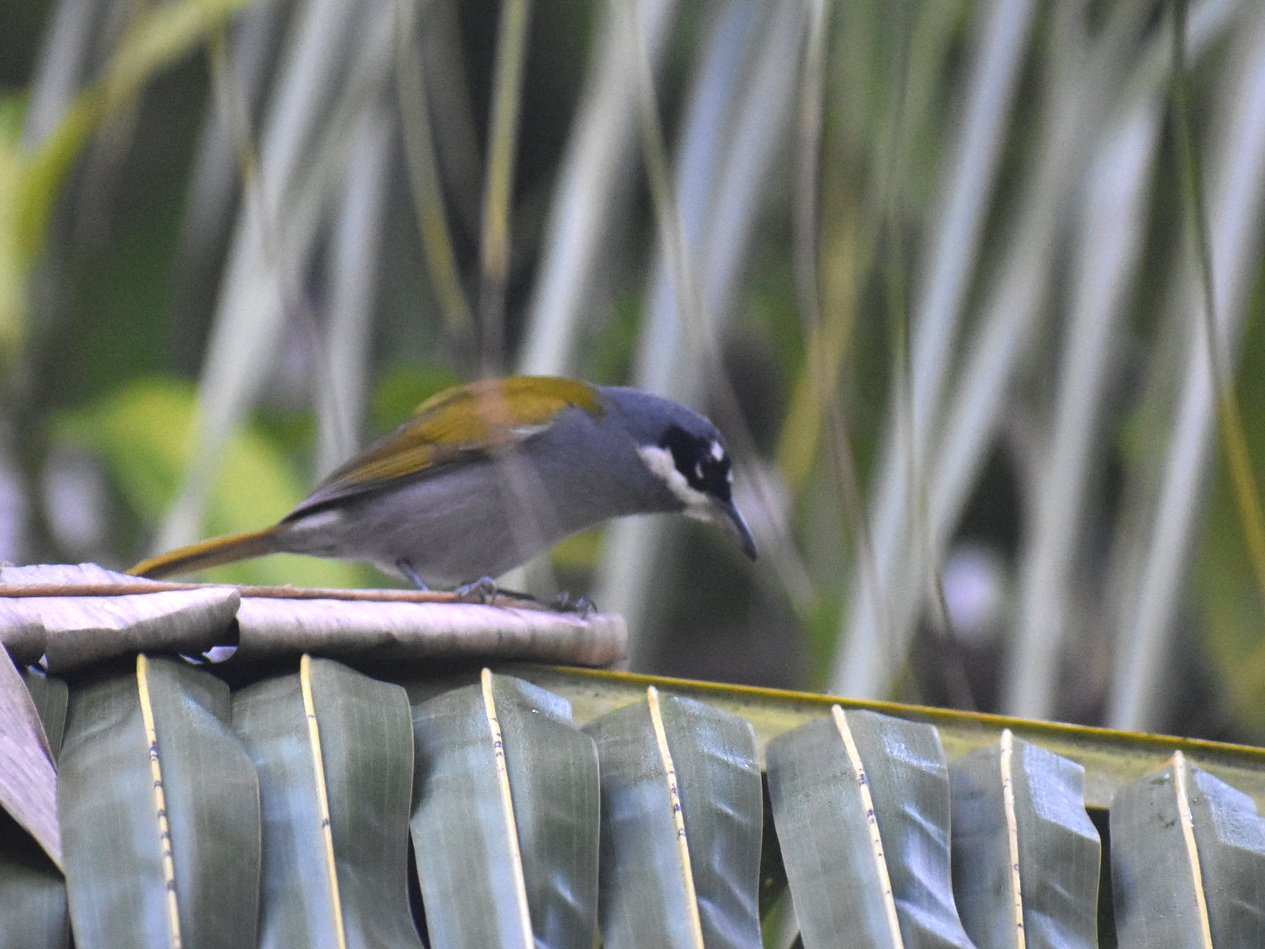
About 18 cm, robust, with a fairly heavy, pointed bill. Crown and nape are dark grey; a black mask runs from the lores through the eye, with white spots around the eye. The upperparts and tail are yellow-green. The throat is bright white and sharply set off from the dark grey breast and belly. The sexes are alike. The subspecies coryi of Gonâve is larger and paler, with a white streak down the centre of breast and belly; tetraopes of Île-à-Vache is slightly paler than the nominate form.
Confusion species
Black-crowned Palm-tanager Phaenicophilus palmarum has a black crown that merges with the black of the head, and a white throat that blends more gradually into the grey underparts. Hybrids show intermediate features and cannot always be assigned with certainty. White-winged Warbler Xenoligea montana is much smaller and has a white wing patch.
Habitat
All forest types, from dry to wet, as well as tree plantations, yards, parks and gardens. From sea level to about 2,400 m. This broad choice allows the species to persist even in the heavily deforested south-west of Haiti.
Where the bird is most at home, classified by the vegetation types of the Caribbean.







Range and movements
Only in Hispaniola. On the Tiburon Peninsula of south-western Haiti and the islet of Grande Cayemite, with separate subspecies on Gonâve and Île-à-Vache. In the Dominican Republic only very locally in the Sierra de Bahoruco, including Loma del Toro and the Hoyo de Pelempito. The species does not occur outside Hispaniola.
- Resident
- dark = core range, pale = thinly spread
How and when to look
In the Dominican Republic the species can be found in the higher parts of the Sierra de Bahoruco at Loma del Toro and the Hoyo de Pelempito. A good view of the crown and the sharply bordered white throat is needed, since Black-crowned Palm-tanagers and hybrids may be nearby. In Haiti it can be found across the whole Tiburon Peninsula, including gardens and plantations.
Conservation status
Near Threatened. The population size is unknown but probably declining because of severe deforestation in Haiti and the Dominican Republic. Because the species also lives in gardens and degraded vegetation, it is less vulnerable than true forest birds.
Scientific name
Phaenicophilus poliocephalus | (Bonaparte, 1851)
Bonaparte described the species in 1851 as Dulus poliocephalus; because it was later moved to another genus, the author and year stand in brackets. The genus Phaenicophilus was introduced in 1851 by Strickland. Phaenicophilus is Greek, from phoinix 'date palm' and philos 'lover': 'palm-lover'. poliocephalus is Greek, from polios 'grey' and kephalē 'head', after the grey crown. The specimen the first description was based on came from Haiti.