All species › Passerines › Thrushes › Grey-cheeked Thrush
Grey-cheeked Thrush | Catharus minimus
Grijswangdwerglijster | Zorzalito carigrís
The Grey-cheeked Thrush breeds in the taiga and shrub tundra of Alaska, Canada and northeast Siberia and winters in northern South America. Most of its migration over the Caribbean takes place at night and without stopping, so it appears on the islands only sparingly and inconspicuously. It is the coldest-toned of the Catharus thrushes that pass through the region.
Voice
Usually silent on migration. The call is a thin, nasal, descending vee-er or queer, also given at night in migration. The song, a nasal, fluty series that drops at the end, is rarely heard in the region.
Recording: Seth Beaudreault (Toolik Field Station) — CC BY-NC-SA 4.0 · converted to mono · xeno-canto
Identification
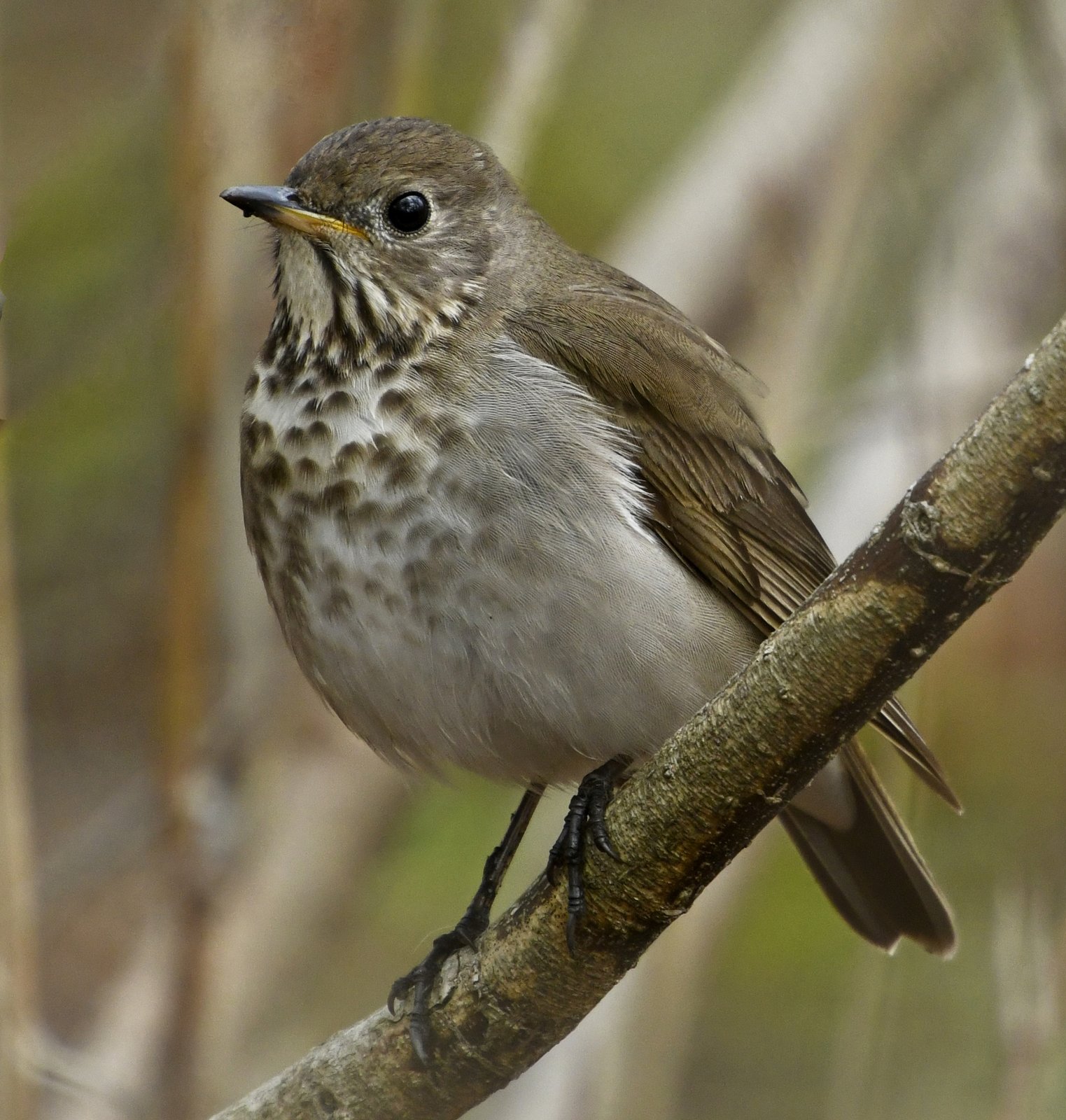
16–18 cm, slim, with a fairly short tail and long wings. The upperparts are plain grey-brown to olive-grey from crown to tail, without a rufous tone. The face is grey and plain, with grey lores and a narrow, indistinct eye-ring. Throat and breast are dull white with dark, rather diffuse spots, the flanks grey. The underwing shows a pale band. The base of the lower mandible is pale yellow to pinkish, the legs pink. The sexes are alike.
Confusion species
Bicknell's Thrush Catharus bicknelli is practically inseparable in the field; it is slightly smaller, with a somewhat warmer brown tail and more yellow on the lower mandible, and winters mainly in the mountains of Hispaniola. Swainson's Thrush Catharus ustulatus has a bold buffy eye-ring and pale lores forming spectacles, and a browner tone. Veery Catharus fuscescens is warm rufous-brown above and only faintly spotted. Hermit Thrush Catharus guttatus has a rufous tail contrasting with the back.
Habitat
On passage in almost any woodland with dense undergrowth, from dry coastal forest to moist montane forest, and in gardens and parks with trees. It forages on the ground and in low shrubs for insects and fruit and usually keeps to the shade.
Where the bird is most at home, classified by the vegetation types of the Caribbean.




Range and movements
Scarce to rare passage migrant in the Bahamas, Cuba, the Cayman Islands, Jamaica, Hispaniola and Puerto Rico; further east and south, in the Lesser Antilles and the islands off Venezuela, only a handful of records. Breeds from northeast Siberia and Alaska to Labrador and Newfoundland and winters in northern South America.
- Summer visitor (c. Oct–Mar)
- Passage (Mar–Apr, Oct–Nov)
- dark = core range, pale = thinly spread
How and when to look
Best looked for after the passage of cold fronts in October, in coastal woodland and gardens in Cuba and the Bahamas. A grey Catharus without obvious spectacles warrants a photograph and, if possible, a sound recording of the call, since Bicknell's Thrush is almost identical.
Conservation status
Not threatened. The global population is large, although numbers are declining in parts of the breeding range. On migration birds are at risk from collisions with lit buildings and communication towers.
Scientific name
Catharus minimus | (de Lafresnaye, 1848)
De Lafresnaye described the species in 1848 as Turdus minimus; because it was later moved to another genus, the author and year stand in brackets. The genus Catharus was introduced in 1850 by Bonaparte. Catharus is from Ancient Greek katharos 'pure, clean', a name given for the clean plumage of the orange-billed nightingale-thrush. minimus is Latin for 'smallest'. The specimen the first description was based on came from Bogotá, Colombia.