All species › Passerines › Thrushes › Hermit Thrush
Hermit Thrush | Catharus guttatus
Heremietlijster | Zorzalito colirrufo
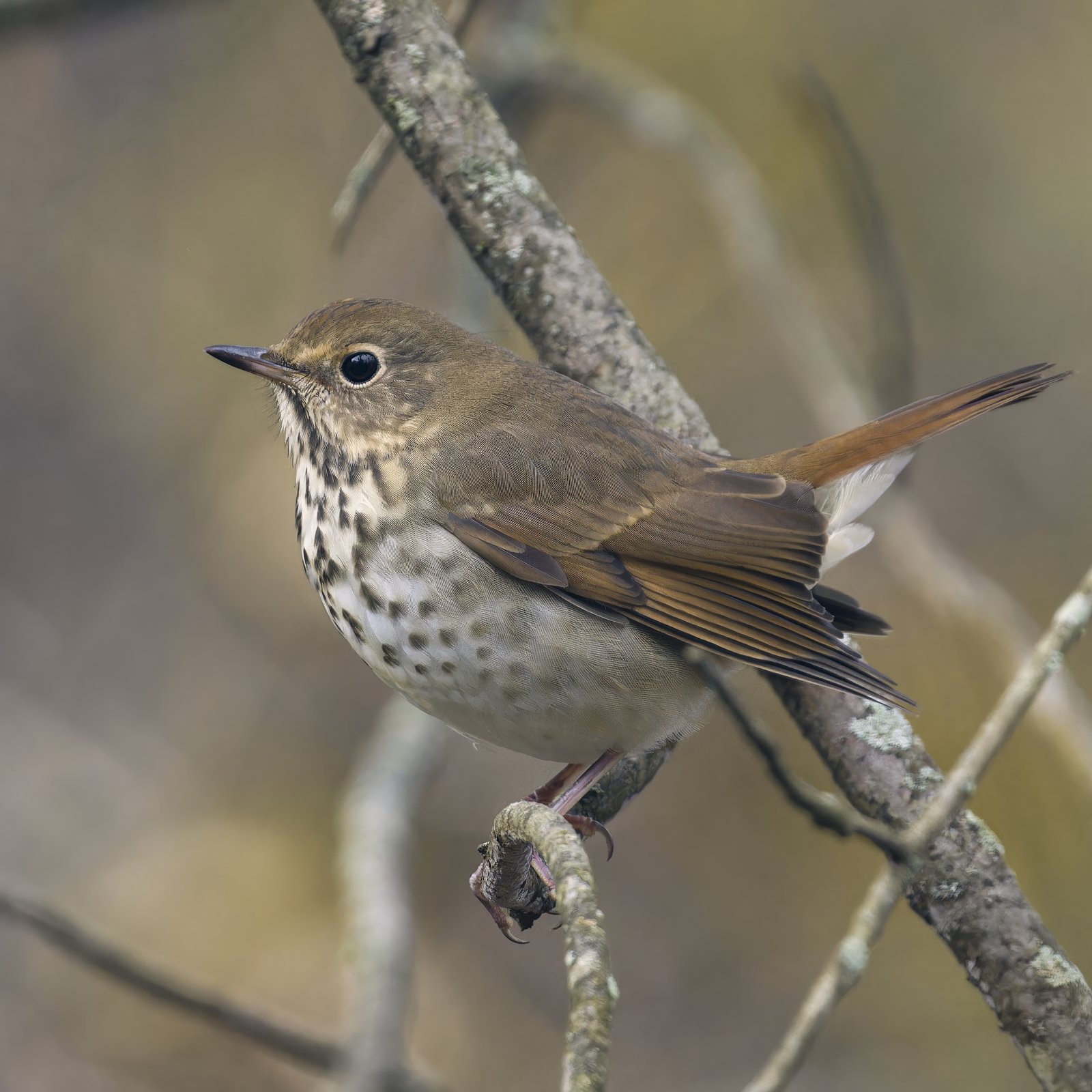
The Hermit Thrush is the only Catharus thrush that winters in North America; most birds stay in the southern United States and Mexico. Only a small number reach the northern Bahamas, and elsewhere in the Caribbean the species is a vagrant. It is recognised by its rufous tail, which it slowly raises and lowers after landing.
Voice
In winter mainly a soft, low chuck and a rising, plaintive zhweee. The song, a whistled opening note followed by ethereal, echoing phrases at changing pitches, is hardly ever heard in the region.
Recording: Ray Cooke — CC BY-NC 4.0 · shortened to the first 60 s, mono · xeno-canto
Identification
15–18 cm, the smallest Catharus thrush in the region. The upperparts are olive-brown to grey-brown, the rump and tail warm rufous and clearly contrasting. A narrow white eye-ring stands out in the otherwise plain face. The throat is white, bordered by a dark malar stripe; the breast is buffish with sharp, blackish spots, the belly white and the flanks grey-brown. The base of the lower mandible is pale, the legs pink. The sexes are alike.
Confusion species
Grey-cheeked Thrush Catharus minimus and Bicknell's Thrush Catharus bicknelli are greyer, without a rufous tail and with an indistinct eye-ring. Swainson's Thrush Catharus ustulatus has buffy spectacles and a tail the same colour as the back. Veery Catharus fuscescens is rufous from head to tail, with faint spotting. Wood Thrush Hylocichla mustelina is larger, with a rufous head and large, round black spots over the entire underparts.
Habitat
In winter in the understorey of woodland and scrub; in the Bahamas mainly pine forest with a shrub layer, dry broadleaf forest and coastal scrub, also sheltered gardens. It forages on the ground in leaf litter for insects and spiders and in winter also takes berries.
Where the bird is most at home, classified by the vegetation types of the Caribbean.




Range and movements
Rare winter visitor to the northern Bahamas, including Grand Bahama, Abaco, Andros and New Providence. Elsewhere in the region a vagrant, with a few records from Cuba and scattered reports from other islands. Breeds in northern and western North America and winters from the southern United States to Guatemala and El Salvador.
- Winter visitor (c. Apr–Sep)
- dark = core range, pale = thinly spread
How and when to look
The best chance is in winter in the pine forest of Grand Bahama and Abaco, where the bird perches on a low twig or on the ground and raises its tail after landing. The soft chuck from dense undergrowth is often the first sign.
Conservation status
Not threatened. The global population is large and stable to increasing. In the Caribbean the species is too rare to play a role of its own in conservation.
Scientific name
Catharus guttatus | (Pallas, 1811)
Pallas described the species in 1811 as Muscicapa guttata; because it was later moved to another genus, the author and year stand in brackets. The genus Catharus was introduced in 1850 by Bonaparte. Catharus is from Ancient Greek katharos 'pure, clean', a name given for the clean plumage of the orange-billed nightingale-thrush. guttatus is Latin for 'spotted, speckled', after the dark drop-shaped spots on the breast. The specimen the first description was based on came from Kodiak Island, Alaska.