All species › Passerines › New World blackbirds › Hispaniolan Oriole
Hispaniolan Oriole | Icterus dominicensis
Hispaniolatroepiaal | Turpial de La Española
The Hispaniolan Oriole is a black and yellow oriole found only on Hispaniola and a few offshore islands. Until 2010 it was combined with the orioles of Cuba, Puerto Rico and the Bahamas as one species, the Greater Antillean Oriole; since then the four forms have been treated as separate species. In the Dominican Republic it is called cigua canaria.
Voice
The call is a sharp, short keck or check, often the first clue. The song, a series of high, clear whistles, is heard mainly shortly after dawn and seldom during the day.
Recording: Barry Edmonston — CC BY-NC-SA 4.0 · converted to mono · xeno-canto
Identification
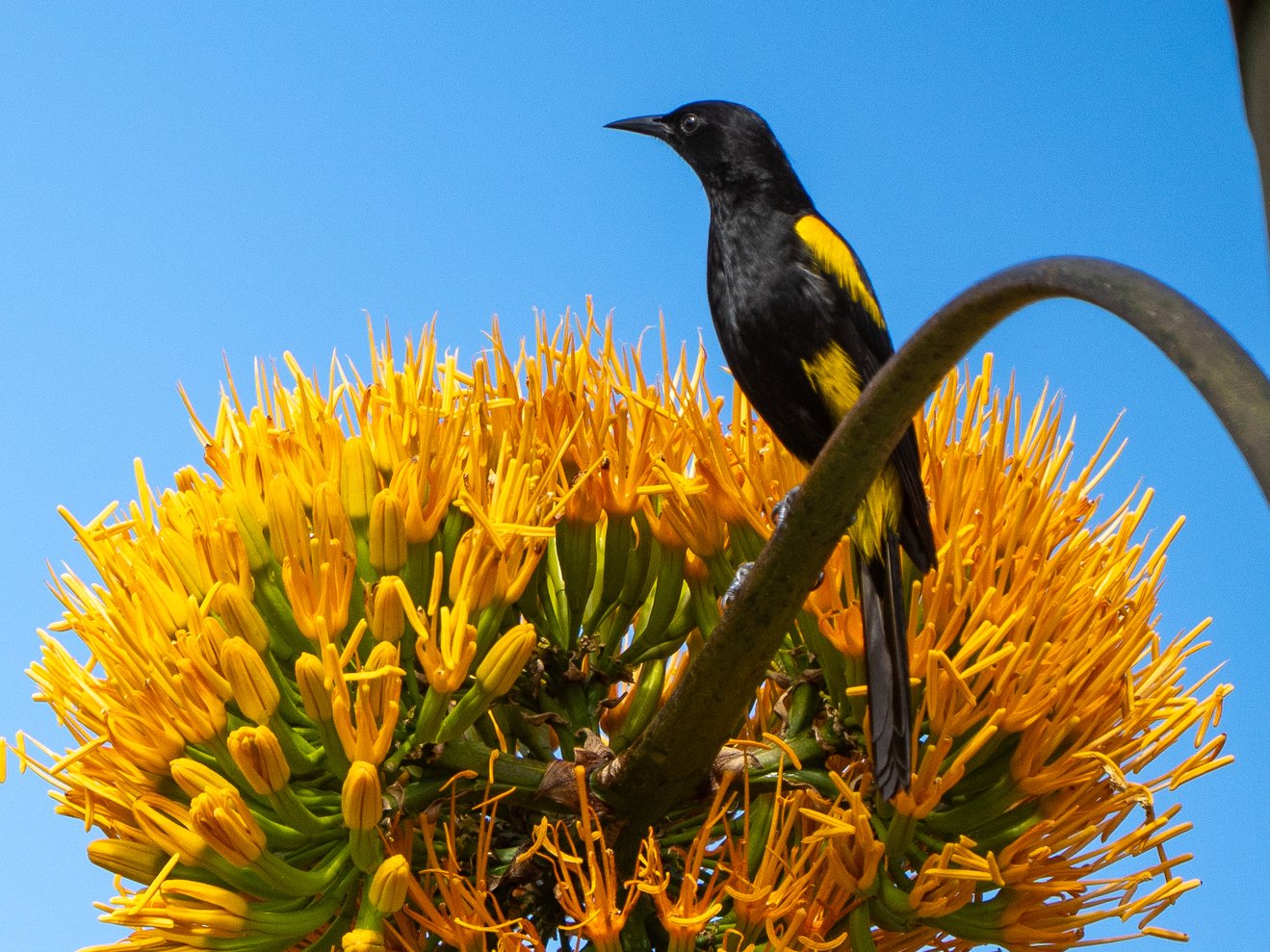
20–22 cm, slender, with a long tail and a pointed, slightly decurved black bill. The adult plumage is mostly black, with yellow on the shoulder, rump, lower belly, thighs and undertail; the yellow on the underparts reaches the lower breast. There are no white wing markings. The sexes are alike. Juveniles are olive above and dull yellow below, with black wings and a black or rufous-brown throat that merges gradually into the breast.
Confusion species
Baltimore Oriole Icterus galbula and Orchard Oriole Icterus spurius are winter visitors with white wing bars; the male of the former is orange and black, that of the latter chestnut and black, and females are olive-yellow with white wing bars. Tawny-shouldered Blackbird Agelaius humeralis is all black with only a tawny shoulder patch and has no yellow on rump or belly. Greater Antillean Grackle Quiscalus niger is entirely glossy black, with a yellow eye.
Habitat
Moist and dry lowland forest, forest edges, open woodland, shade-coffee plantations, gardens, parks and villages with palms, from the coast to middle elevations. It searches trees and palms for insects, fruit and nectar. The nest is a hanging pouch of finely woven plant fibres, mostly from palm leaves, attached to the underside of a palm frond or banana leaf.
Where the bird is most at home, classified by the vegetation types of the Caribbean.




Range and movements
Only on Hispaniola, in Haiti and the Dominican Republic, and on the islands of Gonâve, Tortuga and Saona. On the main island widespread wherever there are trees and palms. Records from Cuba, Puerto Rico and the Bahamas in the map database belong to the former, broader species concept and refer to Cuban Oriole Icterus melanopsis, Puerto Rican Oriole Icterus portoricensis and Bahama Oriole Icterus northropi.
- Resident
- dark = core range, pale = thinly spread
How and when to look
Around palms in gardens, hotel grounds and village edges, and in shade coffee at middle elevations, for example around Jarabacoa and in the Sierra de Bahoruco. A soft keck from a palm crown is often the first sign; the birds forage unhurriedly and can then be watched well.
Conservation status
Not threatened. The species is widespread and also lives in gardens and plantations. Brood parasitism by Shiny Cowbird Molothrus bonariensis, established on Hispaniola since the 1970s, may reduce breeding success.
Scientific name
Icterus dominicensis | (Linnaeus, 1766)
Linnaeus described the species in 1766 as O[riolus] dominicensis; because it was later moved to another genus, the author and year stand in brackets. The genus Icterus was introduced in 1760 by Brisson. Icterus is from Ancient Greek ikteros, a yellow bird usually taken to be the golden oriole, the sight of which was thought to cure jaundice. dominicensis is Latin for 'of Santo Domingo', the old name for Hispaniola, not the island of Dominica. The specimen the first description was based on came from Hispaniola.