All species › Passerines › Tyrant flycatchers › Hispaniolan Pewee
Hispaniolan Pewee | Contopus hispaniolensis
Hispaniolapiewie | Maroíta
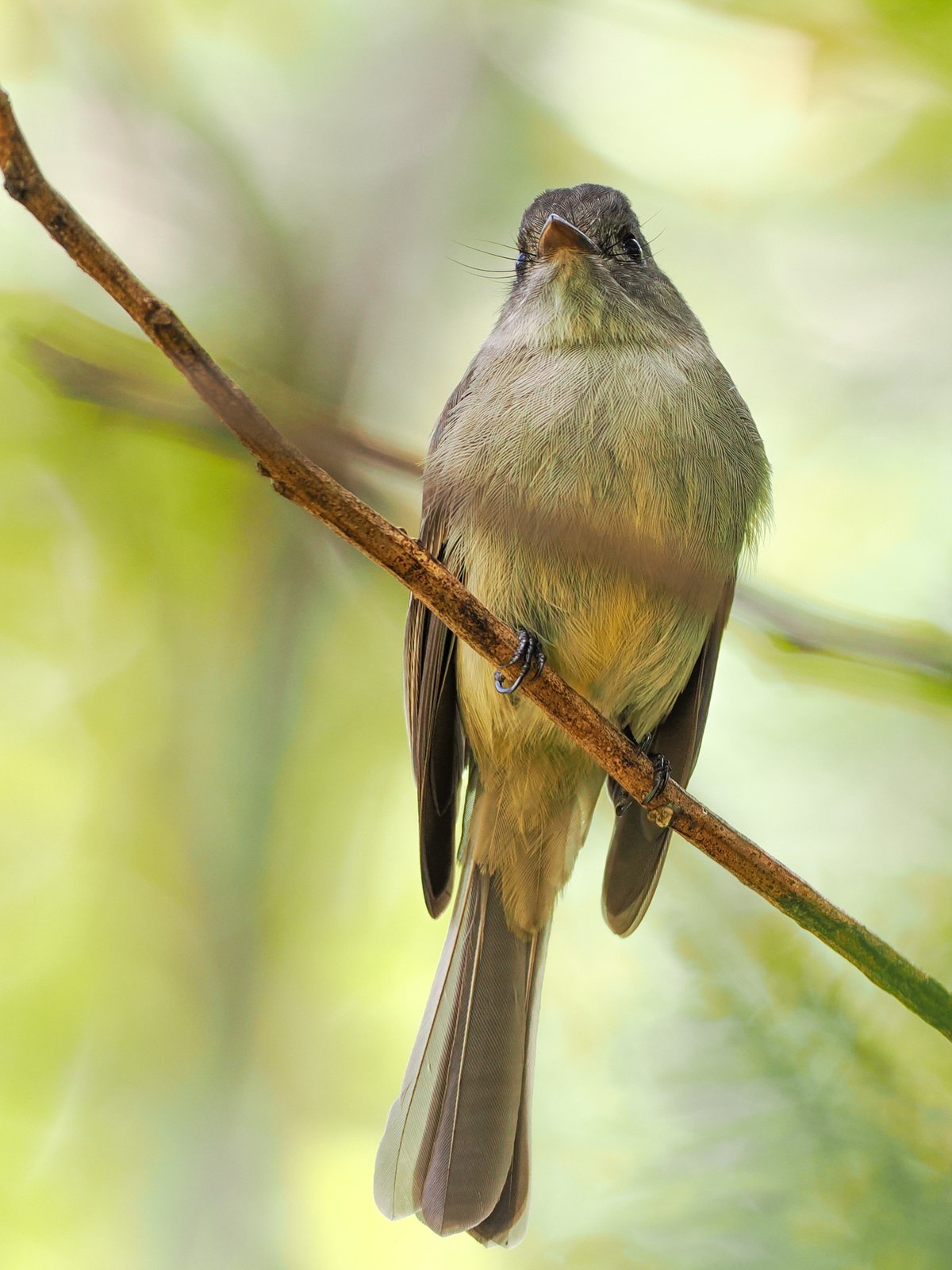
The Hispaniolan Pewee is a small, dark flycatcher found only on Hispaniola and the nearby island of Gonâve. It perches upright on a low, shaded branch, sallies briefly after an insect and usually returns to the same perch. In the Dominican Republic it is called maroíta.
Voice
The call is a soft purr followed by a series of pip-pip-pip-pip. The dawn song is a loud, rapid series of paired notes rising in pitch.
Recording: Zac Peterson — CC BY 4.0 · Converted to mp3, mono, full length · iNaturalist
Identification
15–16 cm. Upperparts greyish olive, the crown slightly darker. Wings and tail dark; two faint, narrow wing bars are sometimes visible. Throat grey, breast grey washed with olive, belly and undertail coverts yellowish buff mixed with grey. The bill is broad and blackish, with a paler base to the lower mandible. Legs blackish, iris dark. The sexes are alike.
Confusion species
Hispaniolan Elaenia Elaenia cherriei has distinct white wing bars and a smaller bill, and perches less upright. Stolid Flycatcher Myiarchus stolidus is larger, with a shaggier head, yellow belly and broad white edges to the flight feathers. Eastern Wood Pewee Contopus virens, which passes through on migration, is paler and greyer below, with clearer wing bars and longer primaries.
Habitat
Evergreen and semi-evergreen broadleaf forest, dry forest, pine forest, shade coffee and orchards, from sea level to about 2000 m; most numerous in the mountains. It hunts flying insects from low perches, often at forest edges and in clearings. It breeds mainly in May and June; the nest is an open cup of rootlets, moss and lichen 3–5 m up, holding two to four eggs.
Where the bird is most at home, classified by the vegetation types of the Caribbean.





Range and movements
Only on Hispaniola, in both Haiti and the Dominican Republic, and on Île de la Gonâve, home of the subspecies tacitus; the nominate form occupies the main island. There are single vagrant records from Mona (Puerto Rico) and Providenciales (Turks and Caicos Islands).
- Resident
- dark = core range, pale = thinly spread
How and when to look
Mainly in the mountain forests of the Dominican Republic, such as the Sierra de Bahoruco and the Cordillera Central, where birds sit on low branches along forest trails. The call usually gives it away before it is seen; on landing it briefly quivers its tail.
Conservation status
Not threatened. The species is still common, but the population is thought to be declining through deforestation and the conversion of forest to farmland.
Scientific name
Contopus hispaniolensis | (Bryant, 1867)
Bryant described the species in 1867 as Tyrannula carriboea (var. hispaniolensis); because it was later moved to another genus, the author and year stand in brackets. The genus Contopus was introduced in 1855 by Cabanis. Contopus is Greek, from kontos 'pole, shaft' and pous 'foot', after the short legs. hispaniolensis is Latin for 'of Hispaniola', the island where the species lives. The specimen the first description was based on came from Santo Domingo (Hispaniola).