All species › Passerines › Tyrant flycatchers › Cuban Pewee
Cuban Pewee | Contopus caribaeus
Bruinbuikpiewie | Pibí Cubano
The Cuban Pewee is the resident pewee of Cuba and the northern Bahamas. It used to be lumped with the pewees of Jamaica and Hispaniola as a single species. In Cuba it is one of the commonest small flycatchers, found in almost every forest type from sea level into the mountains; there it is called bobito chico.
Voice
The dawn song consists of high, squeaky whistles in varied phrases. During the day a long, descending weeeooooo. The call is a repeated weet or dee.
Recording: Cin-Ty Lee — CC BY-NC-SA 4.0 · converted to mono · xeno-canto
Identification
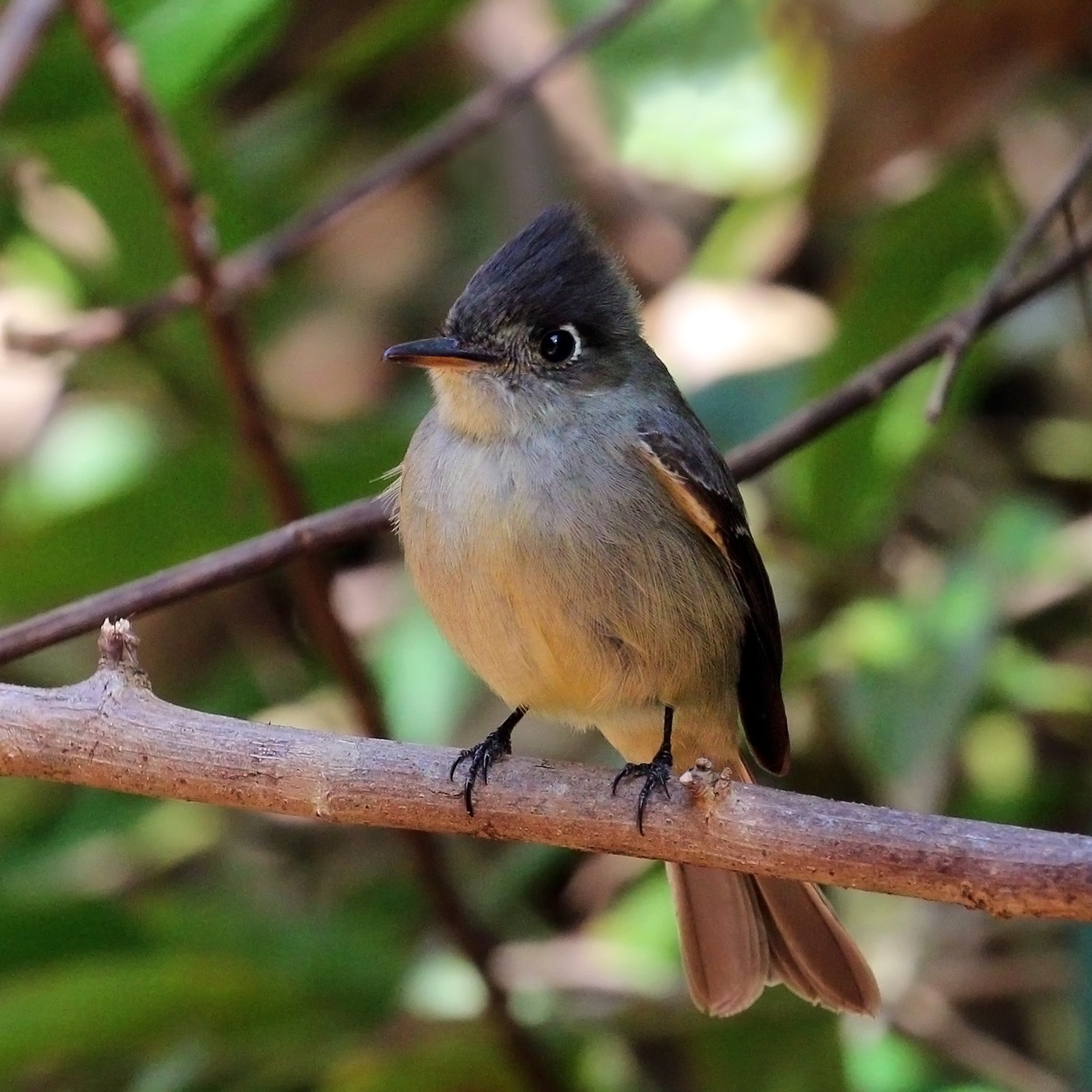
15–16.5 cm, with a slight crest and a fairly large, broad bill. Crown dark olive-grey, face and back olive-brown. A white crescent behind the eye is the best feature. The wings are dark brown with faint, pale wing bars. Throat pale grey, breast beige-grey with an olive wash, belly ochre to mustard-yellow. The upper mandible is black, the lower orange-yellow. Legs black. The sexes are alike.
Confusion species
Eastern Wood-Pewee Contopus virens, a passage migrant, is greyer, with distinct white wing bars, longer wings and no white crescent behind the eye. La Sagra's Flycatcher Myiarchus sagrae is larger and slimmer, with greyish-white underparts and rufous edges to the wings and tail. Empidonax flycatchers, all rare migrants, have a complete eye-ring and distinct wing bars. Hispaniolan Pewee Contopus hispaniolensis and Jamaican Pewee Contopus pallidus do not occur in Cuba or the Bahamas.
Habitat
Broadleaf and pine forest, limestone forest, scrub, swamp forest, mangroves and tree plantations, from sea level to about 1800 m, but rarely above 1000 m. The subspecies of the Zapata Swamp and the south coast of Cuba lives mainly in mangroves. It hunts insects from a low, open perch and quivers its tail on landing; it also eats some fruit.
Where the bird is most at home, classified by the vegetation types of the Caribbean.






Range and movements
Cuba, the Isle of Youth and many cays, including the Jardines de la Reina, and in the northern Bahamas on Grand Bahama, Abaco, Andros, New Providence, Eleuthera and Cat Island. Four subspecies are recognised. Records from Jamaica and Hispaniola in databases derive from the old, broad species concept and refer to Jamaican and Hispaniolan Pewees.
- Resident
- dark = core range, pale = thinly spread
How and when to look
In Cuba it can be found in woodland almost anywhere, for example in the Zapata Swamp and the Sierra de los Órganos; in the Bahamas mainly in pine forest on Andros, Abaco and Grand Bahama. The white crescent behind the eye can be seen even at a distance.
Conservation status
Not threatened. The species is common and widespread, with a stable population, and tolerates secondary forest and plantations.
Scientific name
Contopus caribaeus | (d'Orbigny, ACVMD, 1839)
D'Orbigny, ACVMD described the species in 1839 as Muscipeta caribaea; because it was later moved to another genus, the author and year stand in brackets. The genus Contopus was introduced in 1855 by Cabanis. Contopus is Greek, from kontos 'pole, shaft' and pous 'foot', after the short legs. caribaeus is Latin for 'Caribbean', after the Caribbean region (Cuba). The specimen the first description was based on came from Holguín, Cuba.