All species › Waders, gulls and terns › Sandpipers and snipes › Hudsonian Godwit
Hudsonian Godwit | Limosa haemastica
Rode grutto | Aguja café
The Hudsonian Godwit breeds around Hudson Bay and in Alaska and winters in the far south of South America. In autumn most of the eastern population flies non-stop over the Atlantic, so only birds blown off course by weather or wind end up in the Caribbean. It is therefore a scarce passage migrant, most frequent in the east and south of the region.
Voice
Rather quiet away from the breeding grounds. On take-off a high toe-wit or kwid-wid.
Recording: Avery Bartels — CC BY-NC-SA 4.0 · converted to mono · xeno-canto
Identification
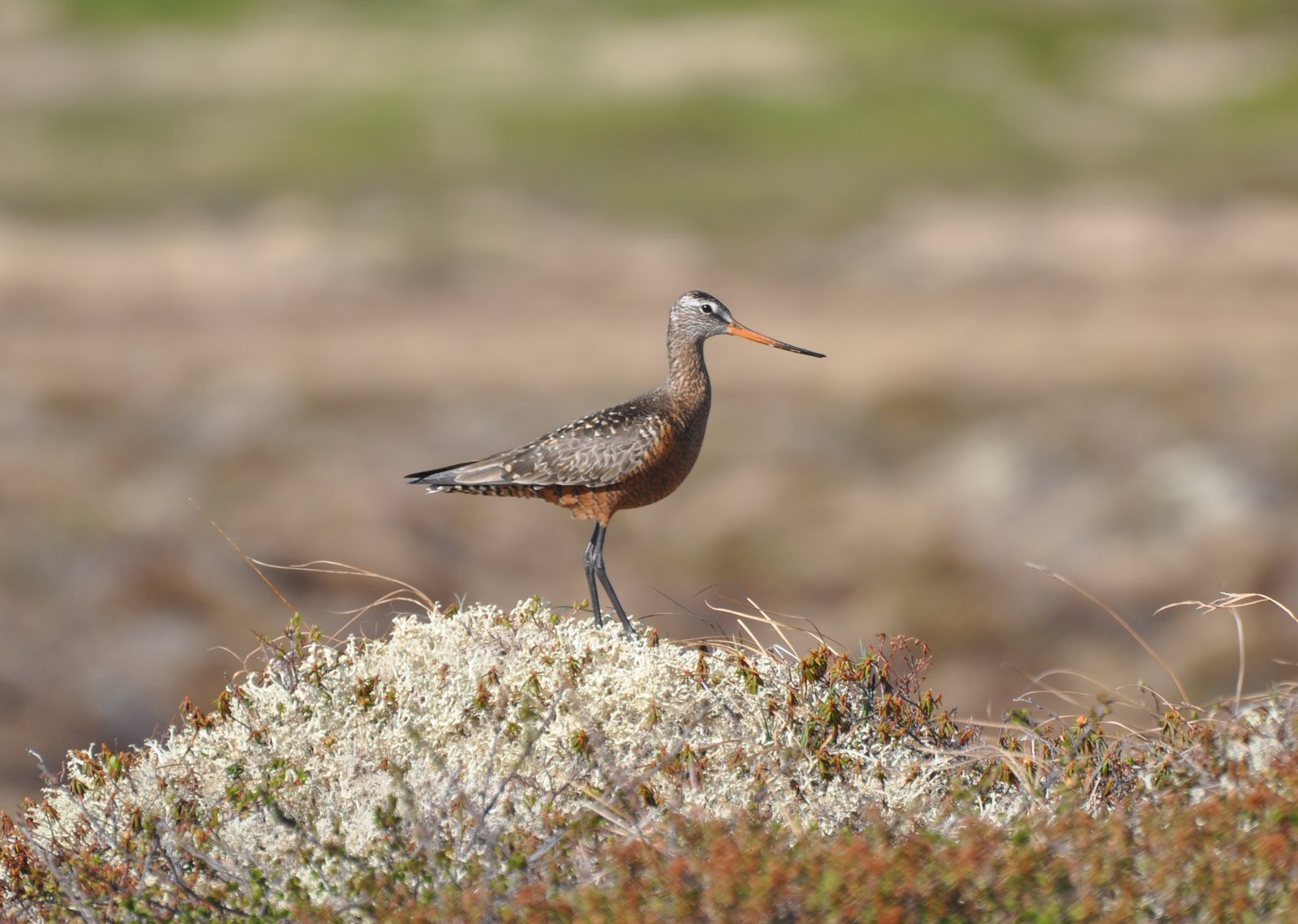
37–42 cm, with a long, slightly upturned bill that is pink or orange at the base and dark towards the tip. In non-breeding plumage plain grey above, paler grey on the breast and white on the belly, with a short white supercilium in front of the eye. In breeding plumage, which may still be partly visible in August, the underparts are deep chestnut with dark barring; females are paler. Juveniles are brownish grey with pale feather fringes. In flight a narrow white wing-bar, black underwing coverts, a white band across the rump and a black tail stand out.
Confusion species
Marbled Godwit Limosa fedoa is larger and cinnamon-brown, with cinnamon-rufous underwings and no wing-bar or white rump. Willet Tringa semipalmata has a shorter, straight, dark bill and a much broader white wing band. The dowitchers Limnodromus are much smaller, with shorter legs and a white wedge up the back.
Habitat
Shallow saline lagoons and salt ponds, mudflats, reservoirs, sewage ponds, rice fields and flooded grassland. It feeds by wading, often belly-deep, and probes the bottom with its long bill for worms, insect larvae and small molluscs.
Where the bird is most at home, classified by the vegetation types of the Caribbean.





Range and movements
Scarce autumn migrant, most frequent on the ABC Islands, Barbados, Guadeloupe, Trinidad and Puerto Rico; rare elsewhere in the Lesser Antilles, the Virgin Islands, the Cayman Islands and the Bahamas, and a vagrant on Cuba, Jamaica and Hispaniola. There are hardly any spring records, as the species then migrates north through the interior of North America. Outside the region it breeds in Alaska and around Hudson Bay and winters in Argentina and Chile, with the largest numbers on Tierra del Fuego and Chiloé.
- Summer visitor (c. Oct–Mar)
- Passage (Mar–Apr, Oct–Nov)
- dark = core range, pale = thinly spread
How and when to look
Salt ponds and sewage ponds on Curaçao, Bonaire and Aruba and the ponds on Barbados are the best places in September. After tropical storms or north-easterly winds a few birds may suddenly appear and sometimes stay for days.
Conservation status
Vulnerable according to the IUCN. The world population is concentrated at a small number of staging and wintering sites, which makes the species sensitive to disturbance and habitat loss there. On Barbados it is legally protected from hunting.
Scientific name
Limosa haemastica | (Linnaeus, 1758)
Linnaeus described the species in 1758 as Scolopax Haemastica; because it was later moved to another genus, the author and year stand in brackets. The genus Limosa was introduced in 1760 by Brisson. Limosa is Latin for 'muddy', from limus 'mud'. haemastica comes from the Greek haimatikos, 'blood-red' — for the deep chestnut-red underparts in breeding plumage. The specimen the first description was based on came from Hudson Bay, Canada.