All species › Kingfishers, bee-eaters and rollers › Todies › Jamaican Tody
Jamaican Tody | Todus todus
Jamaicaanse todie | Barrancolí jamaicano
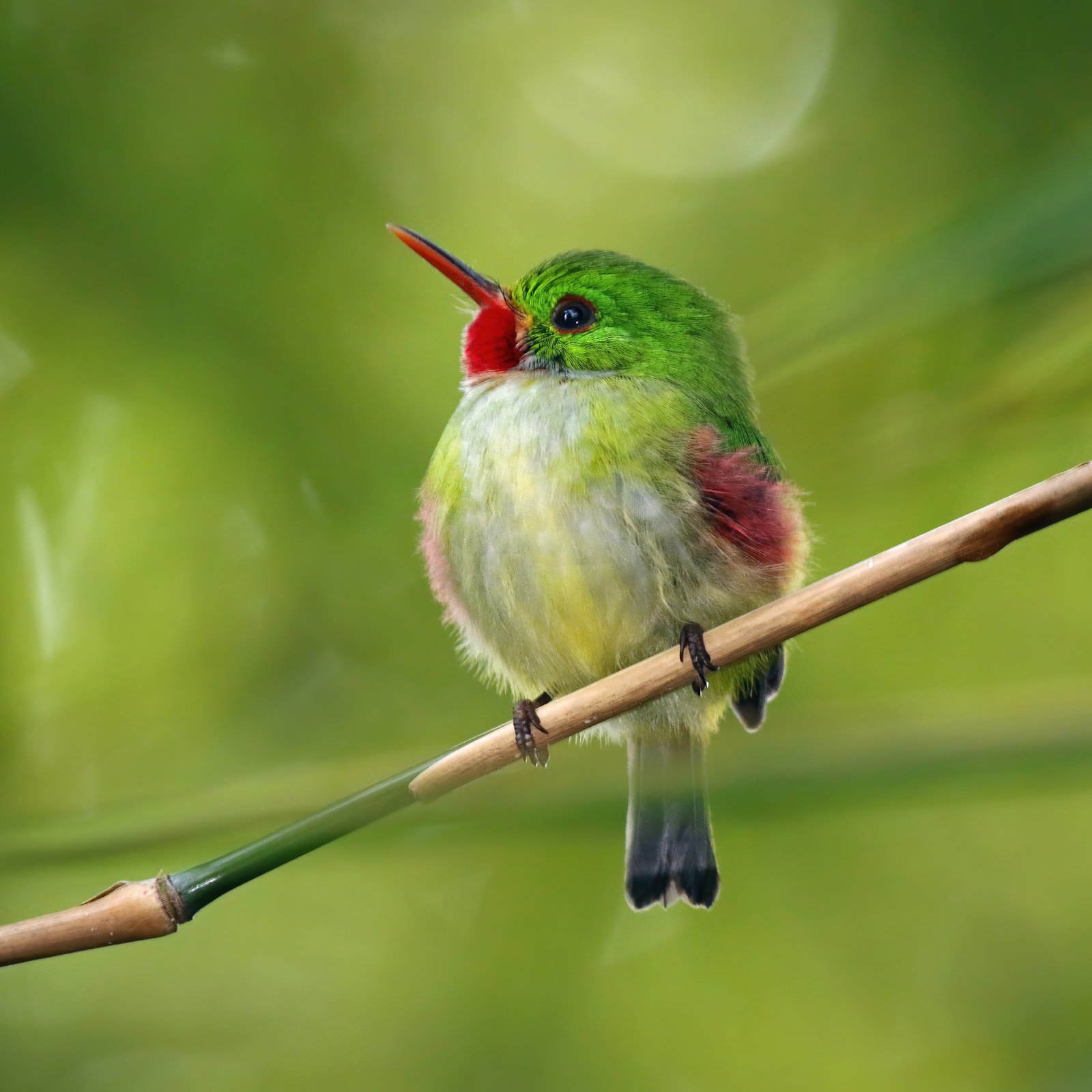
The Jamaican Tody is the only tody in Jamaica and occurs across the whole island, from the dry coast to the humid mountains. In Jamaica it is called robin, robin redbreast or rasta bird. It sits still on a low or mid-level perch, then leaps upwards at prey on the underside of a leaf.
Voice
A nasal, scratchy zheh or beep, in series of about one per second, and a brief, rapid, harsh rattle.
Recording: George Wagner — CC BY-NC-SA 4.0 · converted to mono · xeno-canto
Identification
9–11 cm, compact, with a large head, short tail and a long, broad, flat, mostly red bill. Head and upperparts are bright green, the throat red. The breast is whitish washed green, belly and undertail coverts yellowish and the flanks pink. Legs reddish brown. The sexes are alike.
Confusion species
No other tody occurs in Jamaica. Red-billed Streamertail Trochilus polytmus and Black-billed Streamertail Trochilus scitulus are also green, but have thin bills, hover at flowers, and the males carry long tail streamers.
Habitat
Almost all forest types in Jamaica: dry and moist limestone forest, montane forest, secondary forest, shade coffee and even mangroves, from sea level to about 1800 m. It hunts insects from perches in the lower and middle storeys. It breeds between December and July in a dug tunnel in a steep bank, with an unlined chamber; the clutch is one to four white eggs.
Where the bird is most at home, classified by the vegetation types of the Caribbean.






Range and movements
Endemic to Jamaica, across the whole island wherever there is forest or scrub. The species does not occur outside Jamaica.
- Resident
- dark = core range, pale = thinly spread
How and when to look
In almost any forest in Jamaica, including the Blue Mountains and the Cockpit Country. Usually in pairs. The scratchy call is the best lead; the bird itself, at eye level, is noticed only when it moves.
Conservation status
Not threatened. The species is common and occurs in a wide range of forest types, including secondary forest and plantations.
Scientific name
Todus todus | (Linnaeus, 1758)
Linnaeus described the species in 1758 as Alcedo Todus; because it was later moved to another genus, the author and year stand in brackets. The genus Todus was introduced in 1760 by Brisson. Todus is a Latin word for a small bird, mentioned by the playwright Plautus and the grammarian Festus. todus repeats the genus name, a Latin word for a small bird. The specimen the first description was based on came from Jamaica.