All species › Passerines › New World warblers › Kentucky Warbler
Kentucky Warbler | Geothlypis formosa
Kentuckyzanger | Reinita de Kentucky
The Kentucky Warbler is a stocky, short-tailed warbler of the forest floor that breeds in the eastern United States and winters from southern Mexico to northern South America. Most birds cross the Gulf of Mexico directly, so the Caribbean is touched only along its western edge. It walks on the ground and turns over leaves, and therefore often goes unnoticed.
Voice
The song, seldom heard in the region, is a loud, rolling series of two-syllable phrases, churry-churry-churry. The call is a low, full chuck, lower than in most other warblers; often the first sign of the bird in dense forest.
Recording: David A. Brinkman — CC BY-NC-SA 4.0 · shortened to the first 60 s, mono · xeno-canto
Identification
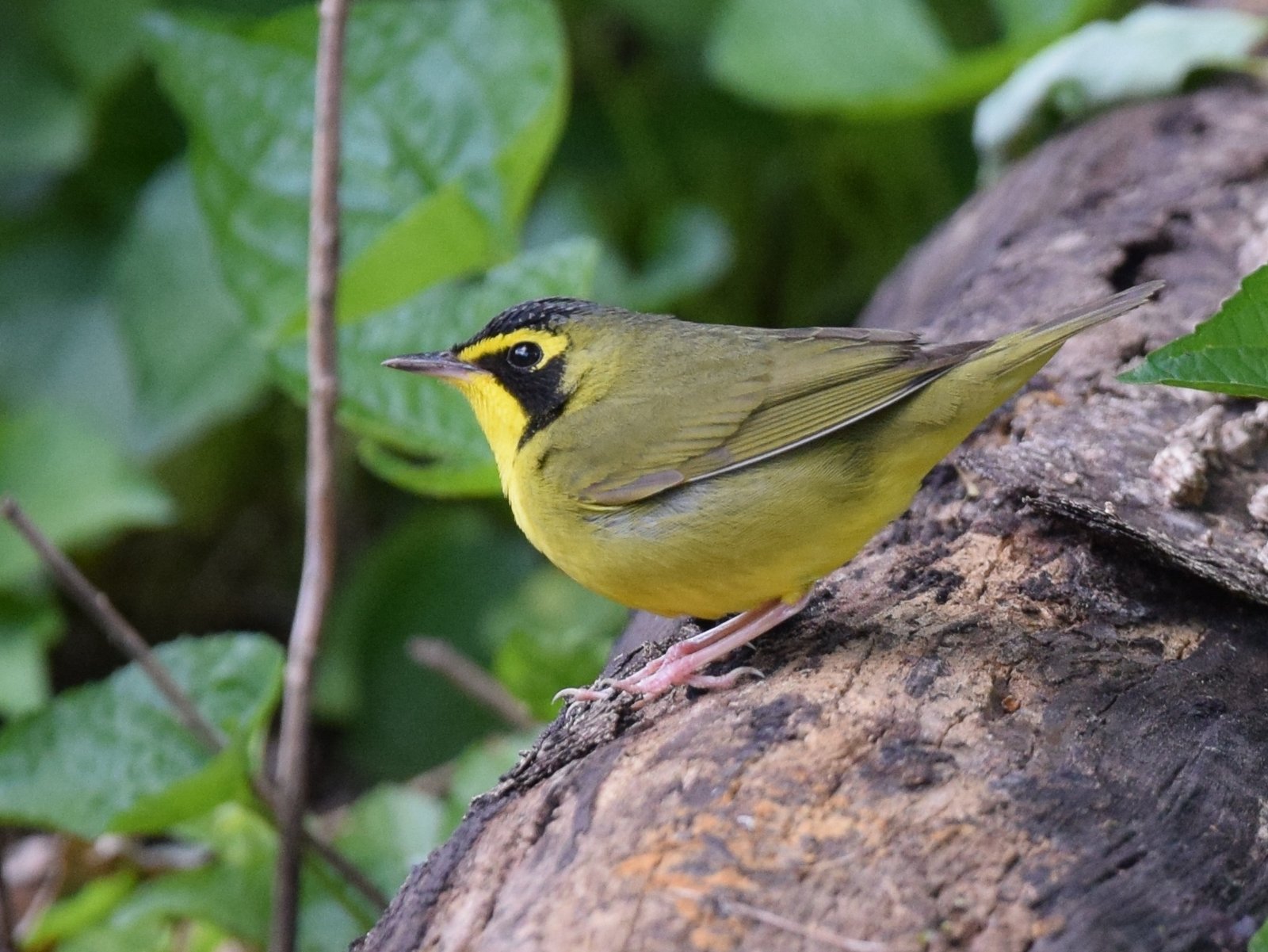
13 cm, with a fairly long bill, short tail and pale pink legs. Upperparts are plain olive-green, underparts bright yellow from throat to undertail. The head is distinctive: yellow 'spectacles' run from the bill base above and behind the eye, and below them a black sideburn extends from the eye to the side of the neck. The forehead and forecrown are black, the hindcrown greyish. Females show less black on the head and cheek; young birds in autumn may have almost no black, but keep the yellow spectacles and all-yellow underparts.
Confusion species
Common Yellowthroat Geothlypis trichas is smaller, with a whitish belly and brownish flanks and no yellow spectacles; the male has a black mask across the eye. Female Hooded Warbler Setophaga citrina has a yellow face without a black sideburn and white tail spots, shown as it constantly fans its tail. Mourning Warbler Geothlypis philadelphia and Connecticut Warbler Oporornis agilis have a grey or grey-brown hood. Canada Warbler Cardellina canadensis is grey above with a streaked necklace.
Habitat
On migration and in winter the understorey of moist and semi-evergreen forest, limestone forest and montane forest, also dense growth along streams and overgrown secondary forest. It forages on or just above the ground, walking, sallying up to insects on the undersides of leaves and flipping over leaf litter.
Where the bird is most at home, classified by the vegetation types of the Caribbean.




Range and movements
Mainly a passage migrant on Cuba, the Cayman Islands, Jamaica and the Bahamas, with a few wintering on Cuba and Jamaica. Rare to very rare on Hispaniola, Puerto Rico, the Virgin Islands and San Andrés; only a handful of records in the Lesser Antilles. Outside the region it breeds in the eastern and south-eastern United States and winters from southern Mexico through Central America to Colombia and Venezuela.
- Summer visitor (c. Oct–Mar)
- Winter visitor (c. Apr–Sep)
- Passage (Mar–Apr, Oct–Nov)
- dark = core range, pale = thinly spread
How and when to look
The best chances are in September and April in shady forest in western Cuba and on Jamaica. The low chuck from the undergrowth is usually the clue; patient waiting at the edge of an open patch of forest floor is then the way to see the bird.
Conservation status
Not threatened. A gradual decline has been measured in the breeding range over recent decades, attributed mainly to fragmentation of deciduous forest and browsing of the understorey by high deer numbers.
Scientific name
Geothlypis formosa | (Wilson, 1811)
Wilson described the species in 1811 as Sylvia formosa; because it was later moved to another genus, the author and year stand in brackets. The genus Geothlypis was introduced in 1847 by Cabanis. Geothlypis is Greek, from gē 'ground' and thlupis, an unidentified small bird: 'ground warbler', after its life low in dense cover. formosa is Latin for 'beautiful'. The specimen the first description was based on came from Kentucky (USA).