All species › Tubenoses › Northern storm petrels › Leach's Storm Petrel
Leach's Storm Petrel | Hydrobates leucorhous
Vaal stormvogeltje | Paíño boreal
Leach's Storm Petrel breeds in burrows on islands in the northern Atlantic and Pacific and winters on tropical seas. In the Caribbean it is a scarce winter visitor and passage migrant, staying mostly far out at sea and therefore rarely seen. It comes ashore only at night, and only in the breeding range.
Voice
Silent at sea. At the colony, purring and chattering calls from the burrow at night and a cackling call in flight.
Recording: Doug Hynes — CC BY-SA 4.0 · converted to mono · xeno-canto
Identification
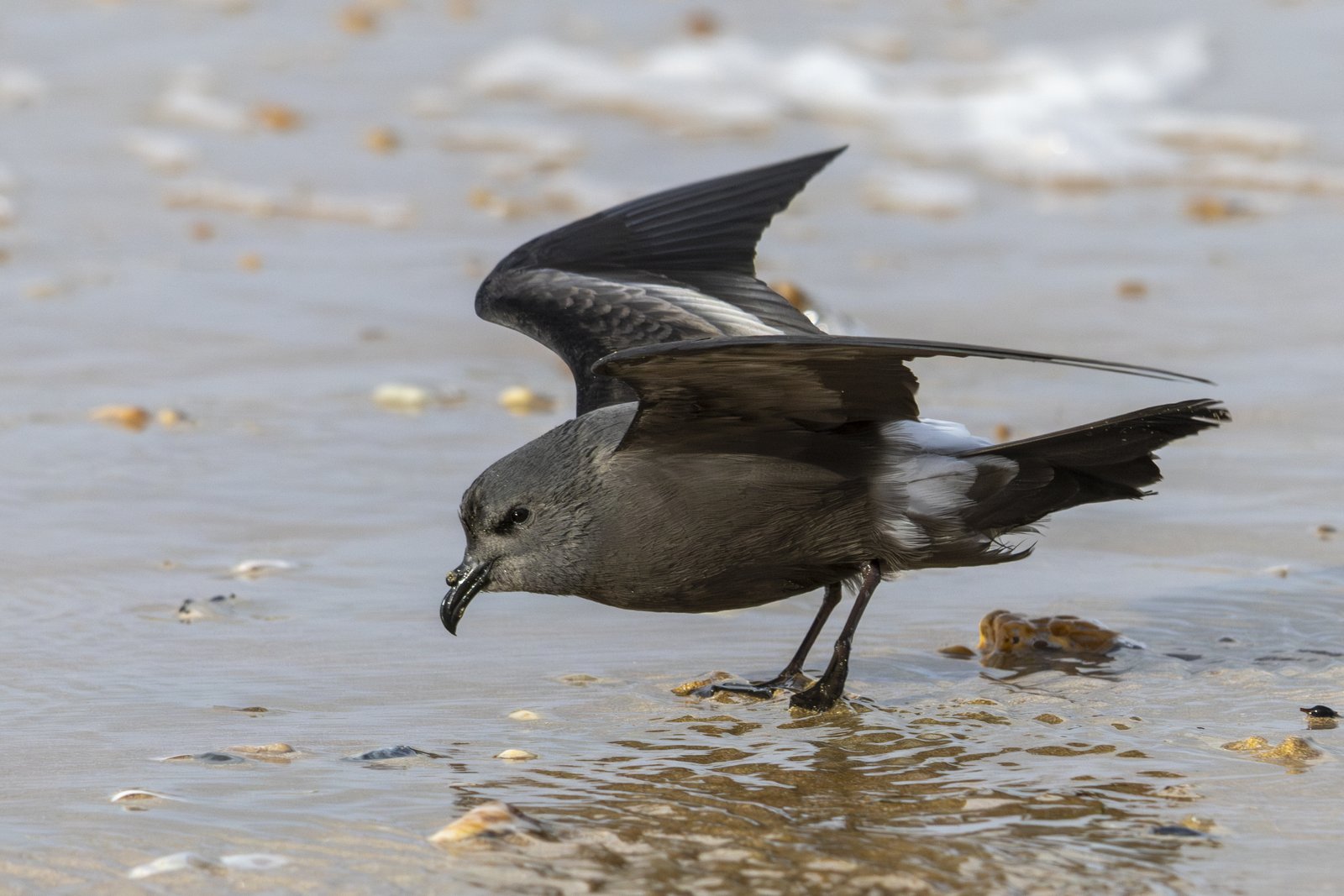
18–21 cm. A dark blackish-brown storm petrel with long, pointed wings clearly angled at the carpal, and a forked tail. On the upperwing a pale grey-brown bar across the coverts that almost reaches the leading edge. The white rump is V-shaped and often divided by a dark central line; the white barely reaches the undertail coverts. The legs do not project beyond the tail. The sexes are alike.
Confusion species
Wilson's Storm Petrel Oceanites oceanicus is smaller, with shorter, less angled wings, a square tail, a broad white rump band wrapping onto the undertail coverts, a more diffuse wing bar and feet projecting beyond the tail. The rare Band-rumped Storm Petrel Hydrobates castro has a narrower, undivided rump band, a less forked tail and a stiffer flight with more gliding.
Habitat
Open ocean, usually far offshore over deep water. It flies with deep wingbeats in a bounding, erratic flight with sudden changes of direction, picking plankton, small crustaceans and small fish from the surface. It rarely follows boats.
Where the bird is most at home, classified by the vegetation types of the Caribbean.
Range and movements
Winter visitor and passage migrant at sea, with most records in the waters of the Lesser Antilles, Puerto Rico and Hispaniola; rare around the Bahamas, Cuba, Jamaica, the ABC Islands and Trinidad and Tobago. Outside the region it breeds in the North Atlantic, from Newfoundland and Maine to Iceland, the Faroes, Scotland and Norway, and in the North Pacific; Atlantic birds winter in tropical parts of the ocean.
- Summer visitor (c. Oct–Mar)
- dark = core range, pale = thinly spread
How and when to look
Rarely seen from shore; the best chances are on pelagic trips and inter-island ferries, especially in winter and spring. After storms birds are sometimes seen closer inshore. Look for the angled wings, the obvious wing bar and the erratic flight.
Conservation status
Vulnerable. The largest colonies, especially in Newfoundland, have declined steeply since the 1980s. Causes include predation by gulls and mammals at breeding sites, birds attracted at night to artificial light on ships and oil platforms, and possibly pollution and changes in food supply at sea.
Scientific name
Hydrobates leucorhous | (Vieillot, 1818) (GBIF: Oceanodroma leucorhoa)
Vieillot described the species in 1818 as Procellaria leucorhoa; because it was later moved to another genus, the author and year stand in brackets. The genus Hydrobates was introduced in 1822 by Boie. Hydrobates is Greek, from hudro- 'water' and batēs 'walker': 'water walker'. leucorhous is Greek, from leukos 'white' and orrhos 'rump', after the white rump band. The specimen the first description was based on came from the coast of Picardy.