All species › Passerines › New World warblers › Mangrove Warbler
Mangrove Warbler | Setophaga petechia
Mangrovezanger | Reinita de manglar
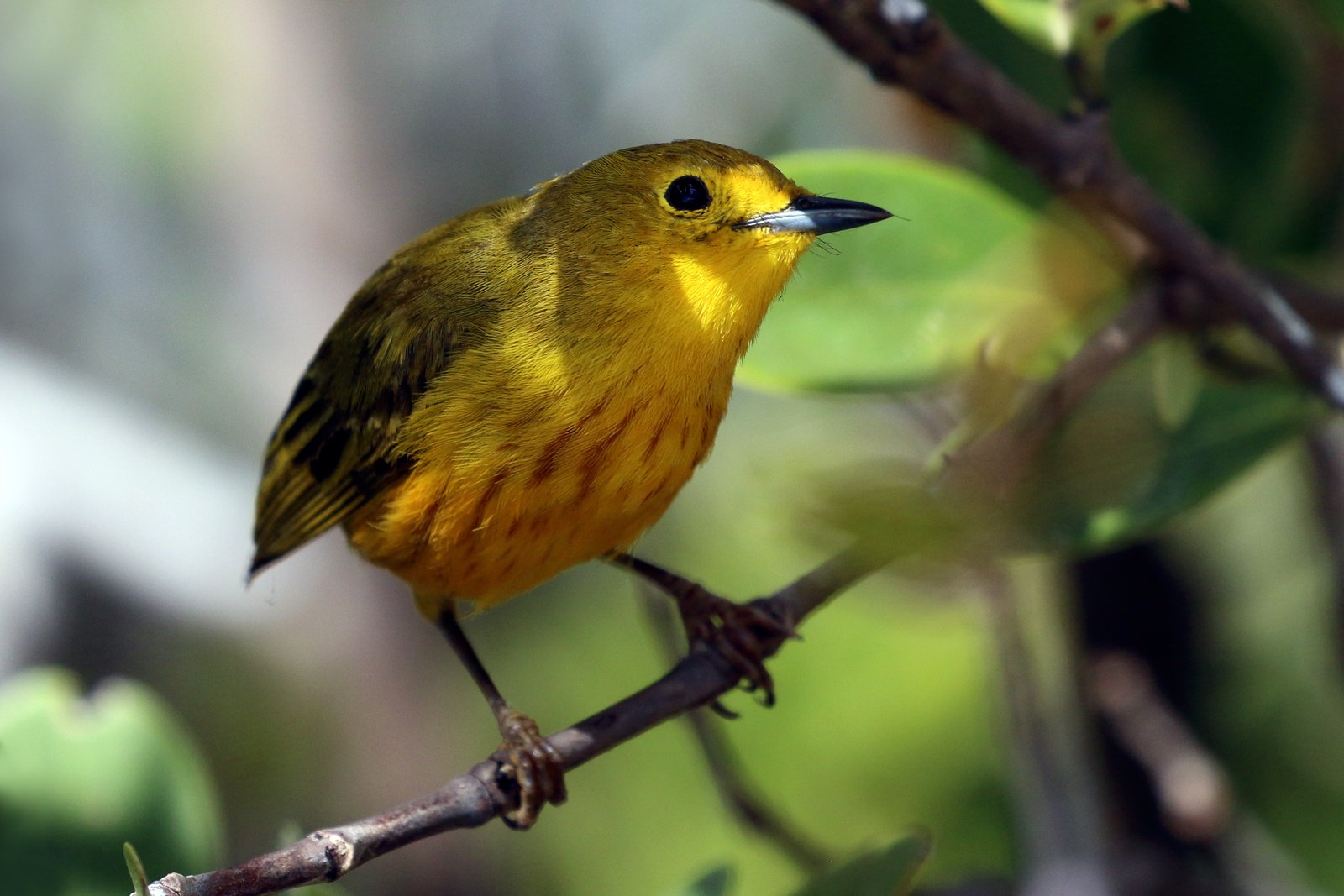
The Mangrove Warbler is the resident member of the ‘yellow warblers’ and one of the most widespread songbirds of the Caribbean. Since the split of the former Yellow Warbler the species comprises all non-migratory forms of mangroves and islands, from the Bahamas to the ABC Islands; the island forms are also grouped as the ‘Golden Warbler’ group. Almost every island has its own subspecies, often with its own head pattern.
Voice
The song is a fast, bright series of whistles with an accelerating or rising ending, related to that of American Yellow Warbler but differing between islands. The call is a sharp chip. Males sing all year, mainly in the early morning, from a prominent branch in the mangroves.
Recording: Bobby Wilcox — CC BY-NC-SA 4.0 · converted to mono · xeno-canto
Identification
12–14 cm, yellow with an olive-green back, a large dark eye in a plain face and yellow spots in the tail. Males have reddish streaks on the breast and flanks; the head varies by island. In the Greater Antilles and the Bahamas the male's crown is yellow to orange-tinged, on part of the Lesser Antilles, such as Martinique, rufous, and in the ABC Islands the male has a rufous crown. Females and young birds are duller and unstreaked, young birds sometimes greyish.
Confusion species
American Yellow Warbler Setophaga aestiva, a winter visitor, often cannot be told apart in the field; a male with rufous on the head, or a bird in the mangroves in the breeding season, is a Mangrove Warbler. Adelaide's Warbler Setophaga adelaidae, Barbuda Warbler Setophaga subita and St. Lucia Warbler Setophaga delicata have grey upperparts, a yellow supercilium and white wing bars. Vitelline Warbler Setophaga vitellina has olive streaks on the face and along the flanks, without rufous.
Habitat
Mainly mangroves along coasts and lagoons, also coastal woodland and coastal scrub; on dry islands such as the ABC Islands and Barbados also thorn scrub, gardens and parks inland. It searches foliage and twigs at all heights for insects and spiders.
Where the bird is most at home, classified by the vegetation types of the Caribbean.





Range and movements
Resident in the Bahamas, the Turks and Caicos Islands, Cuba and its offshore cays, the Cayman Islands, Jamaica, Hispaniola (Haiti and the Dominican Republic), Puerto Rico, the Virgin Islands, the Lesser Antilles south to Grenada and Barbados, the ABC Islands and San Andrés and Providencia. Not resident in Trinidad and Tobago. Outside the region in the mangroves of the Florida Keys, Mexico, Central America, northern South America and the Galápagos Islands.
- Resident
- Summer visitor (c. Oct–Mar)
- Winter visitor (c. Apr–Sep)
- Passage (Mar–Apr, Oct–Nov)
- dark = core range, pale = thinly spread
How and when to look
Almost any mangrove fringe, including near harbours and hotel beaches, produces a singing male within minutes, best in the early morning. Between September and April American Yellow Warbler may be in the same mangroves; when in doubt, ‘yellow warbler sp.’ is the honest entry.
Conservation status
Not threatened. Habitat is lost locally through the clearing and filling of mangroves for coastal development. The Barbados form is listed by the United States as an endangered foreign species.
Scientific name
Setophaga petechia | (Linnaeus, 1766)
Linnaeus described the species in 1766 as Motacilla petechia; because it was later moved to another genus, the author and year stand in brackets. The genus Setophaga was introduced in 1827 by Swainson. Setophaga is Greek, from sēs, sētos 'moth' and -phagos '-eating': 'moth-eater'. petechia comes from Italian petecchia 'small red spot on the skin', after the rusty-red breast streaks. The specimen the first description was based on came from Barbados.