All species › Passerines › Mockingbirds and thrashers › Martinique Thrasher
Martinique Thrasher | Ramphocinclus brachyurus
Martiniquespotlijster | Cuitlacoche de Martinica
The Martinique Thrasher is among the rarest birds in the Caribbean. It lives only on the Caravelle Peninsula on the east coast of Martinique, in an area of a few square kilometres. Until recently it was treated together with the birds of Saint Lucia as White-breasted Thrasher; since 2024 the two populations have been regarded as separate species, with Ramphocinclus sanctaeluciae on Saint Lucia.
Voice
Short, harsh calls and a soft, musical tee-roo. In alarm a rough grok grok; young birds give a thin tseep.
Recording: Allen T. Chartier — CC BY-NC-SA 3.0 · converted to mono · xeno-canto
Identification
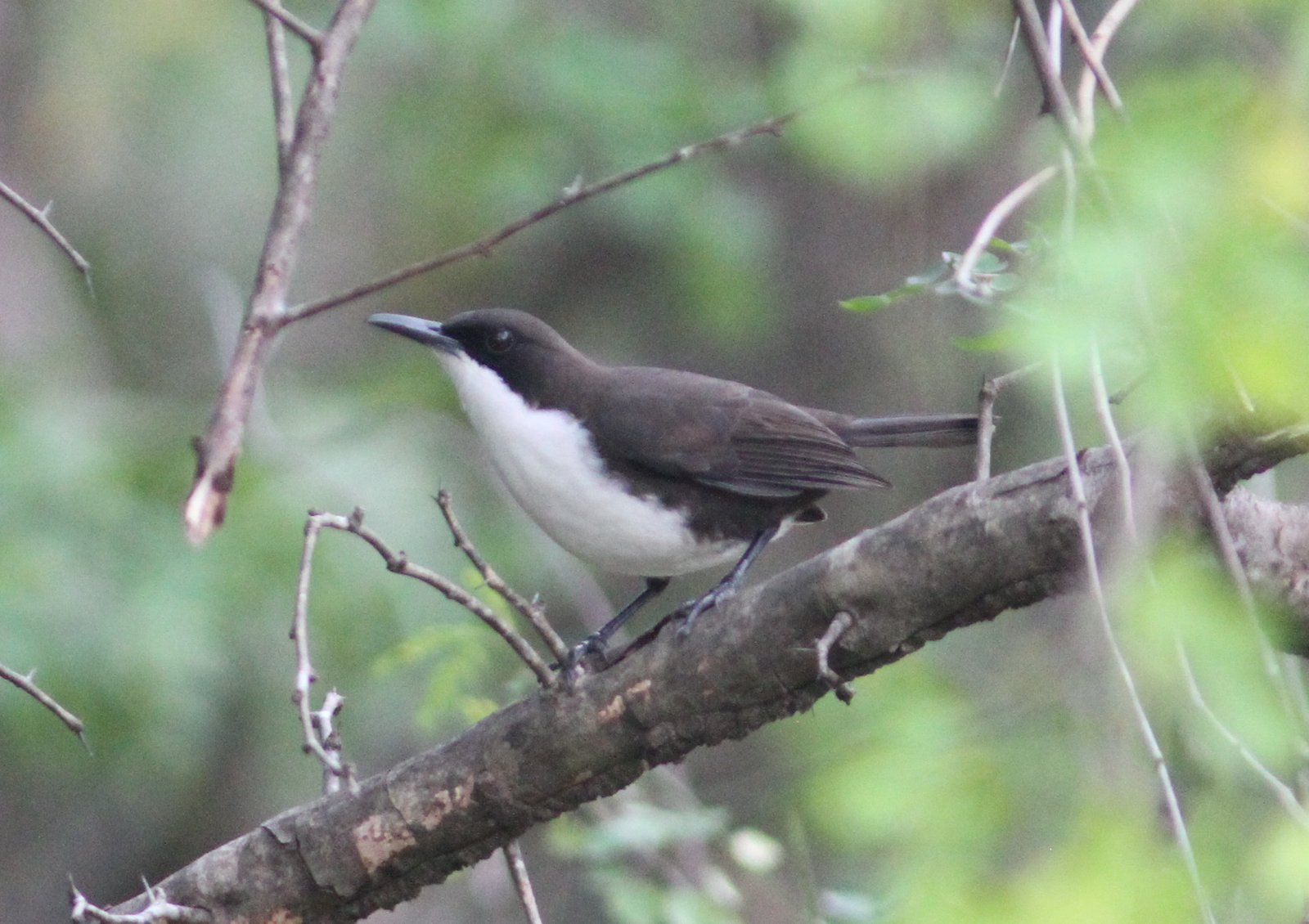
23–25 cm, with a fairly short tail, long black legs and a dark, slightly curved bill. Upperparts, head and tail are plain dark chocolate brown; throat, breast and belly are pure white, sharply contrasting with the brown sides of the head and flanks. The iris is red. The sexes are alike. Immatures are more uniformly brown, with rufous-tinged upperparts and a brown iris.
Confusion species
Scaly-breasted Thrasher Allenia fusca has a heavily spotted breast, a white wing bar and a pale iris. Pearly-eyed Thrasher Margarops fuscatus is larger, with a white iris, a heavy pale bill and streaked and scaled underparts. Grey Trembler Cinclocerthia gutturalis is grey-brown, with a long, slightly curved bill, a yellow iris and less contrast between upperparts and underparts.
Habitat
Dry deciduous forest and dense scrub on the slopes and in the ravines of the peninsula, within about 2 km of the coast and up to around 200 m. It depends on places with a thick layer of leaf litter, where it searches for invertebrates while walking and tossing leaves aside. When excited it flicks its half-open wings.
Where the bird is most at home, classified by the vegetation types of the Caribbean.



Range and movements
Only on Martinique, almost exclusively in the protected area of the Caravelle Peninsula (about 5 km²). It has disappeared from the rest of the island. The related Ramphocinclus sanctaeluciae lives in dry forest on the east coast of Saint Lucia.
- Resident
- dark = core range, pale = thinly spread
How and when to look
The Caravelle nature reserve with its trails through dry forest is the place; best early in the morning, when the birds forage and call in the leaf litter. Staying on the trails limits disturbance in this small habitat.
Conservation status
Endangered. The population is estimated at roughly 130 to 270 individuals in a single small area. Threats are predation by introduced rats, mongooses and feral cats, to which this ground-foraging bird and its nests are highly exposed, and the loss of coastal dry forest.
Scientific name
Ramphocinclus brachyurus | (Vieillot, 1818)
Vieillot described the species in 1818 as Turdus brachyurus; because it was later moved to another genus, the author and year stand in brackets. The genus Ramphocinclus was introduced in 1843 by De Lafresnaye. Ramphocinclus is Greek, from rhamphos 'bill' and kinklos 'thrush': a thrush-like bird with a prominent, slightly curved bill. brachyurus is Greek for 'short-tailed', from brakhus 'short' and oura 'tail'. The specimen the first description was based on came from Martinique.