All species › Gamebirds › New World quail › Northern Bobwhite
Northern Bobwhite | Colinus virginianus
Virginiaanse boomkwartel | Colín de Virginia
The Northern Bobwhite, called codorniz in Cuba, is a small, dumpy quail that in the region occurs naturally only in Cuba. How the Cuban birds got there is uncertain: they are regarded as native, but they may descend from birds brought from Mexico in early colonial or even earlier times. In the Bahamas and on Hispaniola the species was introduced as a game bird.
Voice
The male gives a clear, whistled bob-white or bob-bob-white, the last syllable high and loud. Groups keep in touch with soft, peeping calls.
Recording: Valerie Heemstra — CC BY-NC-SA 4.0 · converted to mono · xeno-canto
Identification
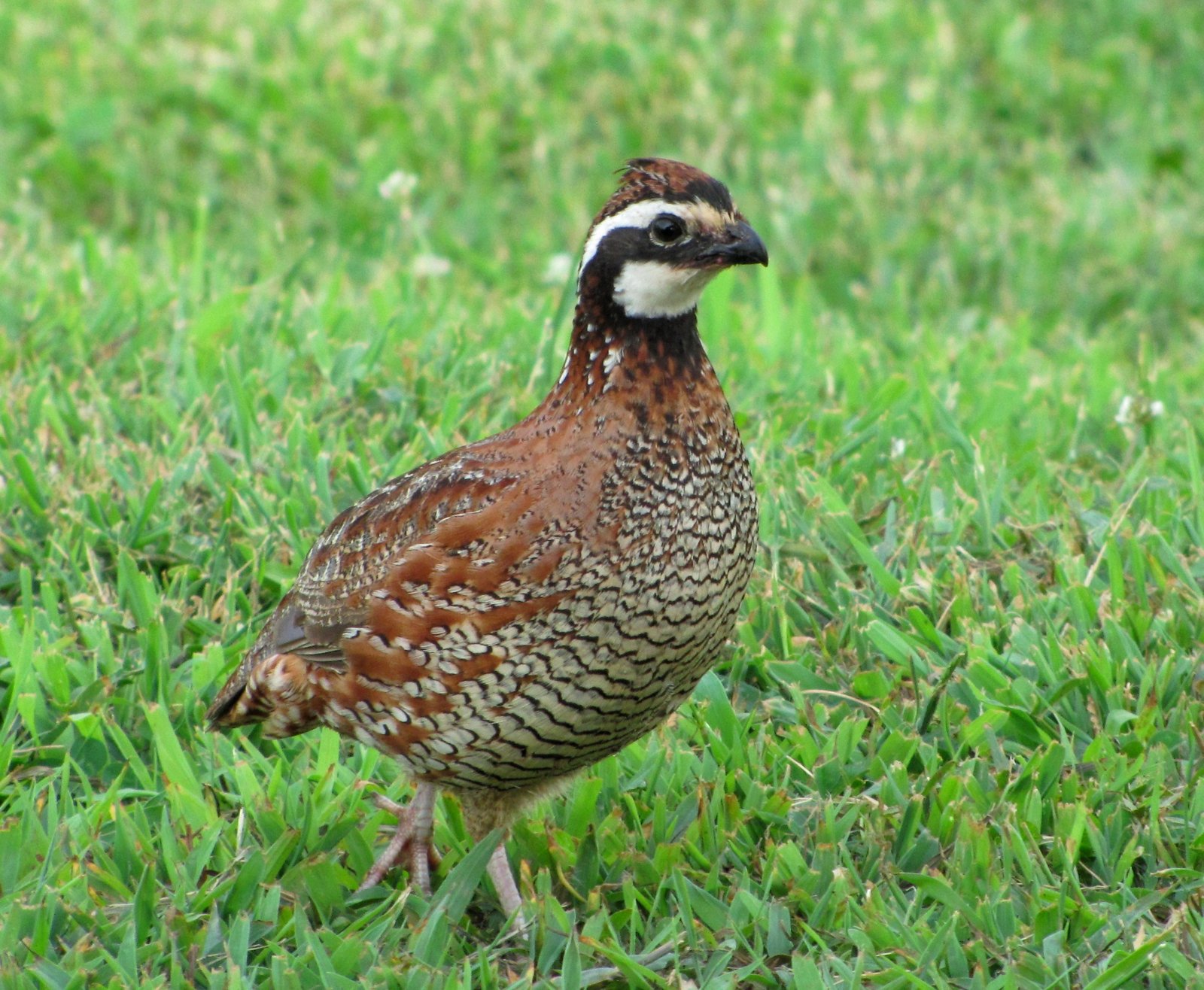
24–28 cm, round and short-tailed. The upperparts are rufous-brown mottled with grey, black and pale. The male has a white throat and a white supercilium, both bordered black; in the female these markings are buff. The underparts are paler, with black scalloping and rufous flank stripes edged white. When disturbed it bursts into flight on whirring wings and drops back into cover after a short distance.
Confusion species
There is no other quail in Cuba or the Bahamas. Crested Bobwhite Colinus cristatus of Aruba and Curaçao has a pointed crest and finely white-spotted underparts; the two do not occur together anywhere. Quail-doves such as Blue-headed Quail-Dove Starnoenas cyanocephala also walk on the ground, but they are doves, with a slim head and different markings.
Habitat
Open country with low vegetation: savanna, pasture, field edges and fallow land, scrub and open pine forest. It lives in small groups on the ground, eats seeds and insects and hides in dense herbage and bushes.
Where the bird is most at home, classified by the vegetation types of the Caribbean.





Range and movements
Native to Cuba, including the Isla de la Juventud, as the subspecies C. v. cubanensis. Introduced and established in the Bahamas, where it is common on the northern islands, and on Hispaniola, where it is scarce. Also taken to Puerto Rico and the Turks and Caicos Islands; there are few recent records from there and its status is uncertain. Outside the region in the eastern and central United States, Mexico and Guatemala.
- Resident
- dark = core range, pale = thinly spread
How and when to look
In Cuba in grassy open country with bushes and in open pine forest, early in the morning when the males are calling. The birds themselves are usually seen only when a group flushes almost underfoot.
Conservation status
Near Threatened, because of the steep decline in North America caused by changes in land use. It is hunted in Cuba; little is known about numbers in the region.
Scientific name
Colinus virginianus | (Linnaeus, 1758)
Linnaeus described the species in 1758 as Tetrao virginianus; because it was later moved to another genus, the author and year stand in brackets. The genus Colinus was introduced in 1820 by Goldfuss. Colinus derives from the Nahuatl word zōlin, 'quail'. virginianus means 'of Virginia': the type locality was first given as 'America' and was later restricted to that state. The specimen the first description was based on came from Virginia.