All species › Waterfowl › Ducks and geese › Northern Pintail
Northern Pintail | Anas acuta
Pijlstaart | Ánade rabudo
The Northern Pintail is the most slender of the dabbling ducks, with a long neck and, in the male, a needle-like tail. In the Caribbean it is a winter visitor from North America, regular in the north of the island chain and fairly common in Cuba. In Cuba it is called pato pescuecilargo, after its long neck.

Voice
The male gives a soft, fluty whistle, proop-proop; the female a low, hoarse quack and a hoarse kwarr when flushed. Little heard in winter.
Recording: Stanislas Wroza — CC BY-NC-SA 4.0 · converted to mono · xeno-canto
Identification
51–76 cm; the long central tail feathers make the male much longer than the female. The male has a chocolate-brown head, a white breast and foreneck with a white stripe running up the side of the neck, a grey, finely vermiculated body, a black rear end with a cream patch in front of it and a long, black, pointed tail. The female is finely mottled greyish-brown, with a plain paler head, a long neck and a pointed tail. The bill is long and blue-grey with a black central stripe. In flight it is slender, with narrow wings, a bronze-green or brown speculum with a white trailing edge and a long neck.
Confusion species
White-cheeked Pintail Anas bahamensis is smaller and warmer brown, with white cheeks and a red bill base. Female Mallard Anas platyrhynchos is stockier, with an orange bill and a blue speculum with broad white borders. Female Gadwall Mareca strepera has a shorter neck, a bill with orange sides and a white wing patch.
Habitat
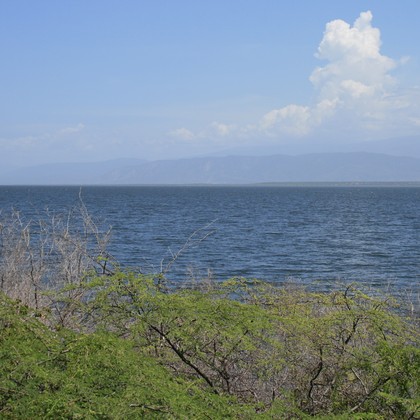
Shallow fresh and brackish lakes, lagoons, salt ponds and flooded grassland, also rice fields. With its long neck it dabbles deeper than other dabbling ducks and eats seeds, aquatic plants and small invertebrates. By day it often rests in flocks on open water.
Where the bird is most at home, classified by the vegetation types of the Caribbean.




Range and movements
A winter visitor to the north of the region: fairly common in Cuba and regular in the Bahamas, Hispaniola and Puerto Rico; in smaller numbers in Jamaica and the Cayman Islands. Scarce and irregular in the Lesser Antilles, Trinidad and Tobago and the ABC islands. Breeds in northern North America, Europe and Asia; American birds winter from the United States to Central America and northern South America.
- Winter visitor (c. Apr–Sep)
- dark = core range, pale = thinly spread
How and when to look
On large, shallow lakes and lagoons in winter, usually among American Wigeons, Northern Shovelers and Blue-winged Teals; the long, slim silhouette picks it out even at a distance. Males acquire their full breeding plumage in the course of the winter.
Conservation status
Least Concern. The North American population has declined sharply since the 1970s through the ploughing of prairie wetlands on the breeding grounds and has not recovered since. In the Caribbean the species is hunted.
Scientific name
Anas acuta | Linnaeus, 1758
Linnaeus described the species in 1758 and placed it straight away in the genus where it still stands. He introduced the genus Anas in that same work. Anas is the Latin word for 'duck'. acuta is Latin for 'pointed', from acuere 'to sharpen', after the long pointed tail feathers of the male. The specimen the first description was based on came from Sweden.