All species › Passerines › Tyrant flycatchers › Ochre-bellied Flycatcher
Ochre-bellied Flycatcher | Mionectes oleagineus
Okerbuikpipratiran | Mosquero ocrillo
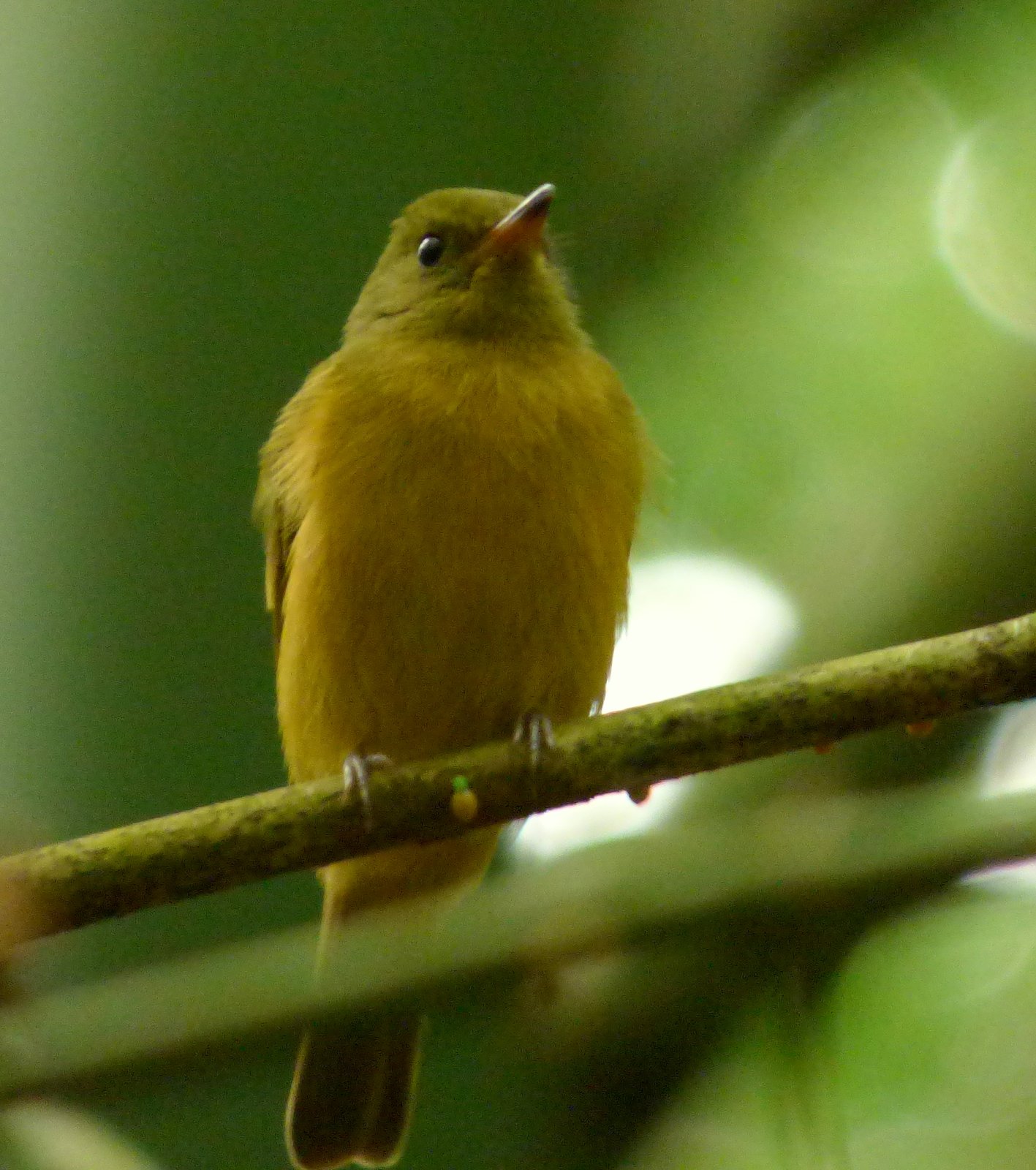
The Ochre-bellied Flycatcher is a small, olive-green tyrant flycatcher with a warm ochre belly, found in the forests of both Trinidad and Tobago. Unlike most flycatchers it feeds mainly on berries and small fruits. In the breeding season males sing for hours from a fixed perch in the understorey, alone or in loose groups within earshot of one another.
Voice
A series of sharp chip notes followed by louder, emphatic notes, and a nasal chee-a chee-a chee-a. Singing males can be heard for much of the day in the breeding season.
Recording: Mateus Gonçalves Santos — CC BY-NC-SA 4.0 · shortened to the first 60 s, mono · xeno-canto
Identification
13–14 cm, slender, with a small, rounded head and a narrow bill. Head, back and rump olive-green; the wings are olive with ochre-buff edges to the coverts and tertials forming faint wing bars. The throat is greyish olive, the rest of the underparts bright cinnamon to ochre-buff. The bill is dark with a paler base to the lower mandible. The sexes are alike. A typical habit is rapidly lifting one wing at a time, alternating sides.
Confusion species
Olive-striped Flycatcher Mionectes olivaceus has streaked underparts and a white spot behind the eye. Slaty-capped Flycatcher Leptopogon superciliaris has a grey crown and a dark crescent on the ear-coverts. Euler's Flycatcher Lathrotriccus euleri is browner, with distinct wing bars and a paler belly, and sallies from a perch for flying insects. Female manakins are stockier and lack the ochre belly.
Habitat
The interior and edges of humid and semi-evergreen forest, secondary forest, gallery forest and shaded cacao and coffee, from the lowlands into the mountains. It eats mainly small berries, including those of mistletoes and Melastomataceae, supplemented with insects. The nest is a hanging, pear-shaped ball of moss and fibres with a side entrance, often attached to a root or vine over a stream or along a steep bank.
Where the bird is most at home, classified by the vegetation types of the Caribbean.




Range and movements
Resident in Trinidad and Tobago, on both islands in almost all forested areas. Absent from the rest of the region. Outside the region from southern Mexico through Central America to Amazonia and the Atlantic Forest of Brazil.
- Resident
- dark = core range, pale = thinly spread
How and when to look
In Trinidad, among other places, in the forest around the Asa Wright Nature Centre and in the Arima Valley; in Tobago in the Main Ridge forest. The wing-lifting and ochre belly are visible even at a distance; the bird is best watched at fruiting shrubs.
Conservation status
Not threatened. The species is widespread and adapts well to secondary forest and plantations.
Scientific name
Mionectes oleagineus | (Lichtenstein, 1823)
Lichtenstein described the species in 1823 as M[uscicapa] oleaginea; because it was later moved to another genus, the author and year stand in brackets. The genus Mionectes was introduced in 1844 by Cabanis. Mionectes is Greek meionektēs 'small, having suffered loss', from meionekteō 'to have too little'. oleagineus is Latin for 'olive-coloured, of the olive tree', from olea 'olive tree', after the olive-green upperparts. The specimen the first description was based on came from Bahia, Brazil.