All species › Oilbird › Oilbird › Oilbird
Oilbird | Steatornis caripensis
Vetvogel | Guácharo
The Oilbird is the sole member of its family and the only bird in the world that forages for fruit in flight at night. By day it roosts in colonies in dark caves, where it finds its way by echolocation using audible clicks. The name refers to the chicks, which grow so fat on a diet of oily fruit that they were once collected to be rendered for oil. In Trinidad it is also known as guácharo or diablotin.

Voice
In the cave a deafening chorus of harsh screams and shrieks, especially when disturbed or exposed to light. For orientation in the dark a series of rapid, dry clicks (around 2 kHz), audible to the human ear.
Recording: Marcin Sołowiej — CC BY-NC-SA 4.0 · converted to mono · xeno-canto
Identification
40–49 cm, slim, with long narrow wings, a long graduated tail and a strongly hooked bill with long rictal bristles. The eyes are large and dark. The plumage is warm rufous-brown, with white spots on the crown, nape, wing-coverts and tail. The underparts are paler cinnamon, with white, black-edged diamond-shaped spots that grow larger from throat to belly. The legs are short and weak. The sexes are similar.
Confusion species
Hardly confusable given its size, colour and habits. Nightjars such as Pauraque Nyctidromus albicollis and Rufous Nightjar Antrostomus rufus are much smaller, have a tiny bill and hunt insects; they rest on the ground or on a branch, not in caves. Common Potoo Nyctibius griseus is mottled grey-brown without white teardrop spots and perches upright on a post or branch by day.
Habitat
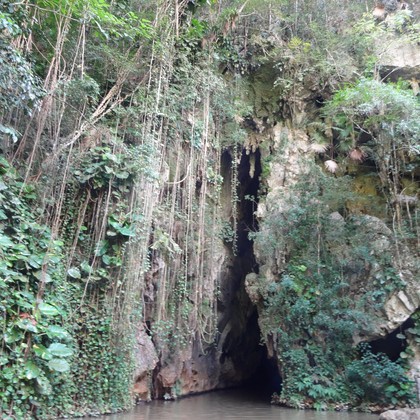
Breeds and roosts in caves and deep, shady gorges in forested hills and mountains, and in sea caves. At night it flies over forest to take fruit, mainly of palms, laurels (Lauraceae) and incense trees (Burseraceae); the fruit is plucked from the tree in flight and swallowed whole, the seeds regurgitated later. The nest is a mound of regurgitated fruit remains and droppings on a ledge in the cave, often above water. Two to four white eggs are laid; the chicks become heavier than the adults before they fledge.
Where the bird is most at home, classified by the vegetation types of the Caribbean.



Range and movements
In the region resident only in Trinidad, with a handful of colonies in caves in the Northern Range, such as Dunston Cave at the Asa Wright Nature Centre, Aripo Cave and Cumaca Cave, and one colony on the islet of Huevos off the north-west coast. Recorded as a vagrant on Aruba. Outside the region from Venezuela and the Guianas through Colombia, Ecuador and Peru to Bolivia and Brazil, from sea level high into the Andes.
- Resident
- dark = core range, pale = thinly spread
How and when to look
Dunston Cave at the Asa Wright Nature Centre is the most accessible colony; visits are limited and only possible with a guide, to avoid disturbance. Other caves require a guide and a strenuous hike or a boat trip. At dusk the birds leave the cave, and their clicks can then be heard in the surroundings. Light in the cave disturbs the colony and is best kept to a minimum.
Conservation status
Not threatened. The world population is estimated at a few tens of thousands of mature birds and is considered stable. Because it depends on a limited number of caves, the species is locally vulnerable to disturbance and to the raiding of colonies; in Trinidad birds are still taken from remote caves.
Scientific name
Steatornis caripensis | Humboldt, 1817
Humboldt described the species in 1817 and placed it straight away in the genus where it still stands. The genus Steatornis was introduced in 1814 by Humboldt. Steatornis is Greek, from stear, steatos 'fat' and ornis 'bird', after the fat nestlings once rendered down for oil. caripensis means 'from Caripe', after the Cueva del Guácharo near Caripe in Venezuela, where Humboldt found the bird. The specimen the first description was based on came from caves of Caripe, Venezuela.