All species › Parrots › Parrots › Olive-throated Parakeet
Olive-throated Parakeet | Eupsittula nana
Olijfkeelaratinga | Perico pecho sucio
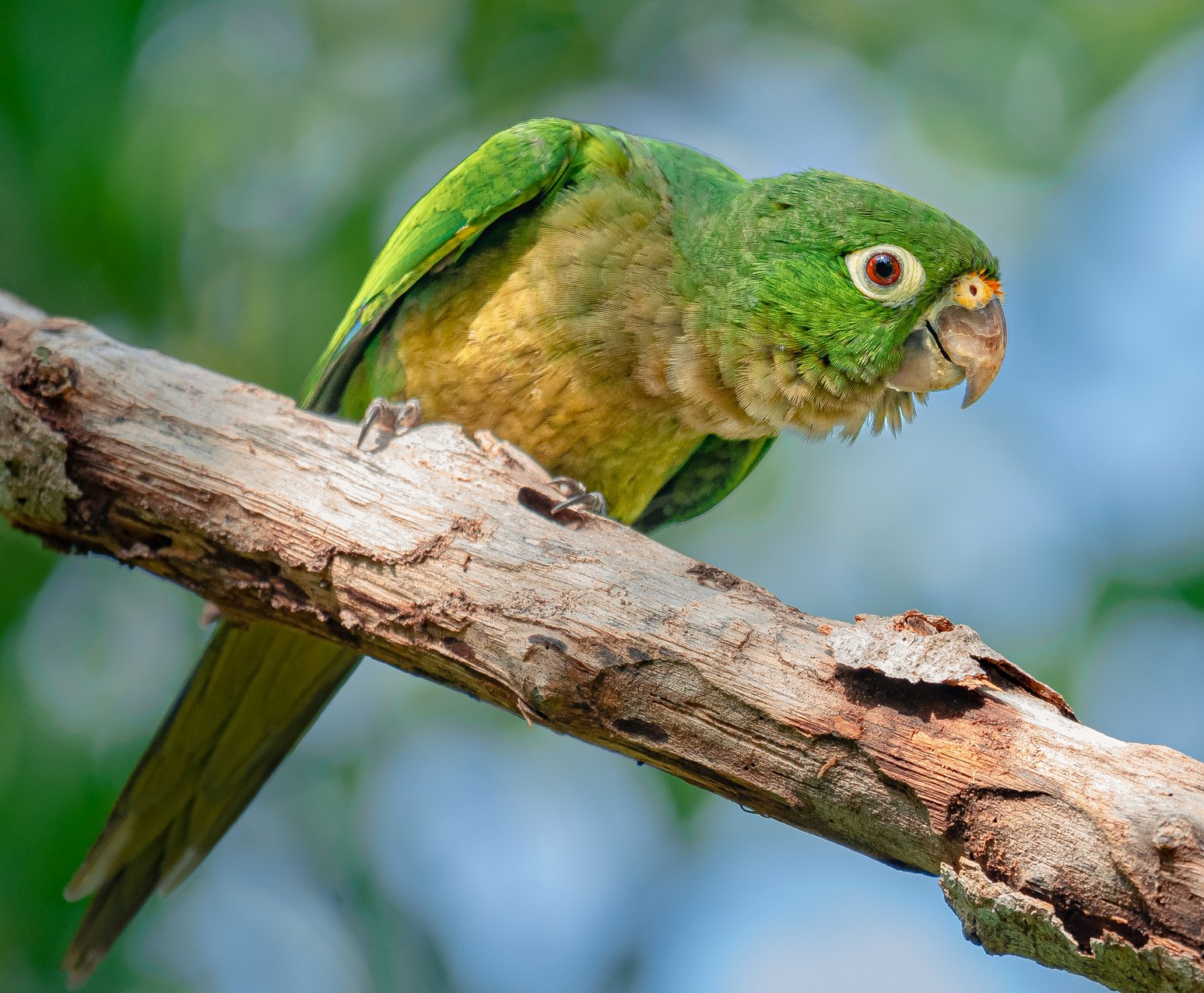
The Olive-throated Parakeet is the only native parakeet of Jamaica, a green parakeet with an olive-brown throat and breast. The Jamaican birds belong to the nominate form nana; the forms on the Central American mainland are sometimes treated as a separate species. Hispaniola has an introduced population of Jamaican origin.
Voice
A sharp, grating krik-krik-krik-krik and a raw krrieh krrie, mainly in flight; flocks keep up a constant chatter in the treetops.
Recording: Manuel Grosselet — CC BY-NC-SA 4.0 · converted to mono · xeno-canto
Identification
22–26 cm, with a long pointed tail. Head and upperparts are dark green, ear coverts and rump slightly yellower. A ring of bare white skin surrounds the eye. Throat and breast are olive-brown, the belly olive-green. The flight feathers are dull blue above, the underwing grey. The tail is yellowish below. Bill brownish horn with a paler tip, iris yellow to orange. The sexes are alike. Flight is fast and direct, usually in noisy small flocks.
Confusion species
Jamaica's two native amazons, Yellow-billed Amazon Amazona collaria and Black-billed Amazon A. agilis, are larger and stockier, with a short square tail. The introduced Green-rumped Parrotlet Forpus passerinus is far smaller, with a short tail. On Hispaniola, Hispaniolan Parakeet Psittacara chloropterus lacks the olive-brown breast, is larger and shows red in the underwing.
Habitat
On Jamaica semi-evergreen and moist forest, dry limestone forest, forest edge, plantations and gardens, from sea level into the hills. It eats seeds, fruit and flowers, and sometimes damages maize and fruit crops. It nests in tree holes or in termite nests. On Hispaniola dry and semi-evergreen forest in the south-west.
Where the bird is most at home, classified by the vegetation types of the Caribbean.






Range and movements
Jamaica: resident across the island wherever there is forest. Hispaniola: introduced to the Dominican Republic, where birds are mainly recorded in the south-west, in Independencia and Pedernales provinces; scattered records elsewhere in the country. Outside the region, in the broader sense, from eastern Mexico to Costa Rica.
- Resident
- dark = core range, pale = thinly spread
How and when to look
On Jamaica in the John Crow Mountains, the Blue Mountains and Cockpit Country, and in rural areas with fruit trees. In the Dominican Republic around Puerto Escondido at the foot of the Sierra de Bahoruco. The parakeets are usually heard first, as flocks pass over the forest.
Conservation status
Listed by the IUCN as Near Threatened. On Jamaica the population is declining through forest loss and coastal development; birds are also persecuted as crop pests and trapped for the cage-bird trade.
Scientific name
Eupsittula nana | (Vigors, 1830) (GBIF: Aratinga nana)
Vigors described the species in 1830 as Psittacara nana; because it was later moved to another genus, the author and year stand in brackets. The genus Eupsittula was introduced in 1853 by Bonaparte. Eupsittula combines Greek eu 'good, true' with Modern Latin psittacula 'little parrot': 'true parakeet'. nana is Latin for 'dwarf' (nanus), after its small size. The specimen the first description was based on came from Jamaica.