All species › Passerines › Cardinals › Painted Bunting
Painted Bunting | Passerina ciris
Purpergors | Azulillo sietecolores
The Painted Bunting is a small cardinal with two separate breeding populations in the United States: one in the south-central states and one along the Atlantic coast from the Carolinas to Florida. Birds of the eastern population winter in Florida, Cuba and the Bahamas. In Cuba it is called mariposa and is sought after as a cage bird.
Voice
The call is a soft, metallic chip or plik. The song is a lively, rapid series of warbled notes; seldom heard in winter.
Recording: Sue Riffe — CC BY-NC-SA 4.0 · converted to mono · xeno-canto
Identification
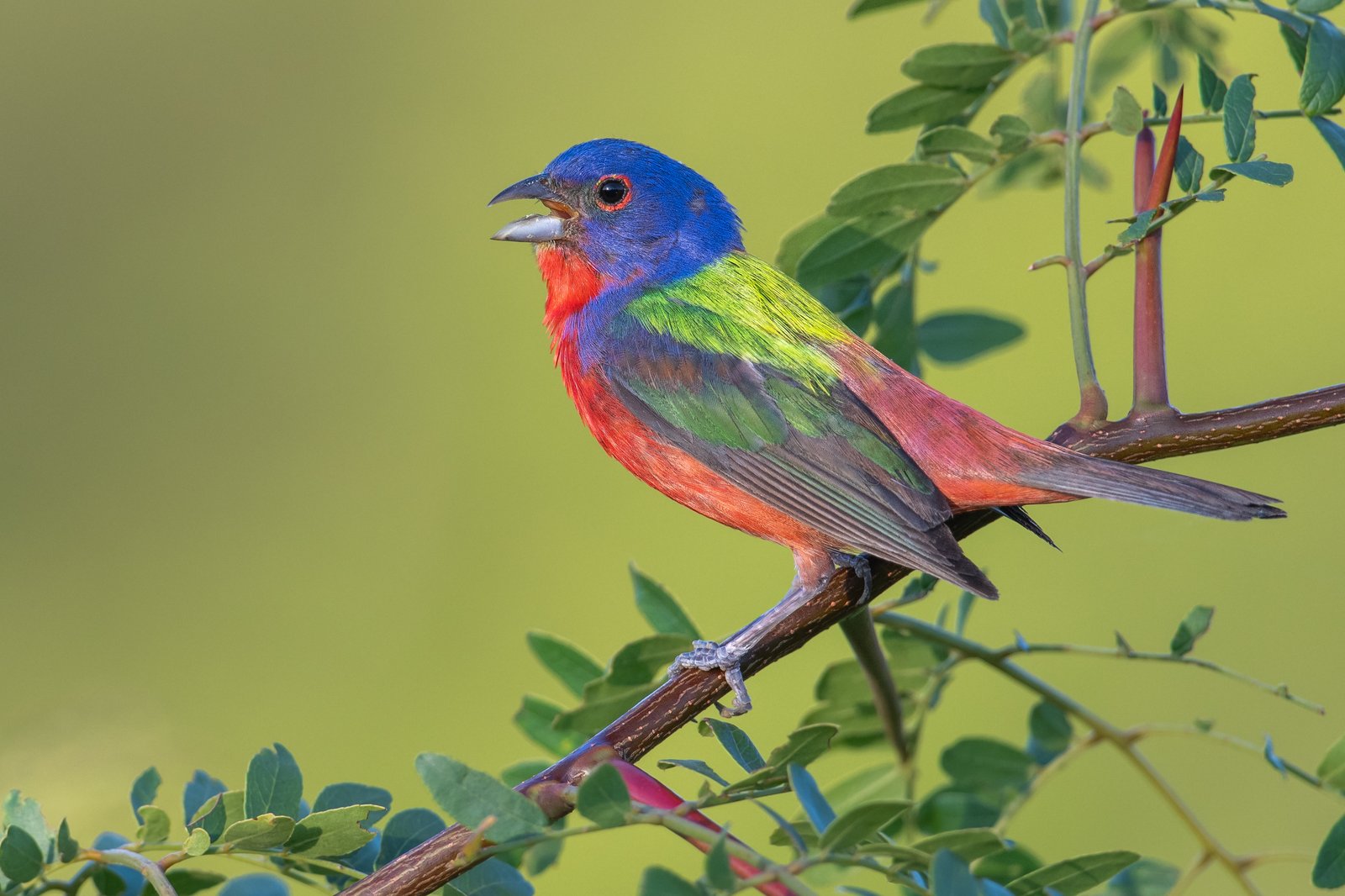
12–14 cm, with a short conical bill. The adult male has a blue head with a red eye ring, a yellow-green mantle, a red rump and entirely red underparts; wings and tail are dark with green and reddish edges. Males acquire this plumage only in their second year; in the first year they resemble the female. The female is plain bright green above and yellow-green below, with a pale eye ring; young birds are duller and greyer green.
Confusion species
No other finch-like bird in the region has this colour pattern. Females and young may be confused with Yellow-faced Grassquit Tiaris olivaceus, which is smaller, olive rather than bright green and has a blacker bill, and with female Indigo Buntings Passerina cyanea, which are brown. Vireos and warblers are also green but have thin, pointed bills.
Habitat
Overgrown ground, scrub along coasts and roads, forest edges, dry forest and coastal woodland with dense undergrowth, abandoned fields and large gardens. It forages unobtrusively on or just above the ground, often in cover, on grass seeds and small insects.
Where the bird is most at home, classified by the vegetation types of the Caribbean.






Range and movements
A fairly common winter visitor in Cuba, especially in the west, and a scarce to fairly common winter visitor in the Bahamas. Rare on Jamaica and the Cayman Islands; only a vagrant on Hispaniola, the Turks and Caicos Islands and elsewhere in the region. Outside the region it breeds in the southern United States and north-eastern Mexico and winters from Florida and Mexico to Panama.
- Resident
- Winter visitor (c. Apr–Sep)
- Passage (Mar–Apr, Oct–Nov)
- dark = core range, pale = thinly spread
How and when to look
In Cuba in winter in rough scrub at forest edges, for example on the Zapata Peninsula and in Pinar del Río province. Birds often stay hidden in cover for long periods; patient waiting by an open patch with seeding grasses gives the best chance.
Conservation status
Not threatened, but numbers have fallen considerably since the 1960s, mainly through loss of scrub and coastal vegetation in the breeding range. The eastern population is small and vulnerable. In Cuba and Central America birds are trapped for the cage-bird trade.
Scientific name
Passerina ciris | (Linnaeus, 1758)
Linnaeus described the species in 1758 as Emberiza ciris; because it was later moved to another genus, the author and year stand in brackets. The genus Passerina was introduced in 1816 by Vieillot. Passerina comes from the Latin passerinus 'sparrow-like', from passer 'sparrow'. ciris is the Latin name of a mythical bird, from the Greek keiris, an unidentified bird. The specimen the first description was based on came from South Carolina.