All species › Waders, gulls and terns › Gulls and terns › Ring-billed Gull
Ring-billed Gull | Larus delawarensis
Ringsnavelmeeuw | Gaviota de Delaware
Ring-billed Gull is the most widespread medium-sized gull in North America and one of the gulls that most often reach the Caribbean. The number of wintering birds has increased since the second half of the twentieth century, especially in the Bahamas and Cuba. It readily seeks out people, in harbours, on beaches and at rubbish dumps.
Voice
A high, mewing kee-ow and a series of laughing kyah-kyah-kyah calls, higher and thinner than those of Herring Gull.
Recording: Tom Cooney — CC BY-NC-SA 4.0 · converted to mono · xeno-canto
Identification
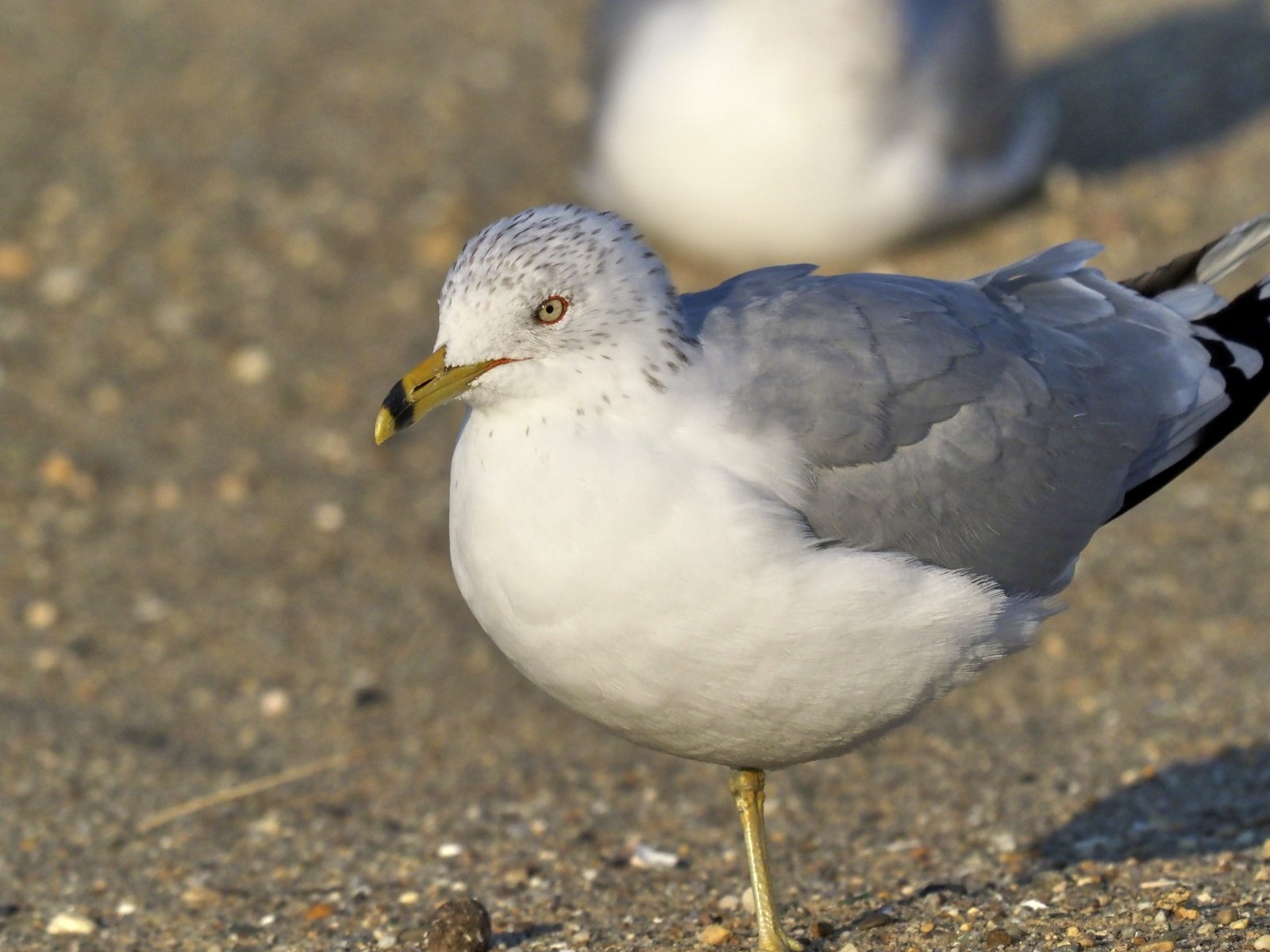
43–54 cm, with a fairly rounded head and a medium-sized yellow bill with a clear black ring just behind the tip. Adults have a pale grey mantle, black wingtips with small white mirrors, a pale eye with a red orbital ring and yellow legs. In winter the head is finely streaked brown. Adult plumage is reached in the third year. First-winter birds have a pale grey mantle, brown-mottled wing coverts, a white tail with a fairly narrow, irregular black terminal band, pink legs and a pink bill with a black tip. In the second year the mantle is fully grey and the bill greenish yellow with a black band.
Confusion species
American Herring Gull Larus smithsonianus is clearly larger, with a heavier bill showing a red spot rather than a ring, and pink legs; young Herring Gulls are much darker brown. Laughing Gull Leucophaeus atricilla is smaller and dark grey above, with dark wingtips without mirrors and a dark bill and legs. Lesser Black-backed Gull Larus fuscus has a dark grey to blackish-grey mantle.
Habitat
Harbours, beaches, tidal flats, salt ponds and lagoons, but also freshwater ponds, sewage ponds, rubbish dumps, playing fields and car parks. It eats fish, invertebrates, refuse and whatever else can be found around people. Often rests in small groups on beaches and piers, sometimes with Laughing Gulls and terns.
Where the bird is most at home, classified by the vegetation types of the Caribbean.






Range and movements
Winter visitor to the Bahamas, the Turks and Caicos Islands, Cuba, the Cayman Islands, Jamaica, Hispaniola and Puerto Rico; most numerous in the Bahamas and Cuba, where it is called gallego real and is fairly common, especially along the north coast. Rare in the Virgin Islands and the Lesser Antilles; very scarce on Barbados. Also recorded on Trinidad and Tobago. Outside the region it breeds in interior Canada and the northern United States and winters from southern Canada to Mexico and Central America.
- Resident
- Winter visitor (c. Apr–Sep)
- Passage (Mar–Apr, Oct–Nov)
- dark = core range, pale = thinly spread
How and when to look
Best looked for in harbours, on piers and at fish landing sites along the north coast of Cuba and in the Bahamas, where small groups often rest close to people. Adults are identified by the bill ring and yellow legs; in young birds the pale grey mantle and narrow tail band are the features to check.
Conservation status
Not threatened. The North American population grew strongly during the twentieth century and benefits from refuse and man-made waters.
Scientific name
Larus delawarensis | Ord, 1815
Ord described the species in 1815 and placed it straight away in the genus where it still stands. The genus Larus was introduced in 1758 by Linnaeus. Larus is Latin, from Ancient Greek laros, and appears to have referred to a gull or another large seabird. delawarensis refers to the Delaware River in eastern North America. The specimen the first description was based on came from the Delaware River near Philadelphia.