All species › Waterfowl › Ducks and geese › Ruddy Duck
Ruddy Duck | Oxyura jamaicensis
Rosse stekelstaart | Malvasía canela
The Ruddy Duck is a small, compact diving duck with a stiff tail, often held upright. The scientific name jamaicensis refers to Jamaica, from where the species was described. The West Indies hold a resident population that breeds on fresh and brackish ponds; in winter, mainly in the north, it is joined by migrants from North America. On several islands it is called pato chorizo.

Voice
Mostly silent. In display the male makes a dry ticking sound by slapping the bill against the inflated breast, ending in a short croaking tick-tick-tick-kurr, which raises bubbles on the water.
Recording: Paul Marvin — CC BY-NC-SA 4.0 · shortened to the first 60 s, mono · xeno-canto
Identification
34–43 cm, with a broad, short head and thick neck. The breeding male is deep chestnut with a black cap, snow-white cheeks and a bright sky-blue bill. Outside the breeding season the male is greyish-brown, with the same white cheek and a dark bill. The female is greyish-brown with a dark cap and a pale cheek crossed by a single dark stripe. The tail consists of stiff, pointed feathers. It flies low and fast on whirring beats after a run across the water, and shows no white in the wing in flight.
Confusion species
Masked Duck Nomonyx dominicus is slightly smaller and shows a white wing patch in every plumage. The male has a black mask and spotted back rather than a white cheek; the female has two dark stripes on the face rather than one. Female Lesser Scaup Aythya affinis and Ring-necked Duck Aythya collaris show a white patch at the base of the bill or a pale eye-ring, but no striped cheek and no stiff tail.
Habitat
Freshwater ponds and lakes with vegetated margins, sewage ponds, brackish lagoons and salt ponds, and inland brackish lakes. It dives for the seeds and roots of aquatic plants, insect larvae and other small aquatic animals. The nest is a platform of plant material in reeds or other emergent vegetation over the water.
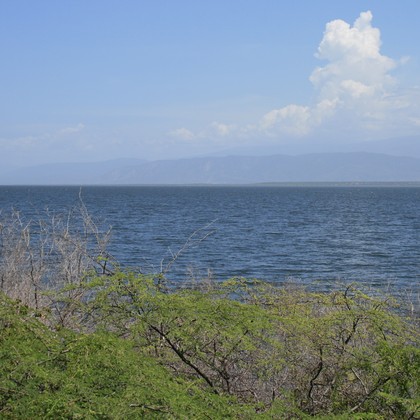
Where the bird is most at home, classified by the vegetation types of the Caribbean.



Range and movements
Scattered through the Bahamas and the Turks and Caicos Islands, Cuba, Jamaica, Hispaniola (Haiti and the Dominican Republic), Puerto Rico and the Virgin Islands, and in the Lesser Antilles south to Grenada, including Anguilla, Sint Maarten, Saint Kitts, Antigua, Guadeloupe and Barbados. Rare in the Cayman Islands, the ABC islands and San Andrés. On many islands local and variable in numbers. Outside the region in North America, from Canada to Mexico, and locally in Central America; introduced and feral in Europe.
- Resident
- dark = core range, pale = thinly spread
How and when to look
In Puerto Rico, Cuba, Hispaniola and Sint Maarten at ponds, sewage ponds and lagoons with vegetated margins, where the birds often swim among other ducks. In the breeding season displaying males with puffed-out breasts and upright tails can be seen.
Conservation status
Not threatened globally. The West Indian population is small and local on many islands; wetland loss and pollution and hunting are the main threats.
Scientific name
Oxyura jamaicensis | (Gmelin, 1789)
Gmelin described the species in 1789 as Anas jamaicensis; because it was later moved to another genus, the author and year stand in brackets. The genus Oxyura was introduced in 1828 by Bonaparte. Oxyura is Greek, from oxys 'sharp' and oura 'tail', after the stiff tail feathers the bird can hold upright. jamaicensis means 'from Jamaica', the island the first described specimen came from. The specimen the first description was based on came from Jamaica.