All species › Passerines › Vireos › Rufous-browed Peppershrike
Rufous-browed Peppershrike | Cyclarhis gujanensis
Roodbrauwpeperklauwier | Vireón ceja rufa
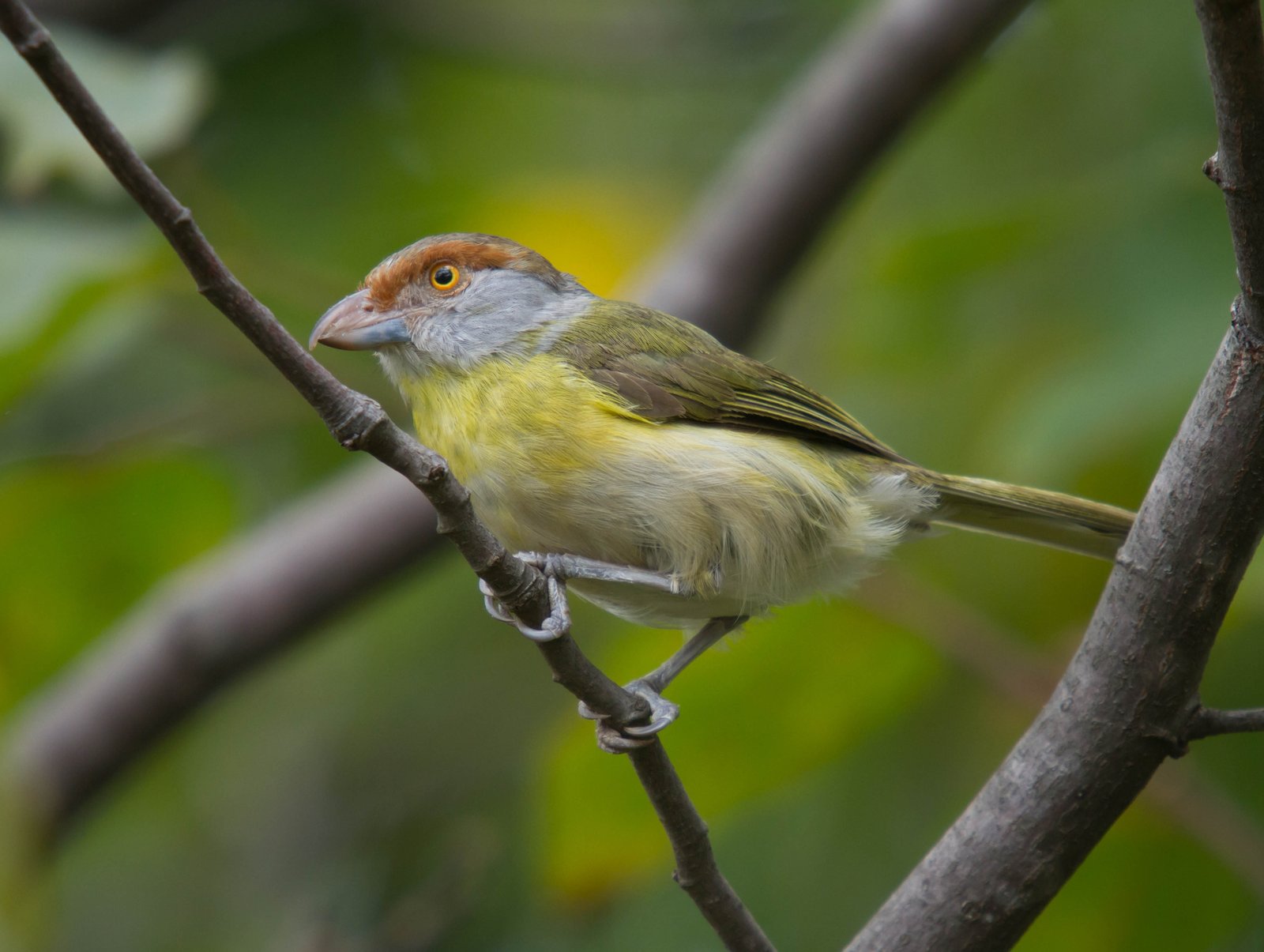
The Rufous-browed Peppershrike is a stocky, large-headed vireo with a heavy, shrike-like bill. It ranges widely from Mexico to Argentina and in the Caribbean reaches only Trinidad, where it is a common resident. It often sits still and hidden in foliage for long periods and is heard far more often than seen.
Voice
The song is a loud, varied whistled phrase of four to seven notes, repeated many times before the bird switches to another phrase, such as chew-wee-chew-wee-wee. The call is a rasping, descending chairr. It sings all year and even in the heat of the day.
Recording: Juan Freile — CC BY-NC-SA 4.0 · converted to mono · xeno-canto
Identification
14–16 cm, compact, with a large head and a thick, hooked bill that is pale pink to grey. Head grey with a broad rufous eyebrow from the bill to behind the eye; crown tinged brown. Upperparts bright olive-green. Throat and breast yellow, merging into a whitish to pale grey belly. Iris orange. The sexes are alike; juveniles are duller, with a less distinct eyebrow.
Confusion species
The combination of grey head, rufous eyebrow and heavy bill is shared by no other species in the region. Red-eyed Vireo Vireo olivaceus is slimmer, with a thin bill, a black-bordered white eyebrow, a red iris and white underparts. Golden-fronted Greenlet Pachysylvia aurantiifrons is much smaller, with a thin bill and dull yellowish underparts.
Habitat
Forest edge, secondary growth, dry and semi-evergreen forest, cacao and citrus plantations, coastal woodland and gardens and parks with tall trees, from sea level into the hills of the Northern Range. It searches the canopy slowly and methodically for caterpillars and other large insects, which it handles with its heavy bill. The nest is a shallow, thin cup slung in a horizontal fork.
Where the bird is most at home, classified by the vegetation types of the Caribbean.






Range and movements
In the region only in Trinidad, where it occurs across the island wherever there are trees. It is absent from Tobago. Outside the region from Mexico through Central America and most of South America to Argentina and Uruguay; Trinidad birds belong to the subspecies flavipectus, which also lives in north-eastern Venezuela.
- Resident
- dark = core range, pale = thinly spread
How and when to look
Following the song is the best approach: a bird repeating the same whistled phrase from one spot is usually this species. Patience is then needed, as it moves little. Forest edges in the Northern Range and the Arima Valley are good places, as are older gardens with large trees.
Conservation status
Not threatened. The species has a very large range, is common in Trinidad and tolerates landscapes heavily altered by people, such as plantations and gardens.
Scientific name
Cyclarhis gujanensis | (Gmelin, 1789)
Gmelin described the species in 1789 as Tanagra gujanensis; because it was later moved to another genus, the author and year stand in brackets. The genus Cyclarhis was introduced in 1824 by Swainson. Cyclarhis is Greek, from kuklos 'circle' and rhis, rhinos 'nostrils', after the round nostrils. gujanensis means 'from Guiana', after the type locality in French Guiana. The specimen the first description was based on came from French Guiana.