All species › Passerines › Ovenbirds and woodcreepers › Stripe-breasted Spinetail
Stripe-breasted Spinetail | Synallaxis cinnamomea
Kaneelstekelstaart | Pijuí pechiestriado
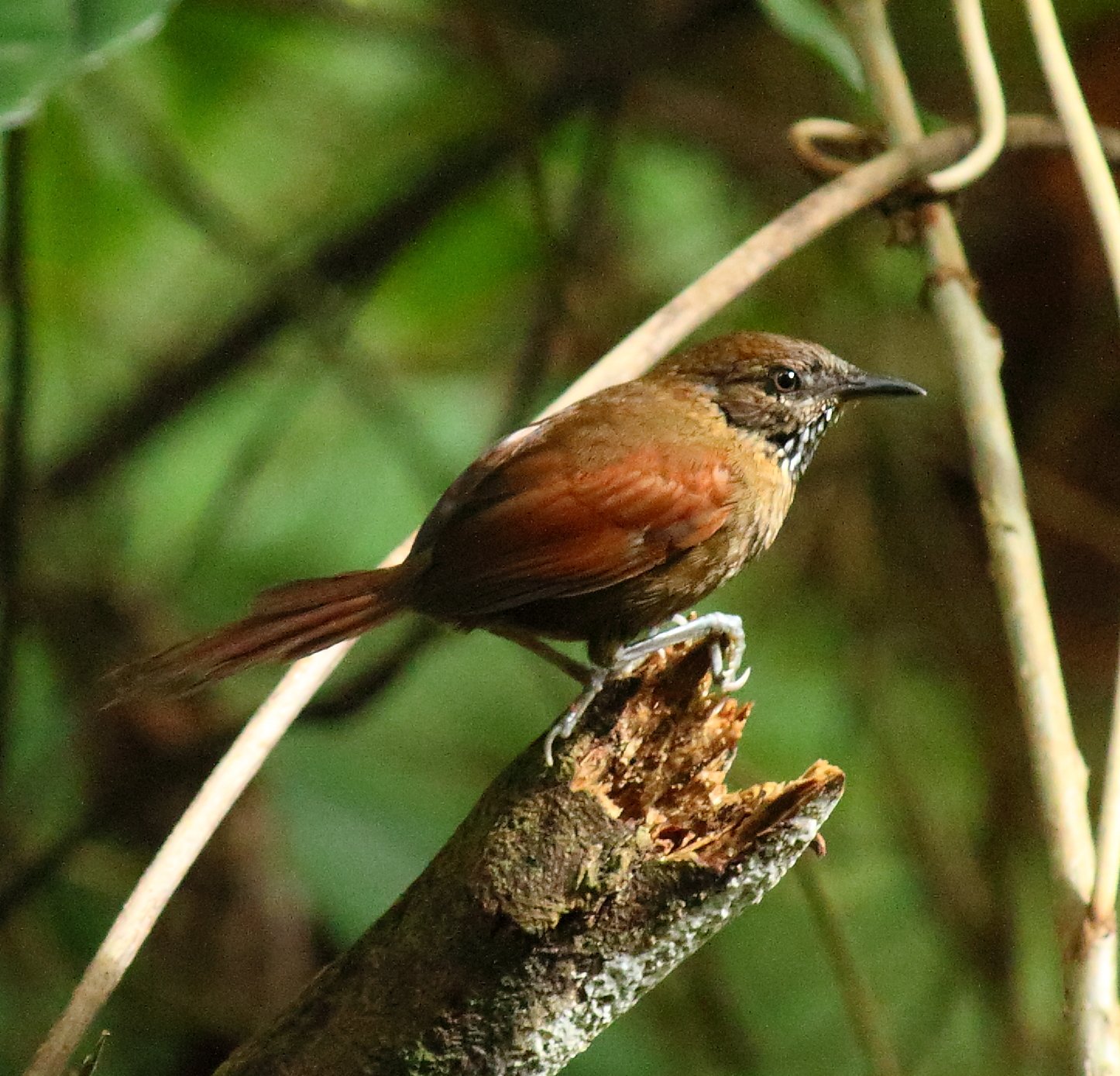
The Stripe-breasted Spinetail is a secretive spinetail of forest undergrowth, often foraging on or just above the ground. Trinidad and Tobago each have their own subspecies: carri on Trinidad and the paler terrestris on Tobago, where the species is most common.
Voice
The song is a nasal, sharp chik-kweek or churt-wert, repeated for long periods. Calls are a soft, whining peeeur and a short chew.
Recording: Francisco contreras — CC BY-NC-SA 4.0 · converted to mono · xeno-canto
Identification
14–16 cm, with a long, graduated tail with spiny feather tips. The upperparts are warm brown, the wings rufous. The throat is streaked black and white. Trinidad's carri is dark brown above, without a supercilium, with a mostly black throat and dull olive-brown underparts with faint streaks. Tobago's terrestris is the palest subspecies, olive-brown above, with largely unstreaked underparts. The sexes are alike.
Confusion species
Pale-breasted Spinetail Synallaxis albescens has a rufous crown, a pale breast and belly and a grey-brown tail, and lives in open grassland. Yellow-chinned Spinetail Certhiaxis cinnamomeus is bright rufous above and white below and lives in marshes.
Habitat
Dense undergrowth in humid and semi-evergreen forest, forest edges, secondary growth and thickets in hills and mountains, on Tobago also in drier forest and scrub close to the coast. It forages in pairs low in vegetation and on the ground among the leaf litter for insects and other invertebrates. The nest is a globe of twigs and leaves with an entrance tunnel on top, on sloping ground or in a shrub up to 3 m high.
Where the bird is most at home, classified by the vegetation types of the Caribbean.



Range and movements
In the region only on Trinidad and Tobago. Fairly common in forest and thickets across Tobago; scarcer on Trinidad and mainly in the Northern Range. Outside the region in northern Colombia and Venezuela.
- Resident
- dark = core range, pale = thinly spread
How and when to look
Found on Tobago, for example along trails in the Main Ridge forest. It helps to listen for the nasal song and then search the undergrowth patiently; the birds sometimes show as they walk across the trail or search the leaf litter.
Conservation status
Not threatened. The species has a limited range, but is locally common within it and also occurs in secondary growth.
Scientific name
Synallaxis cinnamomea | de Lafresnaye, 1843
De Lafresnaye described the species in 1843 as Synnalaxis cinnamomeus; because it was later moved to another genus, the author and year stand in brackets. The genus Synallaxis was introduced in 1818 by Vieillot. Synallaxis is Greek, from sunallaxis 'exchange'; why Vieillot chose the name is unclear. cinnamomea is Latin for 'cinnamon-coloured', after the warm brown plumage. The specimen the first description was based on came from Bogotá, Colombia.