All species › Gamebirds › Guans, chachalacas and curassows › Rufous-vented Chachalaca
Rufous-vented Chachalaca | Ortalis ruficauda
Roodbuikchachalaca | Guacharaca culirroja
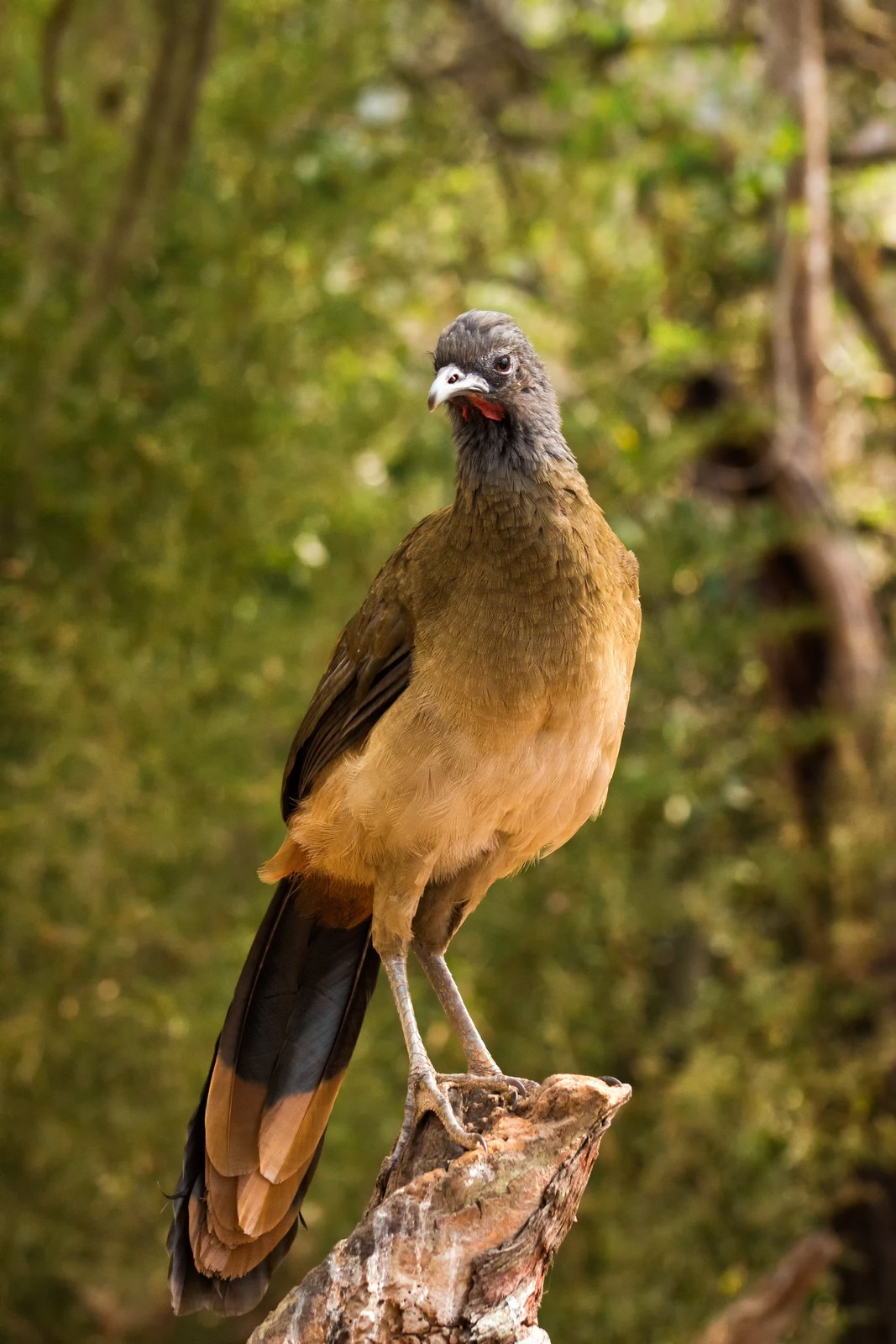
The Rufous-vented Chachalaca, called cocrico on Tobago, is a slim, brown tree fowl with a long tail. It is common on Tobago and, together with the Scarlet Ibis, is the national bird of Trinidad and Tobago; both appear on the country's coat of arms. At dawn the loud choruses of pairs and small groups fill the woods and gardens of the island.
Voice
Pairs and groups call in a loud, grating chorus, mainly at dawn and in the evening: the male a low ka-ka-rooki-rooki-ka, answered by the female in a higher voice. Soft clucking notes while feeding.
Recording: Francisco contreras — CC BY-NC-SA 4.0 · shortened to the first 60 s, mono · xeno-canto
Identification
53–58 cm, slim, with a small head, a thin neck and a long, broad tail. The upperparts are dark olive-brown, head and neck greyer. There is bare blue-grey skin around the eye and a bare reddish strip on the throat, visible only at close range. The underparts are paler greyish-brown, the undertail coverts rufous. The dark tail has broad rufous tips. Bill and legs are grey. The sexes are alike; the male is slightly larger and heavier.
Confusion species
There is nothing on Tobago it can be confused with. No chachalaca lives wild in Trinidad; Trinidad Piping Guan Pipile pipile there is black with white wing patches and a blue throat wattle.
Habitat
Dry and semi-evergreen forest, secondary forest, forest edge and scrub, farmland with trees, and villages and gardens. It lives in trees and bushes, usually a few metres above the ground, and walks carefully along the branches; when alarmed it disappears into dense thickets. It eats fruit, including mango, berries, leaves and seeds. The clutch is two to four eggs.
Where the bird is most at home, classified by the vegetation types of the Caribbean.





Range and movements
In the region on Tobago, where it occurs throughout the island, and on Bequia and Union Island in the Grenadines (Saint Vincent and the Grenadines), where it is scarce and may have been introduced by people. In Trinidad only in captivity. Outside the region in north-eastern Colombia and northern Venezuela, including Margarita Island.
- Resident
- dark = core range, pale = thinly spread
How and when to look
On Tobago almost anywhere with trees, including gardens and hotel grounds; the dawn chorus announces the birds before sunrise. In fruiting trees groups can be watched at close range, also along the roads through the wooded interior.
Conservation status
Not threatened. Common and widespread on Tobago. Little is known about the small populations on Bequia and Union Island.
Scientific name
Ortalis ruficauda | Jardine, 1847
Jardine described the species in 1847 and placed it straight away in the genus where it still stands. The genus Ortalis was introduced in 1786 by Merrem. Ortalis is Greek for 'chick, young hen'. ruficauda is Latin, from rufus 'rufous' and cauda 'tail', after the rufous tail tips. The specimen the first description was based on came from Tobago.