All species › Passerines › Tyrant flycatchers › Southern Beardless Tyrannulet
Southern Beardless Tyrannulet | Camptostoma obsoletum
Geelkeelvliegenpikker | Mosquerito silbador
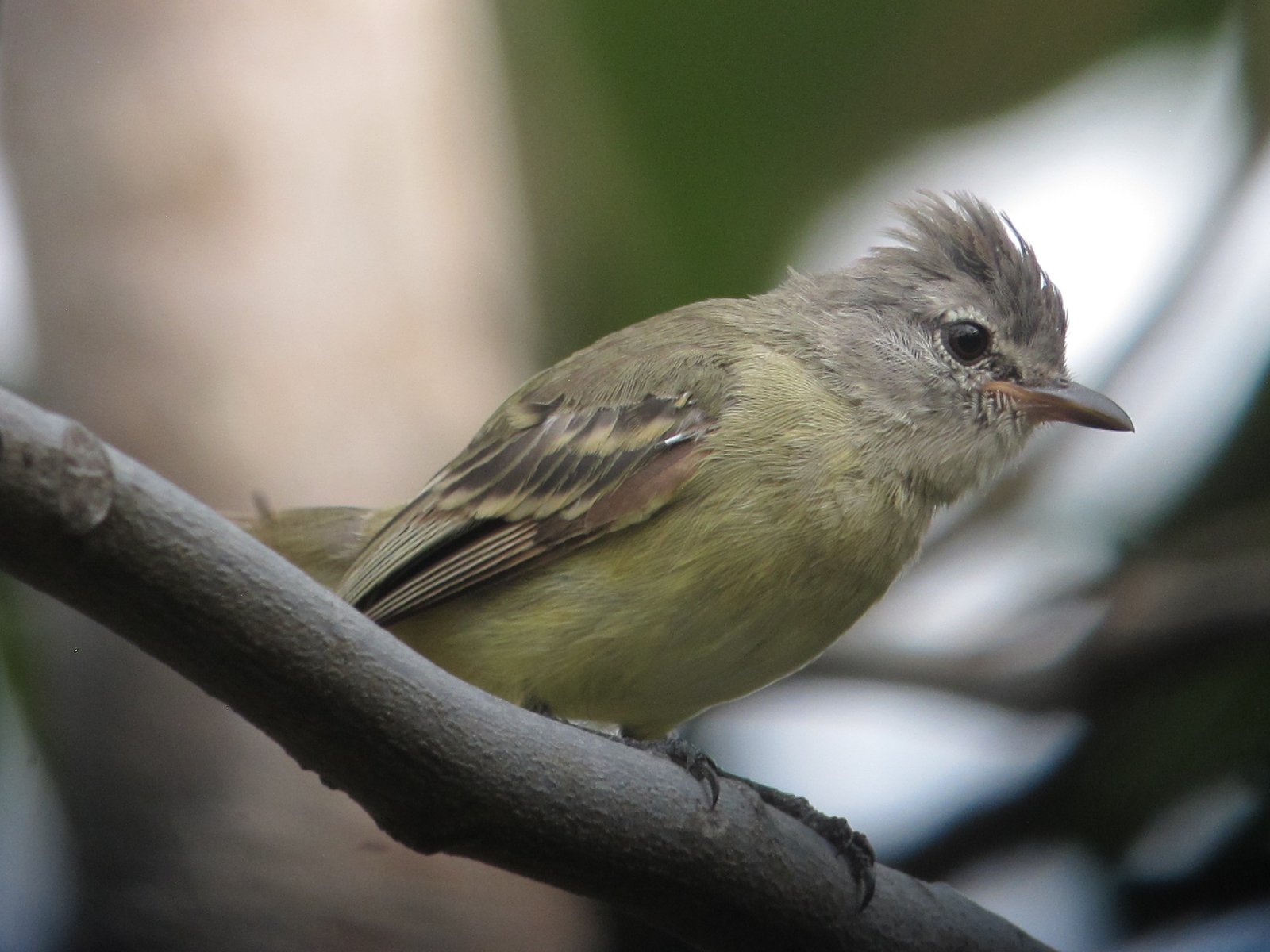
The Southern Beardless Tyrannulet is one of the smallest tyrant flycatchers in the region, a grey-olive bird that behaves more like a warbler or vireo than a flycatcher. It is usually noticed by its high whistled call, given with the short crest raised. Birds in Trinidad and Tobago belong to the subspecies pusillum, which also occurs along the Caribbean coast of Colombia and Venezuela.
Voice
The best-known call is a high, thin whistle, rising and falling slightly, fleeeer, sometimes followed by short notes: fleeee-pit-pit. The song is a series of clear whistles descending in pitch. It calls throughout the day, even in the midday heat.
Recording: JAYRSON ARAUJO DE OLIVEIRA — CC BY-NC-SA 4.0 · converted to mono · xeno-canto
Identification
9.5–10.5 cm, small and compact, with a short bushy crest that is often raised, a short tail that is frequently cocked and a short, slightly curved bill with a pale base to the lower mandible. Crown and nape are greyish, the upperparts grey-olive. A pale supercilium and a broken pale eye-ring mark the face. Two broad cinnamon to buffy wing bars stand out. The throat is greyish white, the rest of the underparts pale yellow. The sexes are alike; juveniles are paler yellow below with paler wing bars.
Confusion species
Mouse-colored Tyrannulet Nesotriccus murinus is larger, longer-tailed and browner, with a dingy white belly, a longer bill and dull brownish wing bars. Northern Scrub Flycatcher Sublegatus arenarum is also larger, with a short all-black bill, a grey breast sharply contrasting with the yellow belly and no raised crest. Elaenias are clearly larger and sound different.
Habitat
Open and semi-open country with trees and shrubs: dry scrub, forest edges, secondary forest, mangrove edges, yards, gardens and parks with trees. It gleans small insects, spiders and small berries from leaves and twigs in the canopy and shrubs, sometimes with a brief hover. The nest is a globe of plant material and spider web with a side entrance.
Where the bird is most at home, classified by the vegetation types of the Caribbean.





Range and movements
Within the region resident in Trinidad and Tobago, common in the lowlands of both islands. Outside the region from Costa Rica and Panama through much of South America to northern Argentina and Uruguay.
- Resident
- dark = core range, pale = thinly spread
How and when to look
Located by call in gardens, along forest edges and in dry scrub, on both Trinidad and Tobago. When calling it raises the crest and flicks the tail, which gives it away in a mixed group of small songbirds.
Conservation status
Not threatened. A common species that does well in man-altered landscapes such as gardens, yards and secondary growth.
Scientific name
Camptostoma obsoletum | (Temminck, 1824)
Temminck described the species in 1824 as Muscicapa obsoleta; because it was later moved to another genus, the author and year stand in brackets. The genus Camptostoma was introduced in 1857 by Sclater. Camptostoma is Greek, from kamptos 'bent' and stoma 'mouth', after the curved culmen. obsoletum is Latin for 'indistinct, worn', after the plain, dull greenish plumage. The specimen the first description was based on came from Curitiba, Paraná, Brazil.