All species › Passerines › Tyrant flycatchers › Forest Elaenia
Forest Elaenia | Myiopagis gaimardii
Boselenia | Fiofío selvático
The Forest Elaenia is a small, greenish tyrant flycatcher of the canopy that is noticed mainly by its sharp call. It sits inconspicuously in the upper storeys and looks more like a vireo or warbler than a typical elaenia. Trinidad has its own subspecies, trinitatis, which is larger and duller above than mainland birds.
Voice
A sharp, explosive two-syllabled call, pi-chweet, often repeated and the best clue to its presence. Also short, high chips.
Recording: JAYRSON ARAUJO DE OLIVEIRA — CC BY-NC-SA 4.0 · converted to mono · xeno-canto
Identification
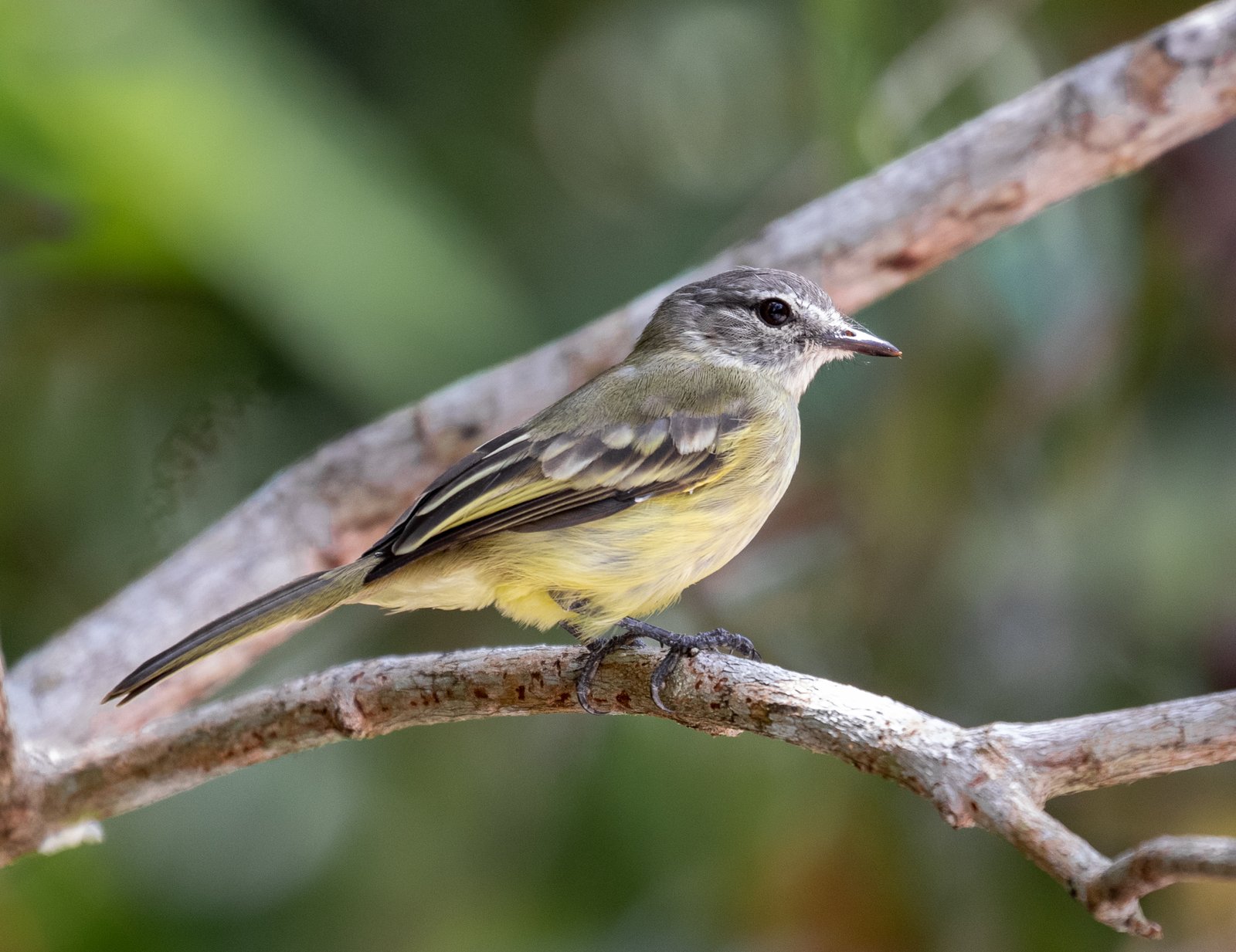
12–13 cm, slim, with a rounded, uncrested head and a short, narrow bill. The crown is dark grey-olive with a partly concealed white to pale yellow central stripe. A pale supercilium and a dark eye-line give the head a striped look. The upperparts are olive-green; the dark wings show two distinct yellowish wing bars and yellow edges to the flight feathers. The throat is greyish white, breast and belly pale yellow, the breast with faint olive streaking. The sexes are alike.
Confusion species
Yellow-bellied Elaenia Elaenia flavogaster is much larger, with an often parted crest, and lives in open country. Yellow-olive Flatbill Tolmomyias sulphurescens has a broad, flat bill, a grey head without a crown stripe and a pale eye. Southern Beardless Tyrannulet Camptostoma obsoletum is smaller and greyer, with cinnamon wing bars and a raised crest. Scrub Greenlet Hylophilus flavipes has a pale eye, a pinkish bill and no wing bars.
Habitat
The canopy and edges of humid lowland forest and tall secondary forest, also the edges of mangrove and swamp forest. Alone or in pairs, often joining mixed flocks. It gleans insects and spiders from leaves in the upper storeys and regularly eats berries.
Where the bird is most at home, classified by the vegetation types of the Caribbean.



Range and movements
Within the region only in Trinidad, where it is fairly common in forest and along mangrove edges; absent from Tobago. Elsewhere from eastern Panama through Colombia, Venezuela and the Guianas across the Amazon basin to Bolivia and Brazil.
- Resident
- dark = core range, pale = thinly spread
How and when to look
Found mostly by ear; on hearing the sharp two-note call, search high in the canopy. Mangrove edges and forest edges with a view into the crowns give the best chance of seeing it. Mixed flocks in the canopy are worth working through.
Conservation status
Not threatened. The species has a very large range and is not rare in Trinidad; loss of lowland forest and mangrove is a local threat.
Scientific name
Myiopagis gaimardii | (d'Orbigny, ACVMD, 1840)
D'Orbigny, ACVMD described the species in 1840 as Muscicapara Gaimardii; because it was later moved to another genus, the author and year stand in brackets. The genus Myiopagis was introduced in 1888 by Salvin & Godman. Myiopagis is Greek, from muia 'fly' and pagis 'trap, snare': 'fly-trap'. gaimardii honours the French naval surgeon and naturalist Joseph Paul Gaimard (1793–1858). The specimen the first description was based on came from Yuracarés, Bolivia.