All species › Passerines › Tyrant flycatchers › Jamaican Elaenia
Jamaican Elaenia | Myiopagis cotta
Jamaicaanse elenia | Fiofío jamaicano
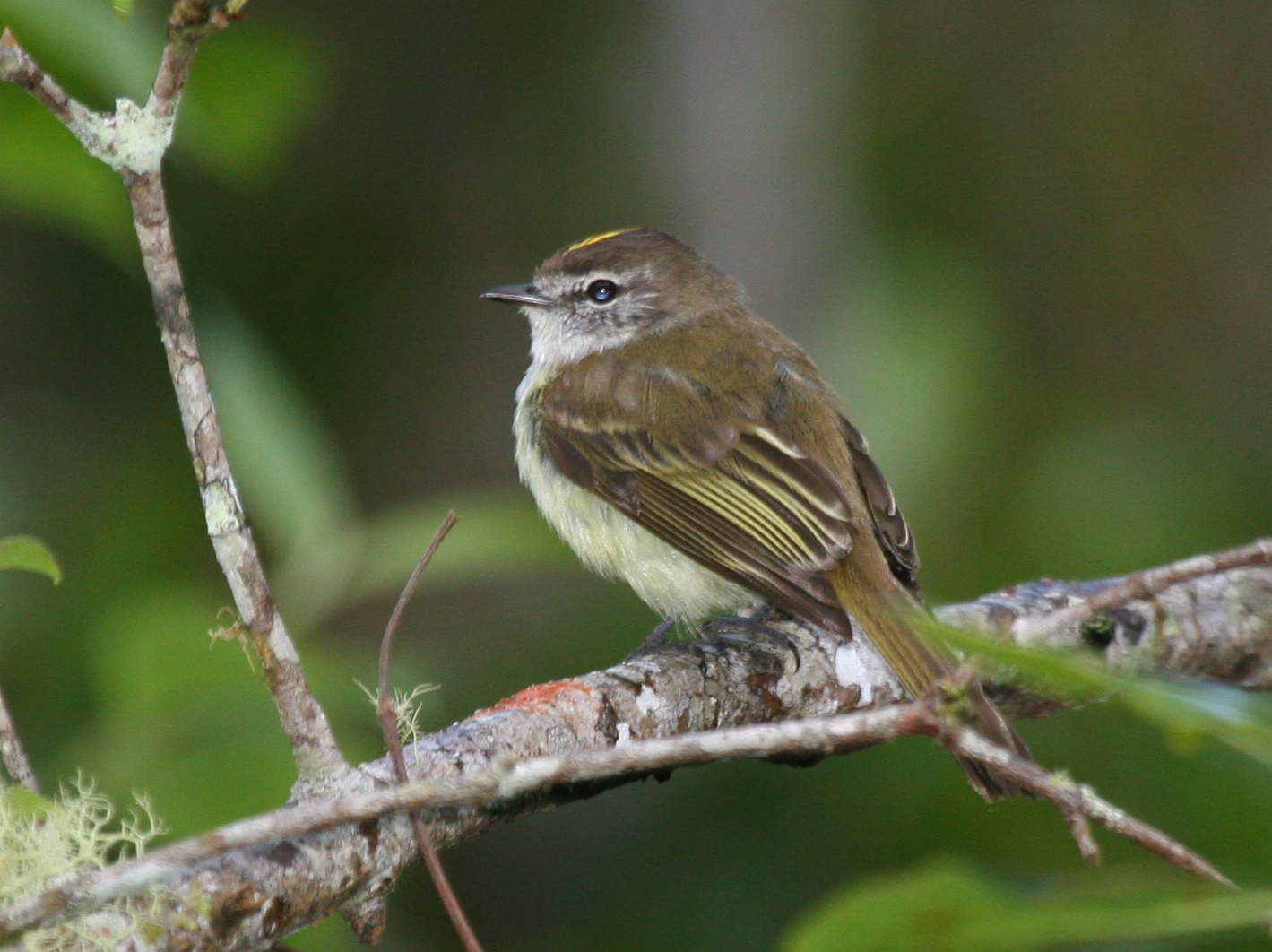
The Jamaican Elaenia is a small olive-green tyrant flycatcher found only in Jamaica. It lives in the humid forests of the middle elevations and limestone hills and is often overlooked because of its plain plumage and its habit of sitting quietly in the foliage. It belongs to the genus Myiopagis and is therefore not closely related to the Blue Mountain Elaenia, which shares the island.
Voice
High, rapid series of thin notes such as ti-si-si-sip. The call is high and thin and does not stand out strongly among other forest sounds.
Recording: Bobby Wilcox — CC BY-NC-SA 4.0 · converted to mono · xeno-canto
Identification
12–13 cm, small and slim, with a rounded head and a short, narrow bill. The upperparts are greenish olive, the head slightly darker, with elongated crown feathers largely hiding a bright orange-yellow crown patch. Wings and tail are dusky olive, the flight feathers edged yellow, but without distinct wing bars. The underparts are whitish to pale yellow, yellowest on the belly. The sexes are alike; juveniles lack the crown patch and are greyer below with a yellower belly.
Confusion species
Blue Mountain Elaenia Elaenia fallax is larger and browner olive, with two distinct white wing bars and a pale eye-ring. Jamaican Vireo Vireo modestus does have wing bars, a thicker bill and a pale eye. Jamaican Pewee Contopus pallidus is darker, perches upright on an exposed lookout and sallies out after insects.
Habitat
Humid and semi-evergreen forest at middle elevations, especially the limestone forest of the Cockpit Country and the forests of the Blue Mountains and John Crow Mountains, locally also in the lowlands and in heavily degraded former forest. It hunts insects from the understorey to the canopy, gleaning them from leaves or catching them in a short flight; it also eats fruit. The nest is a well-built cup of plant material hidden in foliage.
Where the bird is most at home, classified by the vegetation types of the Caribbean.




Range and movements
Endemic to Jamaica, scattered through the island's forested hills and mountains, most numerous in the Cockpit Country and the east. It occurs nowhere else.
- Resident
- dark = core range, pale = thinly spread
How and when to look
Well-known sites are the John Crow Mountains along the Ecclesdown Road, the Blue Mountains at Hardwar Gap and the edges of the Cockpit Country. The high call is the best lead; then patient searching of the foliage for a small bird without wing bars.
Conservation status
Not threatened, but numbers are declining through forest loss. The species depends on the remaining forest in hills and mountains.
Scientific name
Myiopagis cotta | (Gosse, 1849)
Gosse described the species in 1849 as Elania cotta; because it was later moved to another genus, the author and year stand in brackets. The genus Myiopagis was introduced in 1888 by Salvin & Godman. Myiopagis is Greek, from muia 'fly' and pagis 'trap, snare': 'fly-trap'. cotta probably refers to Cotta Wood near Grand Vale Mountain in western Jamaica, where Gosse collected the type specimen. The specimen the first description was based on came from Jamaica.