All species › Pelicans, herons and ibises › Herons and bitterns › Striated Heron
Striated Heron | Butorides striata
Mangrovereiger | Garcita estriada
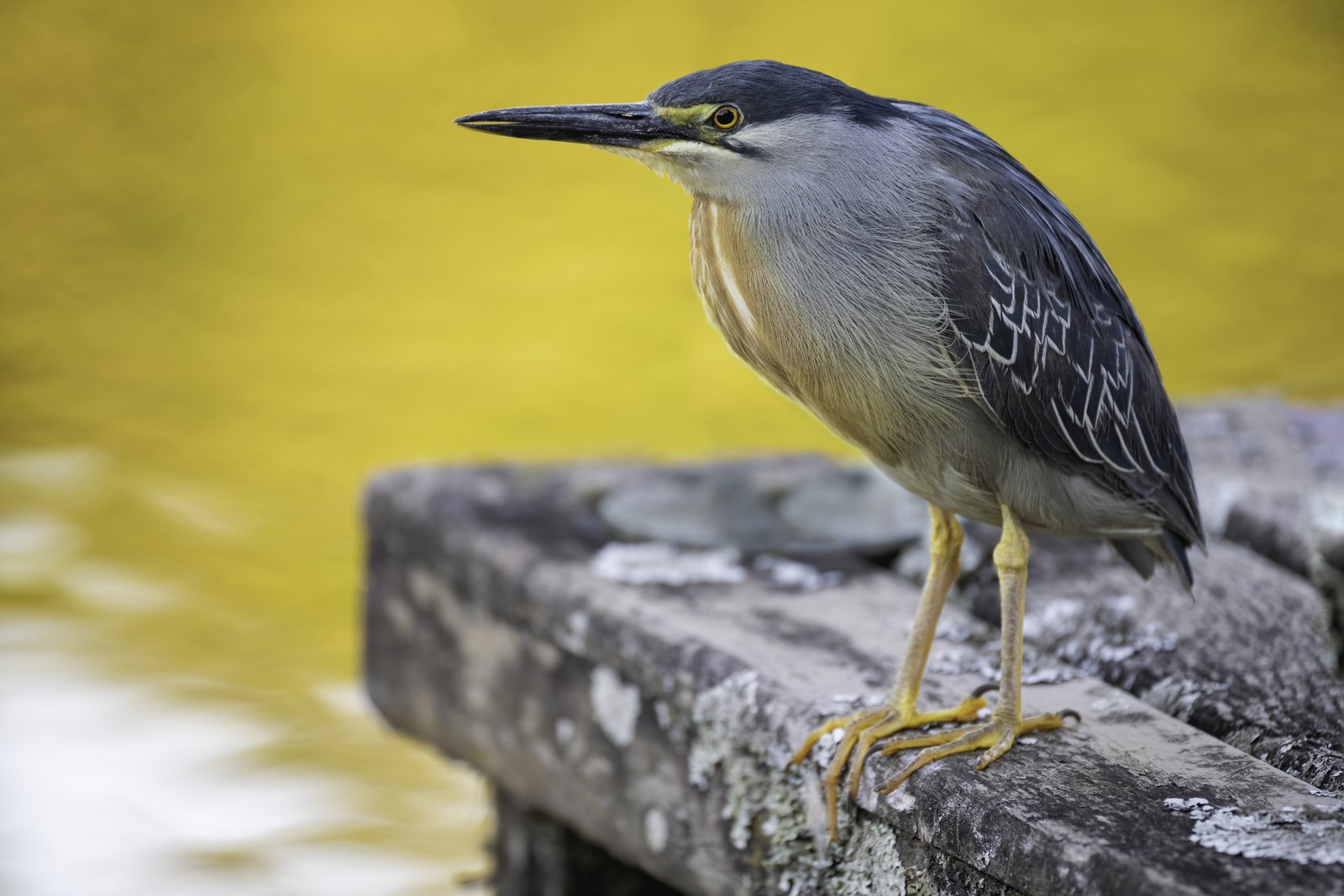
The Striated Heron is the South American and Old World counterpart of Green Heron and replaces it on Trinidad. On Tobago, by contrast, Green Heron predominates, with some Striated Herons and intermediates as well. It is a small, stocky heron that hunts quietly and patiently from branches and roots low over the water. Some authors merge the two species under one name.
Voice
On take-off an explosive, sharp kyow or skeow; also softer, ticking kuk-kuk calls.
Recording: José María Loaiza B. — CC BY-NC-SA 4.0 · converted to mono · xeno-canto
Identification
35–48 cm, stocky, with a short neck, a long, dagger-shaped dark bill and short yellow to orange legs. The crown is black, with a short crest raised when excited; a dark line runs from the bill below the eye. Back and wings are grey-green to blue-grey, the wing coverts pale-edged. The sides of the head and neck are grey to brownish grey, with a white stripe down the front of the throat and neck; the underparts are grey. Juveniles are browner above, with pale spots on the wing coverts, and heavily streaked below. The sexes are nearly alike.
Confusion species
Green Heron Butorides virescens is the same size and build but has a chestnut to purplish-brown neck, clearly rufous especially on the hindneck; in Striated Heron the hindneck is grey to brownish grey. Intermediates with a partly rufous neck occur, especially on Tobago, and cannot be named with certainty in the field. Juveniles of the two are barely separable. Least Bittern Botaurus exilis is smaller, with large buff panels on the wings.
Habitat
Mangroves, tidal creeks, river mouths, riverbanks, ponds and marshes with overhanging vegetation. It eats mainly small fish, plus crustaceans, frogs and insects, caught from a branch, root or stone just above the water. At times it places bait, such as bread or an insect, on the water to attract fish. It nests singly or in loose groups, with a twig nest in a tree or shrub, usually over or near water.
Where the bird is most at home, classified by the vegetation types of the Caribbean.





Range and movements
In the region almost confined to Trinidad and Tobago. On Trinidad it is the usual Butorides heron, along the coast and inland; on Tobago it is scarcer than Green Heron. Reports from other islands mostly concern Green Herons recorded as Butorides striata under the former, merged species concept, or are unconfirmed. Outside the region from Panama through South America to Argentina, and further in Africa, Asia and Australia.
- Resident
- dark = core range, pale = thinly spread
How and when to look
Along mangrove channels, as in the Caroni Swamp, and at ponds with overhanging branches. The bird often sits motionless low over the water and is usually noticed only when it flies off calling. On Tobago a good view of the hindneck is needed before a name can be given.
Conservation status
Not threatened. Very widespread; in the region locally affected by mangrove loss.
Scientific name
Butorides striata | (Linnaeus, 1758)
Linnaeus described the species in 1758 as Ardea striata; because it was later moved to another genus, the author and year stand in brackets. The genus Butorides was introduced in 1852 by Blyth. Butorides combines Butor, the genus Thomas Forster introduced for the bitterns in 1827, with Ancient Greek -oides 'resembling'. striata is Latin for 'striated', after the streaking of the plumage. The specimen the first description was based on came from Suriname.