All species › Owls › Typical owls › Stygian Owl
Stygian Owl | Asio stygius
Grote ransuil | Búho cara oscura
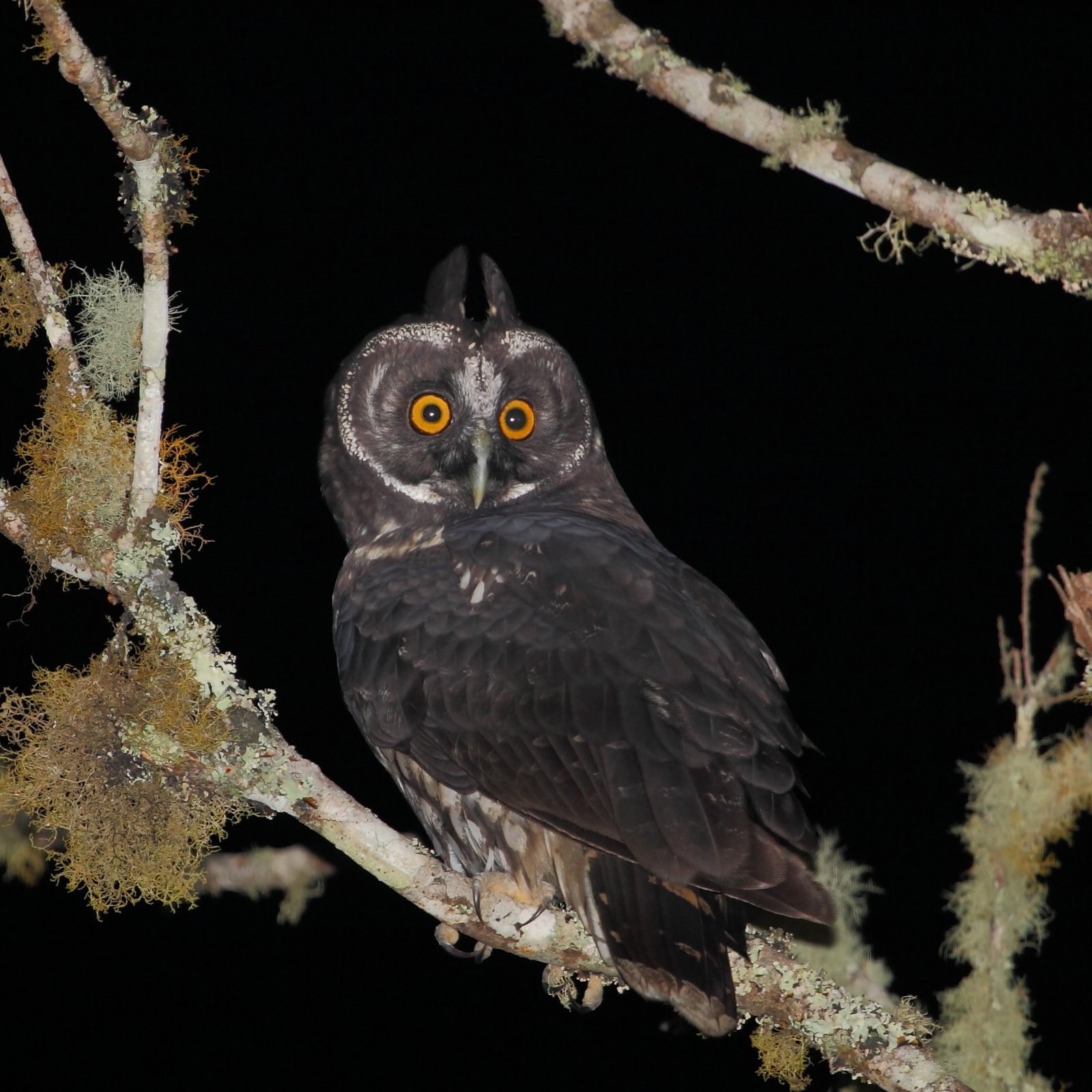
The Stygian Owl is a large, dark Asio owl with long ear tufts, found from Mexico to Argentina and in the Caribbean in Cuba and Hispaniola. It is strictly nocturnal and catches mainly birds at their roosts. In Cuba it is called siguapa; on both islands folk belief regards it as a bringer of bad luck.
Voice
The male gives a single deep, emphatic hoo or whoo at intervals of several seconds. The female answers with a higher, cat-like nyeh. At the nest also short, screamed calls.
Recording: Marcelo J Feliti — CC BY-NC-SA 4.0 · shortened to the first 60 s, mono · xeno-canto
Identification
38–46 cm, large and very dark, with long ear tufts set close together. The facial disc is blackish with a pale rim and a whitish forehead; the eyes are yellow. The upperparts are dark blackish-brown with pale spots. The underparts are buff to dirty white with heavy dark streaks and cross-bars that together form a cross-shaped pattern. The bill is blue-black and the toes are feathered. Females are larger than males.
Confusion species
Short-eared Owl Asio flammeus is paler buff, with a pale face and short, usually invisible ear tufts, and hunts over open land. The barn owls Tyto have dark eyes in a pale heart-shaped disc and no ear tufts. Jamaican Owl Asio grammicus is similar in build but lives only in Jamaica.
Habitat
Dense forest of various types: dry and semi-evergreen broadleaf forest, limestone forest, montane rainforest and pine forest, from the lowlands into the mountains, locally also wooded parks. It hunts mainly birds surprised at their roosts, and also bats, small mammals, frogs and insects. It nests in old nests of other birds, in tree cavities or on the ground.
Where the bird is most at home, classified by the vegetation types of the Caribbean.





Range and movements
Resident in Cuba with Isla de la Juventud (subspecies siguapa) and on Hispaniola with Gonâve (subspecies noctipetens). Rare to locally fairly common on both islands. Outside the region from Mexico through Central and South America to northern Argentina.
- Resident
- dark = core range, pale = thinly spread
How and when to look
Best with a local guide who knows regular roost sites, for example on the Zapata Peninsula. By day the owl sits upright and hidden in a dense tree close to the trunk. At night the deep call in forest is the best lead.
Conservation status
Not threatened as a species, but numbers are thought to be declining. In Cuba and Hispaniola the birds are persecuted and killed out of superstition; deforestation, especially in Haiti, reduces habitat.
Scientific name
Asio stygius | (Wagler, 1832)
Wagler described the species in 1832 as Nyctalops stygius; because it was later moved to another genus, the author and year stand in brackets. The genus Asio was introduced in 1760 by Brisson. Asio is the Latin name of a horned or eared owl. stygius is Latin for 'of the Styx', the river of the underworld: 'gloomy', after the very dark plumage. The specimen the first description was based on came from Minas Gerais, Brazil.