All species › Woodpeckers and allies › Woodpeckers › West Indian Woodpecker
West Indian Woodpecker | Melanerpes superciliaris
West-Indische specht | Carpintero jabado
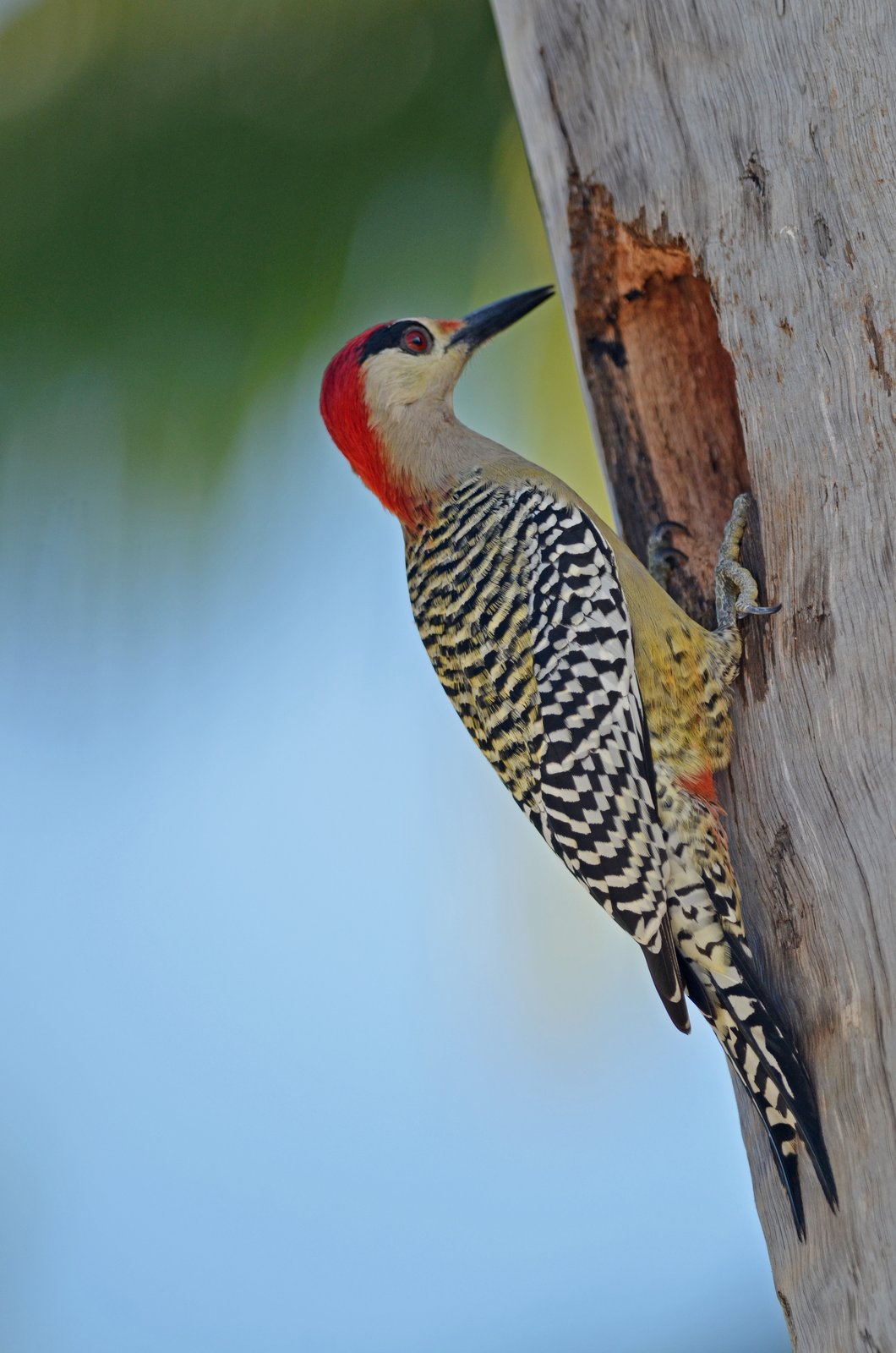
The West Indian Woodpecker, called carpintero jabado in Cuba, is a large Melanerpes woodpecker of Cuba, Grand Cayman and two islands in the Bahamas. It is tied to landscapes with royal palms, in which it often excavates its nest, and gives itself away with a loud rolling call. Birds on the smaller islands are smaller than those in Cuba; five subspecies are recognised.
Voice
A loud rolling kwirr or churr with a slightly screaming quality, and a repeated kra-kra-kra. The drum is rapid.
Recording: FREDERIC Lionel — CC BY-NC-SA 4.0 · shortened to the first 60 s, mono · xeno-canto
Identification
27–32 cm, with a long, strong bill. Upperparts and wings are black with dense white bars; the tail is mostly black, with white bars on the outer feathers. Face and underparts are pale grey to grey-brown, with a red-orange belly patch. The male has a red crown, hindcrown and nape; the female has a pale crown and only the nape red. In the Cuban form a black stripe runs above and behind the eye.
Confusion species
Cuban Green Woodpecker Xiphidiopicus percussus is smaller, green and yellow above and slightly crested. Northern Flicker Colaptes auratus (Cuba and Grand Cayman) and Fernandina's Flicker Colaptes fernandinae are brown with black barring, feed much on the ground and lack the black-and-white barred back. Yellow-bellied Sapsucker Sphyrapicus varius, a winter visitor, is smaller and has a white wing stripe. On Abaco, Hairy Woodpecker Leuconotopicus villosus is smaller, with a white back stripe and a black-and-white striped head.
Habitat
Forest and wooded farmland from sea level to about 1000 m, especially where royal palms grow: dry and semi-evergreen forest, limestone forest, mangroves, pastures with palms, plantations and gardens in villages and towns. On the smaller islands also in dry limestone scrub forest. It eats insects and fruit. It breeds from February to August, sometimes raising two broods. Both adults excavate the nest hole in a dead palm or utility pole, 5–30 m up; the clutch is five or six eggs.
Where the bird is most at home, classified by the vegetation types of the Caribbean.







Range and movements
Resident in Cuba and its offshore cays (Melanerpes superciliaris superciliaris), the Isla de la Juventud (Melanerpes superciliaris murceus), Grand Cayman (Melanerpes superciliaris caymanensis) and, in the Bahamas, Great and Little Abaco (Melanerpes superciliaris blakei) and San Salvador (Melanerpes superciliaris nyeanus). The Grand Bahama population is apparently extinct. There is no established population on Cayman Brac, Little Cayman or the other Bahamian islands. The species does not occur outside the Caribbean.
- Resident
- dark = core range, pale = thinly spread
How and when to look
In Cuba in almost any landscape with royal palms, including roadsides and villages; on Grand Cayman also in gardens. The loud call carries far. A dead royal palm with several round holes is often a nest site.
Conservation status
Not threatened, but BirdLife lists the population as decreasing. The small island populations in the Bahamas are vulnerable to habitat loss; on Grand Bahama the species has already disappeared.
Scientific name
Melanerpes superciliaris | (Temminck, 1827)
Temminck described the species in 1827 as Picus superciliaris; because it was later moved to another genus, the author and year stand in brackets. The genus Melanerpes was introduced in 1832 by Swainson. Melanerpes is Greek, from melas 'black' and herpēs 'creeper': 'black creeper'. superciliaris is Latin for 'eyebrowed', from supercilium, after the black stripe around the eye. The specimen the first description was based on came from Cuba.