All species › Parrots › Cockatoos › White Cockatoo
White Cockatoo | Cacatua alba
Witte kaketoe | Cacatúa blanca
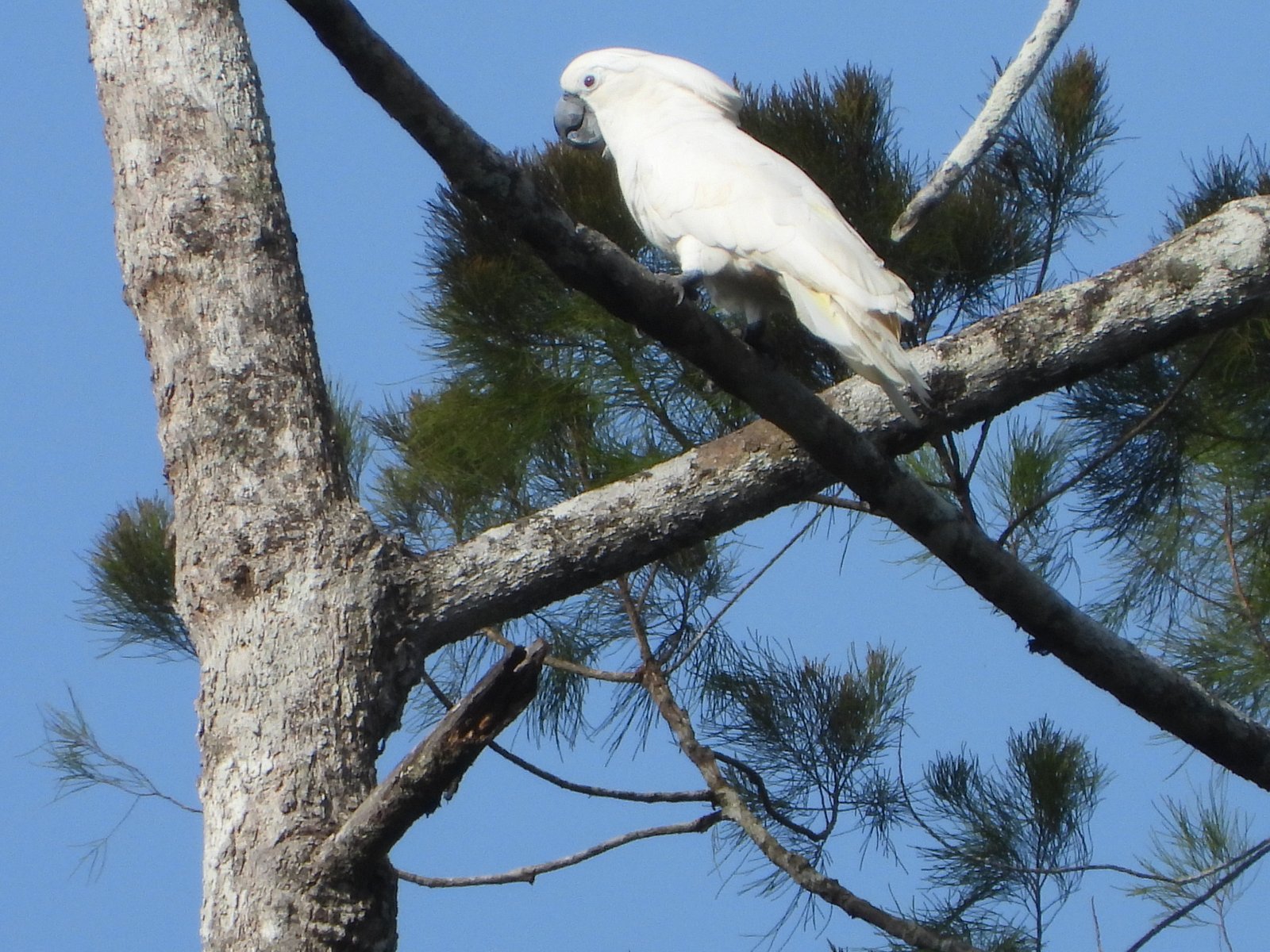
The White Cockatoo is a large, all-white cockatoo from the North Moluccas in Indonesia, known in the trade as Umbrella Cockatoo. Puerto Rico holds a small, local population that arose from escaped or released cage birds and also breeds there. In its native range the species is threatened by trapping for the trade and by forest loss.
Voice
Loud, grating screeches, especially in flight and at the roost, and a repeated nasal kraa-ek. When excited the bird also clicks its bill and taps wood against branches.
Recording: dbeadle — CC BY-NC 4.0 · Converted to mp3, mono, full length · iNaturalist
Identification
46 cm, bulky, with a short, broad tail. The plumage is entirely white; the underside of the wings and tail has a pale yellow wash that shows in flight. The broad, rounded crest lies flat when at rest and is raised into a semicircle. Around the eye is a bare, pale blue ring. The heavy bill and the legs are dark grey to black. The male has a dark brown to black iris and a slightly larger head and bill; in the adult female the iris is reddish-brown. Flies with deep beats of broad, rounded wings, alternating with short glides.
Confusion species
There are no other white cockatoos in this guide, but escaped birds of related species have also been reported in Puerto Rico and Guadeloupe. Salmon-crested Cockatoo Cacatua moluccensis is larger and tinged salmon-pink, with a crest that is orange-pink inside. Sulphur-crested Cockatoo Cacatua galerita has a narrow, forward-curling yellow crest. Other large white birds in the region, such as egrets, differ completely in shape and flight.
Habitat
In Puerto Rico mainly in urban and suburban areas with large trees, parks and gardens, and in adjacent secondary woodland in the moist lowland zone. It eats fruit, seeds and nuts from trees and nests in holes in large trees. In the Moluccas it lives in primary and secondary lowland forest up to about 900 m, at forest edges and along rivers, and also in mangroves and coconut plantations.
Where the bird is most at home, classified by the vegetation types of the Caribbean.



Range and movements
Established in Puerto Rico, where a small, stable population of about two to fifteen birds lives in the adjacent municipalities of Bayamón and Guaynabo in the San Juan metropolitan area; breeding has been confirmed there. A few escaped birds have been reported on Guadeloupe. Native only to Halmahera, Bacan, Ternate, Tidore, Kasiruta and Mandioli in the North Moluccas; an introduced population breeds in Taiwan.
- Resident
- dark = core range, pale = thinly spread
How and when to look
The Puerto Rican birds are best looked for in residential districts and parks in Bayamón and Guaynabo, early in the morning or late in the afternoon, when they fly calling between feeding trees and roost. The white birds stand out in the treetops from far away.
Conservation status
Globally Endangered (EN), through trapping for the cage-bird trade and the clearance of lowland forest in the North Moluccas. In the Caribbean an alien; the Puerto Rican population is small and remains confined to a small area.
Scientific name
Cacatua alba | (Müller, 1776)
Müller described the species in 1776 as Psittacus albus; because it was later moved to another genus, the author and year stand in brackets. The genus Cacatua was introduced in 1817 by Vieillot. Cacatua comes from Malay kakatua, the name for these parrots, which also gave 'cockatoo'. alba is Latin for 'white', after the all-white plumage. The specimen the first description was based on came from the Moluccas.