All species › Birds of prey › Hawks, eagles and kites › White Hawk
White Hawk | Pseudastur albicollis
Grote bonte buizerd | Aguililla blanca
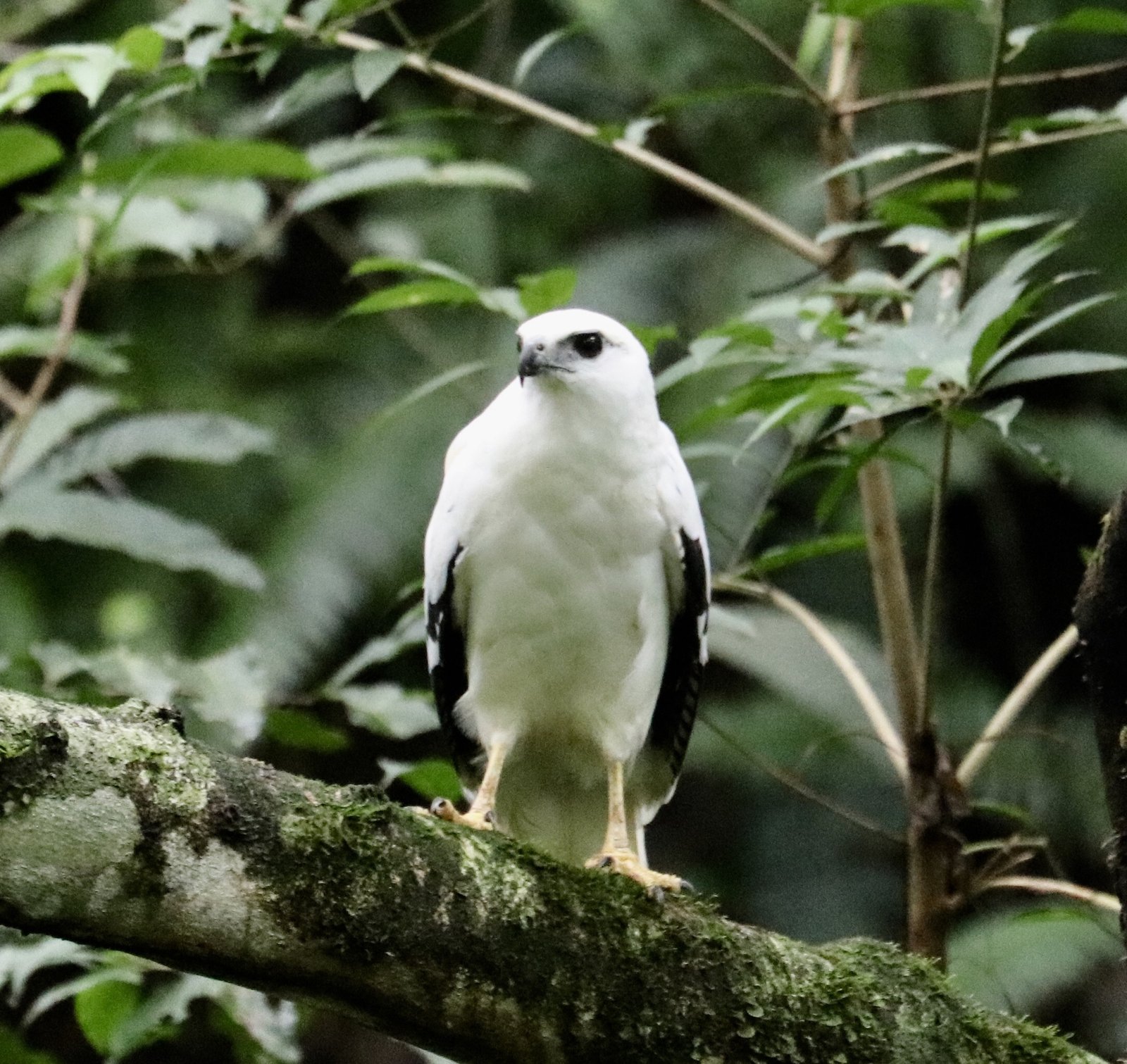
The White Hawk is a white-and-black forest hawk with broad, rounded wings. It often soars over the canopy of hill forest, where its white body can be seen from afar. Within the region it breeds only in the montane forest of Trinidad.
Voice
A plaintive, hoarse kerweee, given from a perch or in flight over the forest.
Recording: JAYRSON ARAUJO DE OLIVEIRA — CC BY-NC-SA 4.0 · converted to mono · xeno-canto
Identification
46–56 cm; the female is larger than the male. Broad, rounded wings and a short tail. Head, body and underwing coverts are white; the upperwing is largely black with white spots on the coverts, and the primaries have black tips, giving a black trailing edge to the wingtip from below. The tail is black with a broad white band and a white tip. The bill is dark with a grey cere, the legs yellow. Juveniles have more black spotting on the upperparts and dark-streaked, whitish underparts.
Confusion species
No similar species in the region. Grey-headed Kite Leptodon cayanensis has a grey head and white underparts, but a dark back, a banded tail and barred underwings. Osprey Pandion haliaetus is white below, but has long, angled wings, a dark eye stripe and a brown back.
Habitat
Moist lowland and hill forest and montane rainforest, forest edges and clearings, including mature secondary forest. It hunts from a sheltered perch below the canopy, mainly for snakes and lizards, and also takes frogs, large insects, crabs and small mammals. It often soars on thermals above the forest around midday.
Where the bird is most at home, classified by the vegetation types of the Caribbean.



Range and movements
In Trinidad a resident of the Northern Range, where it is seen fairly regularly in the forested parts of the mountains; rarely elsewhere on the island. Not on Tobago. Outside the region from southern Mexico through Central America and northern South America to Bolivia and Brazil.
- Resident
- dark = core range, pale = thinly spread
How and when to look
The Northern Range, for example along the Blanchisseuse Road and from viewpoints over the forest near Arima, on clear mornings and around midday, when birds soar above the slopes. A white raptor with black wingtips and a black tail with a white band above the forest is almost certainly this species.
Conservation status
Not threatened. The species depends on continuous forest and disappears where forest becomes heavily fragmented. In Trinidad the Northern Range is still largely forested.
Scientific name
Pseudastur albicollis | (Latham, 1790) (GBIF: Leucopternis albicollis)
Latham described the species in 1790 as Falco albicollis; because it was later moved to another genus, the author and year stand in brackets. The genus Pseudastur was introduced in 1849 by Gray. Pseudastur is Greek-Latin, from pseudos 'false' and Astur, an old genus name for the goshawk: 'false goshawk'. albicollis is Latin, from albus 'white' and collum 'neck': 'white-necked', after the white head and neck. The specimen the first description was based on came from Cayenne, French Guiana.