All species › Passerines › Tyrant flycatchers › White-headed Marsh Tyrant
White-headed Marsh Tyrant | Arundinicola leucocephala
Witkopwatertiran | Viudita cabeciblanca
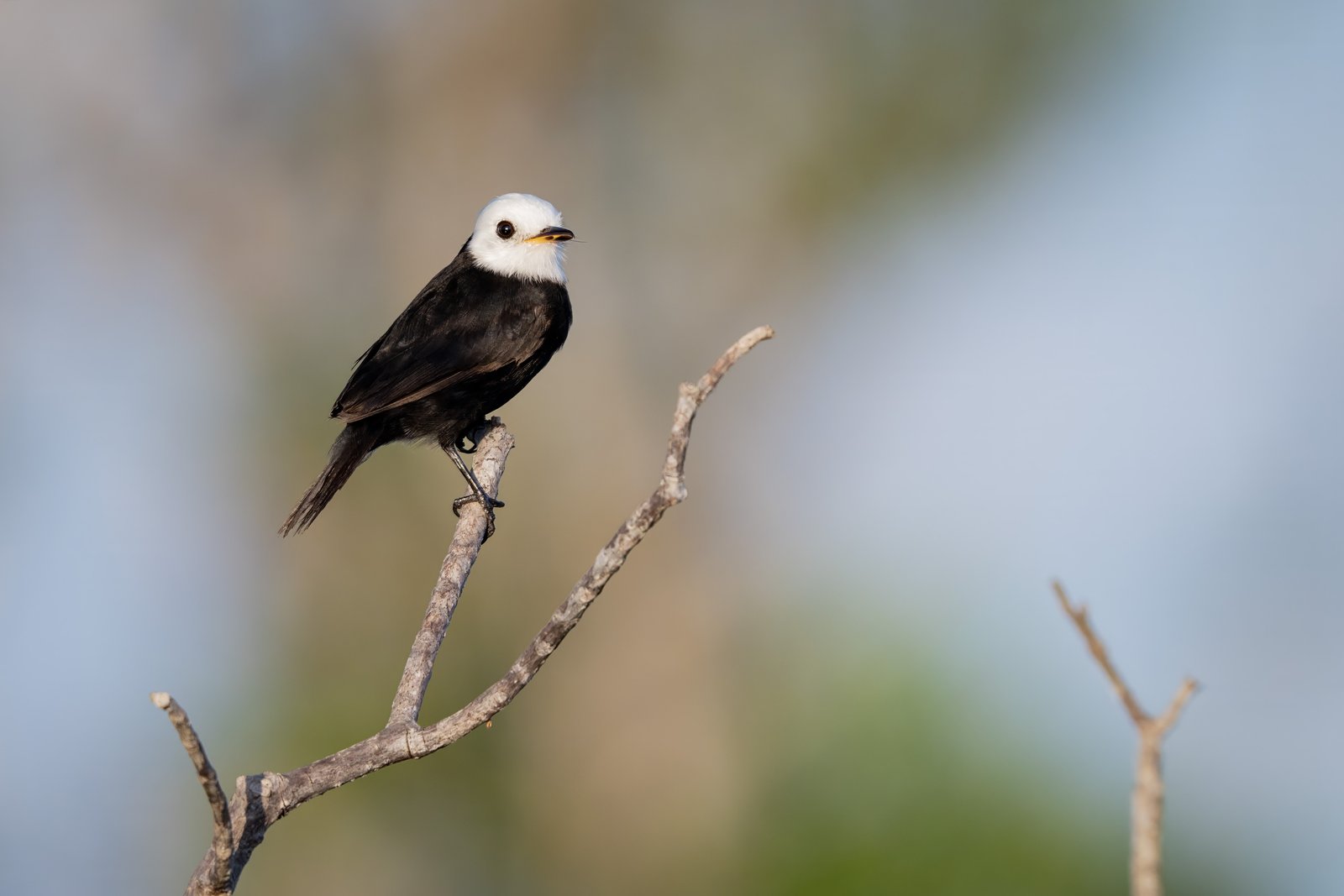
The White-headed Marsh Tyrant is a small marsh flycatcher of tropical South America that, within the region, lives only in Trinidad. The male is black with a white head; the species lives in the island's freshwater marshes. Birds perch low on reeds, small shrubs or fence posts at the water's edge and make short sallies after insects.
Voice
Usually silent. The call is a high, short sedik; in courtship a lower, repeated dew-de-lewde is given.
Recording: JAYRSON ARAUJO DE OLIVEIRA — CC BY-NC-SA 4.0 · converted to mono · xeno-canto
Identification
12.5–13 cm, with a short bill and a small, slightly ragged crest. The male is entirely black with a white head and throat; the upper mandible is black, the lower yellow. The female has a white forehead, face and throat, but is otherwise grey-brown on the upperparts, breast and flanks, with grey-brown wings and tail. Juveniles resemble the female.
Confusion species
Pied Water Tyrant Fluvicola pica shares the same marshes, but is mainly white with a black hindcrown, a black-and-white mottled back and black wings and tail; it lacks the uniformly black body of the male White-headed Marsh Tyrant. The female White-headed is told by the combination of a white face and a plain grey-brown body without any black-and-white pattern.
Habitat
Freshwater marshes, seasonally flooded savanna, rice fields and the vegetated edges of ponds, rivers and ditches in the lowlands. It forages from a low perch over water or wet vegetation. The nest is a domed ball of dry grass with a side entrance, placed low in a marsh shrub.
Where the bird is most at home, classified by the vegetation types of the Caribbean.




Range and movements
Within the region a locally fairly common resident of lowland marshes in Trinidad; absent from Tobago and elsewhere. Outside the region across much of tropical South America east of the Andes, from Colombia, Venezuela and the Guianas to Bolivia, Paraguay and northern Argentina.
- Resident
- dark = core range, pale = thinly spread
How and when to look
In Trinidad best looked for at Nariva Swamp, the edges of Caroni Swamp and in lowland rice fields and marshy ground. Birds often sit in pairs or family groups on an exposed low perch and can then be seen from a distance.
Conservation status
Not threatened. The species has a very large range. In Trinidad it depends on freshwater marshes, which are shrinking through drainage, development and fire.
Scientific name
Arundinicola leucocephala | (Linnaeus, 1764)
Linnaeus described the species in 1764 as Pipra leucocephala; because it was later moved to another genus, the author and year stand in brackets. The genus Arundinicola was introduced in 1840 by D'Orbigny, ACVMD. Arundinicola is Latin, from arundo, arundinis 'reed' and -cola 'dweller': 'reed-dweller', after its marshy habitat. leucocephala is Greek, from leukos 'white' and kephalē 'head', after the male's white head. The specimen the first description was based on came from Suriname.