All species › Waders, gulls and terns › Plovers and lapwings › Wilson's Plover
Wilson's Plover | Anarhynchus wilsonia
Dikbekplevier | Chorlito piquigrueso
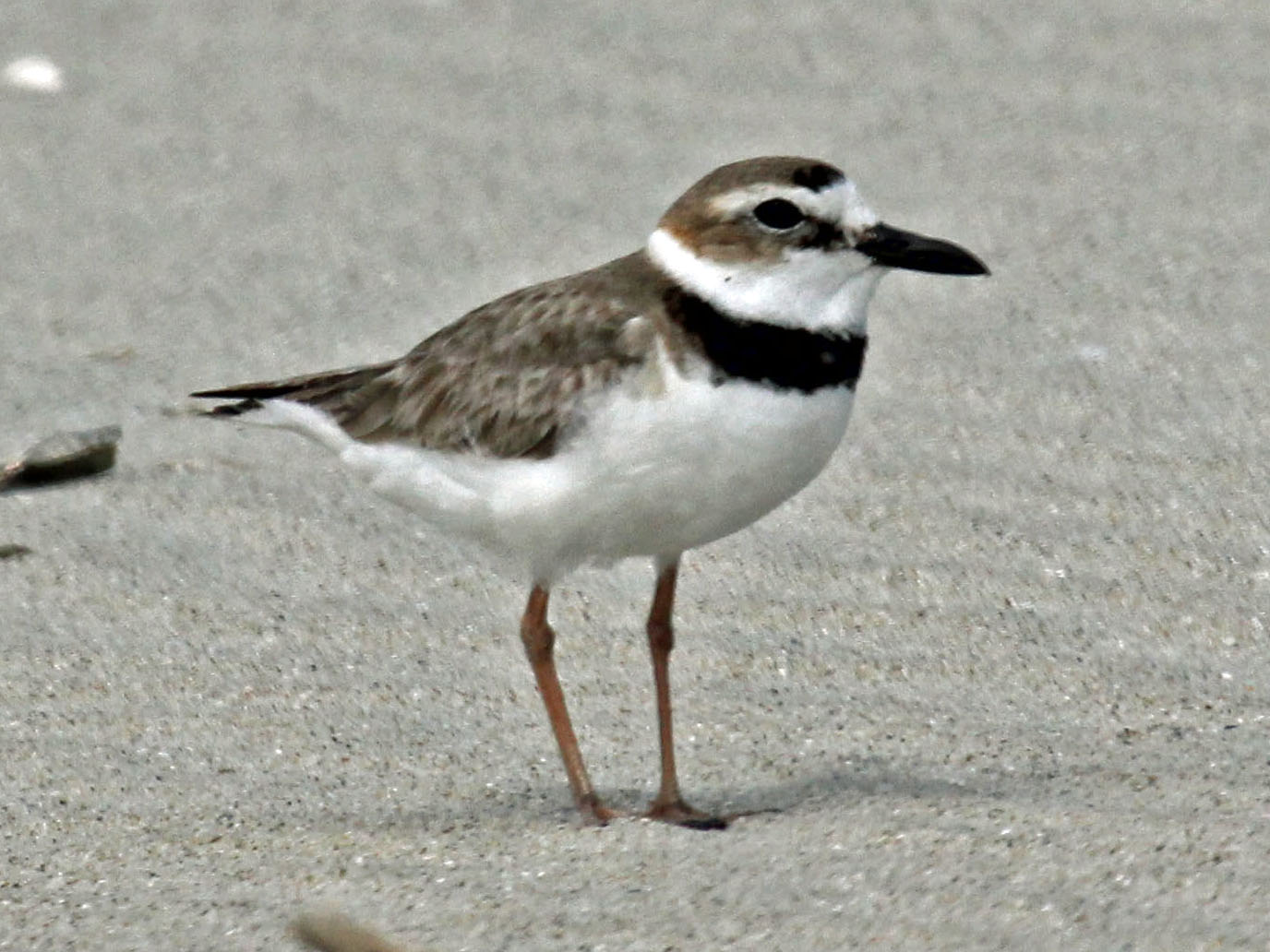
Wilson's Plover is a coastal plover with a heavy, all-black bill, with which it mainly catches crabs. In the Caribbean it is a resident that breeds on beaches, salt pans and mudflat edges of almost all the larger islands. In Cuba it is called títere playero.
Voice
A short, high and rather sharp whistled wheet or quit, often on taking flight. At the nest also a dry, rattling jrrit and alarm peeps; the displaying male calls repeatedly and somewhat more hoarsely.
Recording: Robson Silva e Silva — CC BY-NC-SA 4.0 · converted to mono · xeno-canto
Identification
16–20 cm. A fairly large small plover, with a big head and a long, thick black bill, and flesh-coloured to greyish-pink legs. The upperparts are grey-brown, the underparts white, with a single broad breast band. In breeding males the breast band and a bar across the forecrown are black and the ear coverts and hindcrown may be tinged cinnamon; in females and in winter plumage the breast band is brown. Above the bill there is a white forehead patch that continues into a short white supercilium. Juveniles have pale fringes on the back and an incomplete brown breast band. In flight it shows a narrow white wingbar.
Confusion species
Semipalmated Plover Charadrius semipalmatus is smaller and darker, with a short bill with an orange base, yellow-orange legs and a narrower breast band. Killdeer Charadrius vociferus is larger, with two breast bands and an orange-brown rump. Snowy Plover Anarhynchus nivosus and Piping Plover Charadrius melodus are much paler and smaller, with a thin and a short bill respectively and no complete breast band.
Habitat
Sandy beaches with a beach ridge, shell banks, the dry margins of salt pans and lagoons, mudflats and open spots along the mangroves. It feeds mainly on fiddler crabs and other small crabs, taken with the heavy bill, and also on other crustaceans, worms and insects. The nest is a scrape in sand or bare ground above the tide line, often beside a piece of debris or a plant.
Where the bird is most at home, classified by the vegetation types of the Caribbean.




Range and movements
Resident and breeding in the Bahamas, the Turks and Caicos Islands, Cuba, Jamaica, Hispaniola (Haiti and the Dominican Republic), Puerto Rico, the Cayman Islands and the Virgin Islands. In the Lesser Antilles local and scarcer, mainly on islands with salt pans; also on the ABC Islands, Trinidad and Tobago and San Andrés. Beyond the region along the Atlantic coast of the United States and the Gulf of Mexico, along the Pacific coast from Baja California to Peru and along the Atlantic coast of South America to Brazil.
- Summer visitor (c. Oct–Mar)
- Winter visitor (c. Apr–Sep)
- dark = core range, pale = thinly spread
How and when to look
Along the margins of salt pans and on quiet beaches, often close to the tide line. The heavy bill is the best mark even at a distance. In the breeding season nests and chicks on the beach are often overlooked; a bird that runs calling ahead of a walker or performs a broken-wing display indicates a nest or chicks nearby.
Conservation status
Not threatened. In the Caribbean its breeding sites are under pressure from beach recreation, coastal development, dogs, cats, rats and mongooses, and the conversion of salt pans. On protected salt pans and undisturbed beaches the species can breed locally in good numbers.
Scientific name
Anarhynchus wilsonia | (Ord, 1814)
Ord described the species in 1814 as Charadrius wilsonia; because it was later moved to another genus, the author and year stand in brackets. The genus Anarhynchus was introduced in 1832 by Quoy & Gaimard. Anarhynchus is Greek, from ana- 'backward' and rhunkhos 'bill', after the sideways-bent bill of the wrybill, the type species of the genus. wilsonia honours the Scottish-American ornithologist Alexander Wilson (1766–1813), the 'father of American ornithology'. The specimen the first description was based on came from Cape May, New Jersey.