All species › Parrots › Parrots › Yellow-billed Amazon
Yellow-billed Amazon | Amazona collaria
Geelsnavelamazone | Amazona jamaicana piquiclara
The Yellow-billed Amazon is the commoner and more colourful of the two parrots found only on Jamaica. It lives in the island's forested mountains and hills, and outside the breeding season also visits plantations and gardens at the forest edge.
Voice
Loud, ringing calls in flight, sounding like a high-pitched bugling chatter, and softer grating sounds from perched birds. Flocks are noisiest around sunrise and sunset.
Recording: Bobby Wilcox — CC BY-NC-SA 4.0 · converted to mono · xeno-canto
Identification
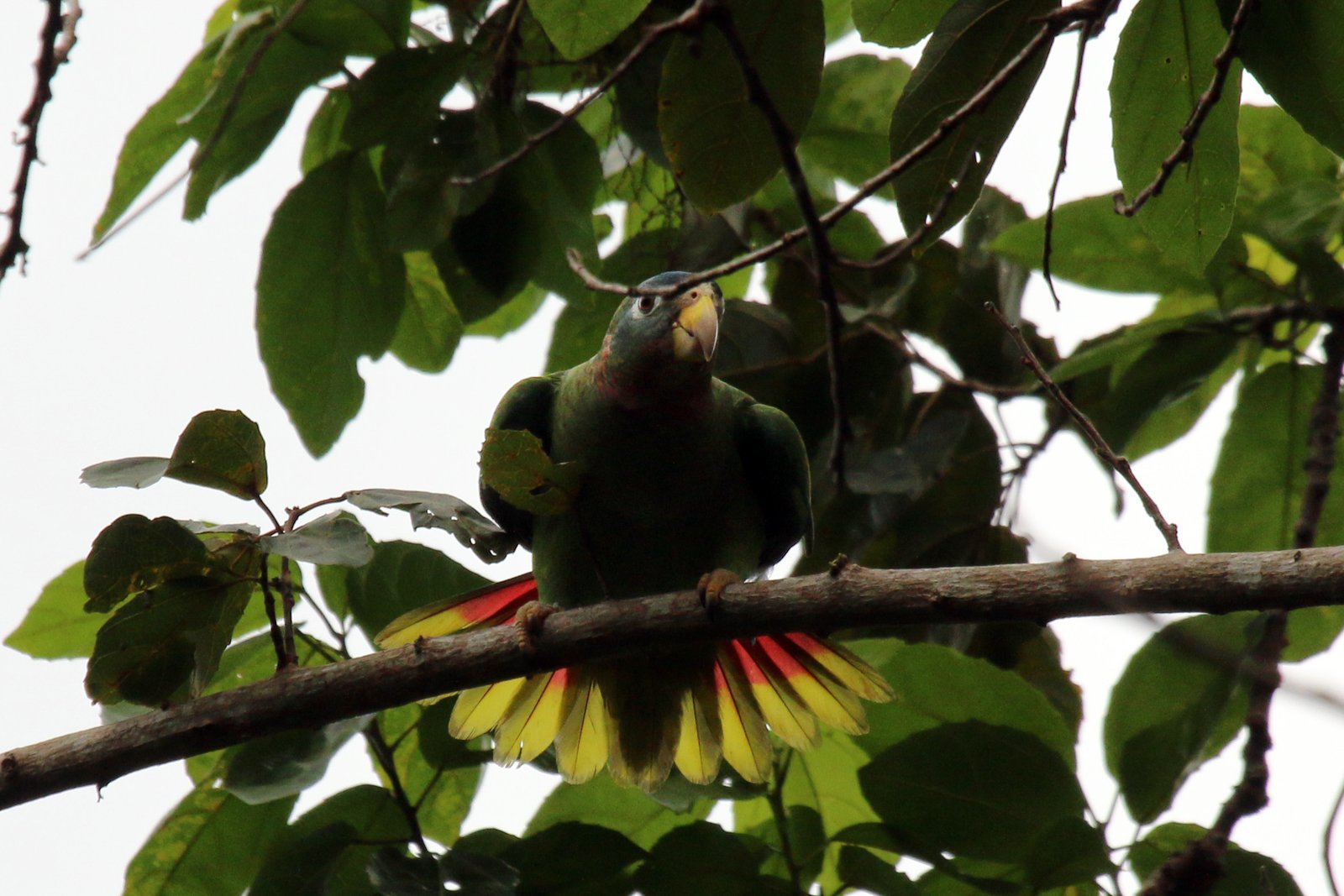
28–31 cm, with a short tail. Green, with a white forehead and eye-ring, a blue forecrown and pale blue lores. Throat, upper breast and sides of the neck are pink to wine-red; the ear coverts are dark blue-green. In the wing the primaries and greater coverts are blue; the tail is red at the base. The bill is yellow, the legs pink. The sexes are alike.
Confusion species
Black-billed Amazon Amazona agilis is smaller and plain green, with a dark bill and no white forehead or pink throat; the male shows red on the forewing. Olive-throated Parakeet Eupsittula nana has a long pointed tail and a brownish throat. Rose-ringed Parakeet Psittacula krameri, now established in urban Jamaica, is slim and pale green with a very long tail and a red bill. Escaped non-native amazons are larger and lack the combination of yellow bill and pink throat.
Habitat
Wet limestone forest, rainforest and montane forest up to about 1,200 m, and forest edge, plantations and rural gardens outside the breeding season; when breeding it stays in the forest. It eats fruit, seeds, nuts and blossom. Nests in cavities in tall trees, often in old dead trunks.
Where the bird is most at home, classified by the vegetation types of the Caribbean.




Range and movements
Endemic to Jamaica. Most numerous in Cockpit Country, around Mount Diablo and in the John Crow Mountains; elsewhere local in forested hills. It does not occur outside Jamaica.
- Resident
- dark = core range, pale = thinly spread
How and when to look
Best early in the morning or late in the afternoon from a lookout above the forest in Cockpit Country or the John Crow Mountains, when small flocks fly calling over the forest. Flying birds are told from Black-billed Amazon by the blue primaries and the absence of red on the forewing.
Conservation status
Vulnerable. The range is small and fragmented. Threats are forest loss, the felling of nest trees, the taking of nestlings for the trade and hybridisation with escaped non-native amazons, which are released more often after hurricanes.
Scientific name
Amazona collaria | (Linnaeus, 1758)
Linnaeus described the species in 1758 as Psittacus collarius; because it was later moved to another genus, the author and year stand in brackets. The genus Amazona was introduced in 1830 by Lesson. Amazona comes from 'Amazone', the French name Buffon gave to various tropical American parrots because they came from the Amazon region. collaria derives from Latin collare 'collar', probably after the pinkish-red throat and neck. The specimen the first description was based on came from Jamaica.