All species › Parrots › Parrots › Cuban Amazon
Cuban Amazon | Amazona leucocephala
Cubaanse amazone | Cotorra cubana
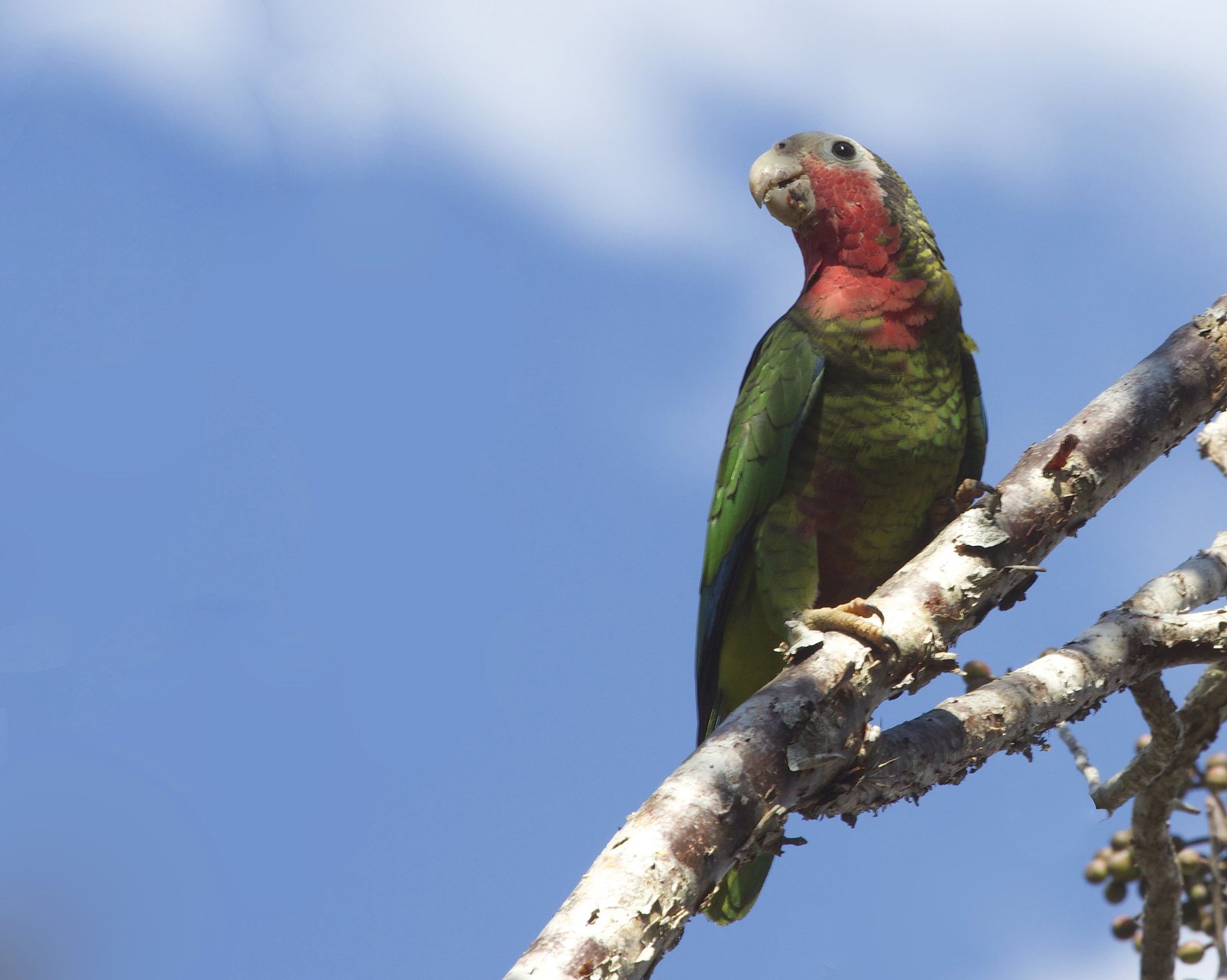
The Cuban Amazon is the only amazon of Cuba, the Bahamas and the Cayman Islands, and the only parrot native to all three island groups. Four subspecies are recognised: the nominate on Cuba and Isla de la Juventud, bahamensis on Abaco and Great Inagua, caymanensis on Grand Cayman and hesterna on Cayman Brac. On Abaco the birds nest in holes in the limestone ground, a habit known from no other amazon. In Cuba it is simply called cotorra.
Voice
Noisy. A harsh, hoarse raa-raa or krrah, often repeated in series in flight, plus screeching and chattering notes. Flocks at roosts and feeding trees can be heard from far away.
Recording: FREDERIC Lionel — CC BY-NC-SA 4.0 · shortened to the first 60 s, mono · xeno-canto
Identification
28–33 cm, stocky, with a short rounded tail. The plumage is green with black feather edges, giving a scaled pattern. Forehead and eye-ring are white; throat, cheeks and lower face pink to rose-red. A maroon to wine-red belly patch varies greatly in size and is often larger in Bahamian birds. The primaries are blue and the outer tail feathers red at the base. The bill is pale horn. The sexes are alike. Flies with fast, shallow wingbeats below the body line, usually in calling pairs or small flocks.
Confusion species
On Cuba the only other native parrot is Cuban Parakeet Psittacara euops, which is smaller and slimmer, with a long pointed tail, red flecks on head and neck and red under the wing. Hispaniolan Amazon Amazona ventralis also has a white forehead, but a black ear patch and no rose-red throat. In the Bahamas and the Caymans escaped cage amazons of other species may turn up; the white-and-pink face is the key feature there.
Habitat
Dry and semi-evergreen forest, limestone forest, pine forest (on Abaco and in western Cuba), palm swamps and open country with scattered trees, also plantations and gardens at the forest edge. It eats fruit, seeds, berries and flowers, including those of palms. Nests in tree cavities, often old woodpecker holes or dead palms; on Abaco in holes in the limestone floor of the pine forest, where nests are sheltered from wildfires.
Where the bird is most at home, classified by the vegetation types of the Caribbean.






Range and movements
Widespread but local on Cuba, mainly in the larger forest areas such as the Zapata Peninsula, Guanahacabibes and the eastern mountains, and on Isla de la Juventud. In the Bahamas only on Abaco and Great Inagua; formerly on other islands too. In the Cayman Islands on Grand Cayman and Cayman Brac; extinct on Little Cayman. Does not occur outside the region; scattered records elsewhere, including Puerto Rico, refer to escaped cage birds.
- Resident
- dark = core range, pale = thinly spread
How and when to look
On Grand Cayman in the interior and at the botanic park, on Cayman Brac in the Parrot Reserve on the limestone bluff, on Abaco in the pine forest of the national park in the south. Birds are most active early in the morning and late in the afternoon, when they commute noisily between roosts and feeding trees.
Conservation status
Near Threatened. The species has declined through trapping for the cage-bird trade, forest clearance and the loss of nest trees; hurricanes can sharply reduce island populations for a time. Around 2006 the populations on Grand Cayman, Abaco and Great Inagua were each estimated at a few thousand birds, Cayman Brac at a few hundred and Cuba at around ten thousand. International trade is banned.
Scientific name
Amazona leucocephala | (Linnaeus, 1758)
Linnaeus described the species in 1758 as Psittacus leucocephalus; because it was later moved to another genus, the author and year stand in brackets. The genus Amazona was introduced in 1830 by Lesson. Amazona comes from 'Amazone', the French name Buffon gave to various tropical American parrots because they came from the Amazon region. leucocephala is Greek for 'white-headed', from leukos 'white' and kephalē 'head', after the white forehead. The specimen the first description was based on came from Cuba (later restricted to eastern Cuba).