All species › Parrots › Parrots › Hispaniolan Amazon
Hispaniolan Amazon | Amazona ventralis
Hispaniola-amazone | Cotorra de La Española
The Hispaniolan Amazon is the only amazon of Hispaniola and endemic to the island. Once common throughout, it has been greatly reduced by trapping, hunting and deforestation and now lives mainly in the protected forests of the Dominican Republic. In Haiti it has become rare. Locally it is called cotorra.
Voice
Noisy, especially in flight: a harsh, hoarse kraa-kraa and kreeh, often repeated, and various screeching and chattering notes at feeding trees and roosts.
Recording: Barry Edmonston — CC BY-NC-SA 4.0 · shortened to the first 60 s, mono · xeno-canto
Identification
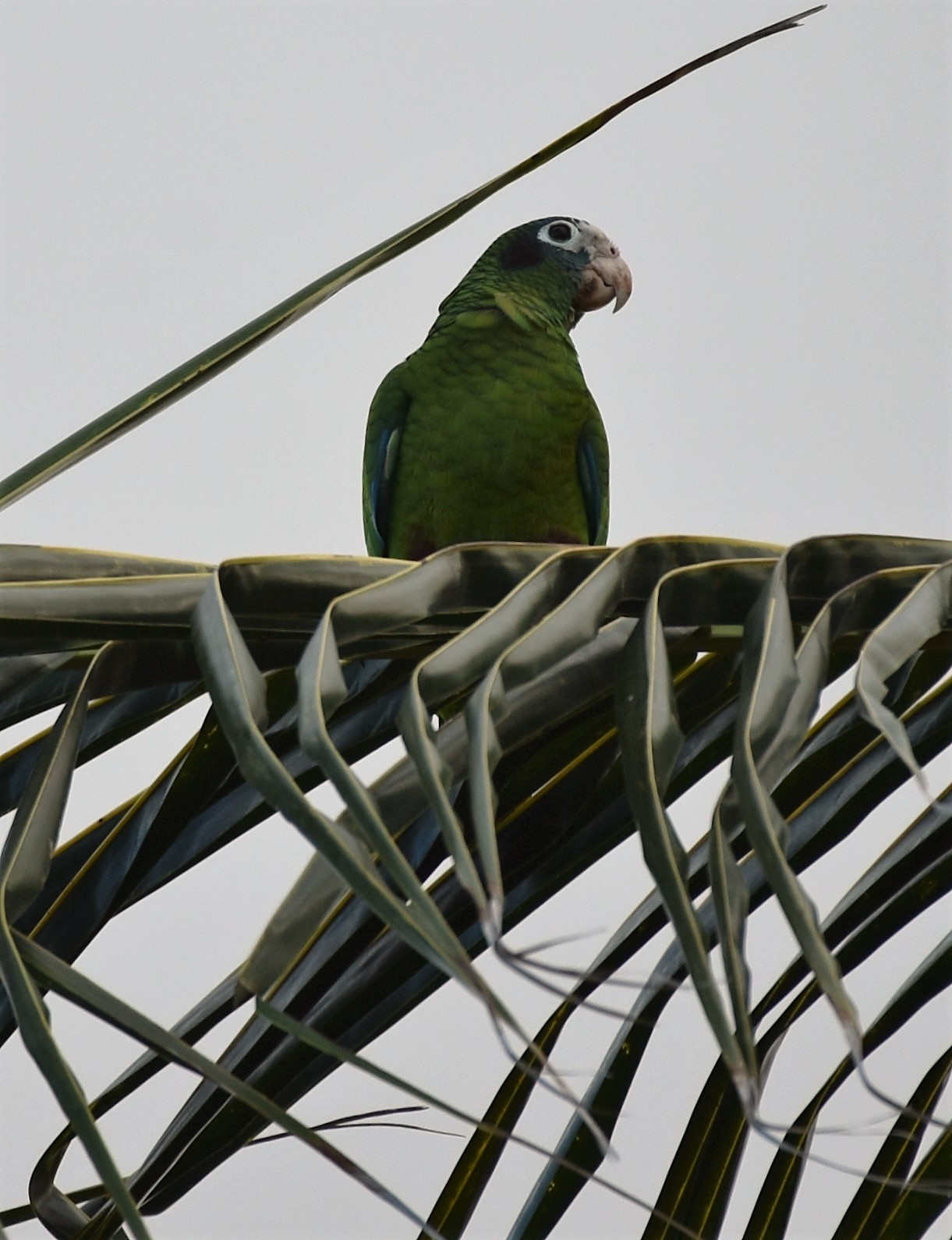
28–31 cm, stocky, with a short rounded tail. Green, the feathers with dark edges. Forehead and the area around the eye are white, the ear coverts black, with some blue on crown and cheeks. There is some red on the chin and a maroon patch on the belly. Primaries and greater coverts are blue, the tail is red at the base. The bill is pale horn. The sexes are alike. Flies with fast, shallow wingbeats, in pairs or flocks.
Confusion species
Hispaniolan Parakeet Psittacara chloropterus is slimmer, with a long pointed tail, no white forehead and red underwing coverts. Cuban Amazon Amazona leucocephala, absent from Hispaniola, also has a white forehead, but a rose-red throat and cheeks and no black ear patch. Puerto Rican Amazon A. vittata has a narrow red frontal band and no white forehead.
Habitat
Almost all forest types from sea level into the mountains: dry and semi-evergreen forest, montane rainforest and pine forest, also open palm country, coffee plantations and fields with scattered trees, where the birds take maize and fruit and can be considered a pest. Nests in tree cavities, often old woodpecker holes and dead palms.
Where the bird is most at home, classified by the vegetation types of the Caribbean.






Range and movements
Endemic to Hispaniola. In the Dominican Republic mostly in national parks such as Los Haitises, Parque del Este, the Sierra de Bahoruco and the Cordillera Central; in a number of places also in and around towns. In Haiti rare and much reduced, mainly in remote forest areas. Escaped cage birds are occasionally seen on Puerto Rico.
- Resident
- dark = core range, pale = thinly spread
How and when to look
In the Dominican Republic best early in the morning at Los Haitises, Parque del Este or the Sierra de Bahoruco, where flocks fly noisily between roosts and feeding trees. A perched bird is hard to see in the canopy until it moves; the white forehead is then the best feature.
Conservation status
Vulnerable. The main threats are the taking of nestlings for trade, in which nest cavities are often hacked open and ruined, hunting, persecution as a crop pest and forest loss. The population is estimated at 10,000 to 20,000 birds. The species is largely confined to protected areas.
Scientific name
Amazona ventralis | (Müller, 1776)
Müller described the species in 1776 as Psittacus ventralis; because it was later moved to another genus, the author and year stand in brackets. The genus Amazona was introduced in 1830 by Lesson. Amazona comes from 'Amazone', the French name Buffon gave to various tropical American parrots because they came from the Amazon region. ventralis is Latin for 'of the belly' (venter), after the maroon belly patch. The specimen the first description was based on came from Hispaniola (originally given in error as Martinique).