All species › Parrots › Parrots › Puerto Rican Amazon
Puerto Rican Amazon | Amazona vittata
Puerto Ricaanse amazone | Cotorra puertorriqueña
The Puerto Rican Amazon is the only native parrot of Puerto Rico and one of the rarest birds in the region. It once ranged across the whole island and its satellite islets, but deforestation, trapping and hunting reduced it to thirteen wild birds in 1975. Since then a captive-breeding and release programme has kept it going. The Taíno called it iguaca, after its flight call.
Voice
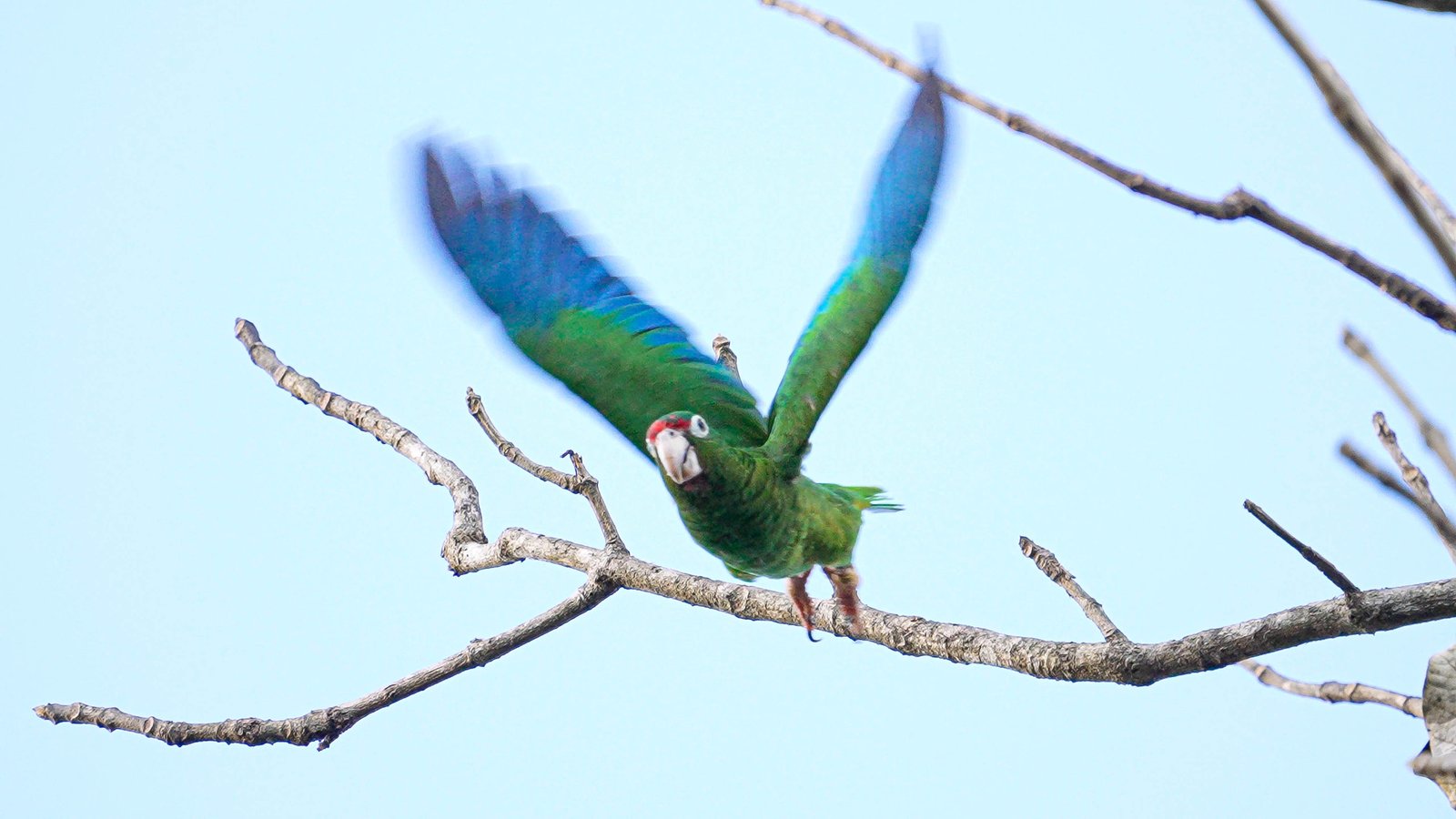
In flight a loud, bugling call rendered as i-gua-ca, and a series of long, hoarse squawks on take-off. Also screeching and chattering notes at the nest and roost.
Recording: campc — CC BY-NC 4.0 · Converted to mp3, mono, full length · iNaturalist
Identification
28–30 cm, stocky, with a short tail. Bright green, the feathers with dark edges, giving a scaled pattern especially on head and nape. A narrow red band across the forehead and a broad white bare eye-ring stand out. Primaries and primary coverts are dark blue; in flight the underwing is bright blue. The tail is green with red at the base of the outer feathers. The bill is pale horn. The sexes are alike.
Confusion species
Several escaped and feral parrots live on Puerto Rico. Hispaniolan Amazon Amazona ventralis has a white forehead, a black ear patch and a maroon belly patch. Orange-winged Amazon A. amazonica has blue and yellow on the head and orange in wing and tail. Parakeets such as Monk Parakeet Myiopsitta monachus are smaller, with long pointed tails.
Habitat
Mature moist forest with old trees that have cavities for nesting: montane rainforest in the Sierra de Luquillo, limestone karst forest at Río Abajo and forest in the Maricao mountains. Formerly also in lowland forest and mangroves. It eats fruit, seeds, flowers and leaves of many tree species. Nests in natural cavities and in nest boxes put up for the species.
Where the bird is most at home, classified by the vegetation types of the Caribbean.



Range and movements
Endemic to Puerto Rico. Wild birds live in three places: El Yunque National Forest in the Sierra de Luquillo, the only site where the species survived its low point; Río Abajo State Forest in the karst, where captive-bred birds have been released since 2006 and have nested on their own since 2013; and Maricao State Forest, where releases began in 2015. Records away from these areas are rare.
- Resident
- dark = core range, pale = thinly spread
How and when to look
El Yunque gives the best chance, where they fly noisily over the forest early in the morning. At Río Abajo they can sometimes be heard around the release site in the karst. Perched birds blend into the green canopy.
Conservation status
Critically Endangered. After the 1975 low the wild population grew slowly, but Hurricane Maria destroyed much of the forest at El Yunque in 2017, leaving only a few wild birds there. Thanks to new releases, the free-flying population at El Yunque reached at least 75 birds in 2025, the highest level since the programme began. The total, wild and captive together, is around five hundred. Hurricanes, predation by Red-tailed Hawks and rats, and competition for nest sites remain threats.
Scientific name
Amazona vittata | (Boddaert, 1783)
Boddaert described the species in 1783 as Psittacus vittatus; because it was later moved to another genus, the author and year stand in brackets. The genus Amazona was introduced in 1830 by Lesson. Amazona comes from 'Amazone', the French name Buffon gave to various tropical American parrots because they came from the Amazon region. vittata is Latin for 'banded' (vitta 'ribbon, band'), after the red band on the forehead. The specimen the first description was based on came from Puerto Rico (originally given as Santo Domingo).