All species › Passerines › New World sparrows › Zapata Sparrow
Zapata Sparrow | Torreornis inexpectata
Zapatagors | Cabrerito de la ciénaga
The Zapata Sparrow is an endemic Cuban sparrow and the only species in the genus Torreornis. It was not discovered until 1927, in the Zapata Swamp, a fact recalled by the name inexpectata, 'unexpected'. Two widely separated populations were later found, on Cayo Coco and on the south coast of Guantánamo province, each in an entirely different habitat. In Cuba it is called cabrerito de la Ciénaga.
Voice
A high, metallic trill repeated at intervals, tziii-tzziii-tzziii, and a quiet tic-tic-tic.
Recording: Andy Mitchell — CC BY-NC-SA 4.0 · converted to mono · xeno-canto
Identification
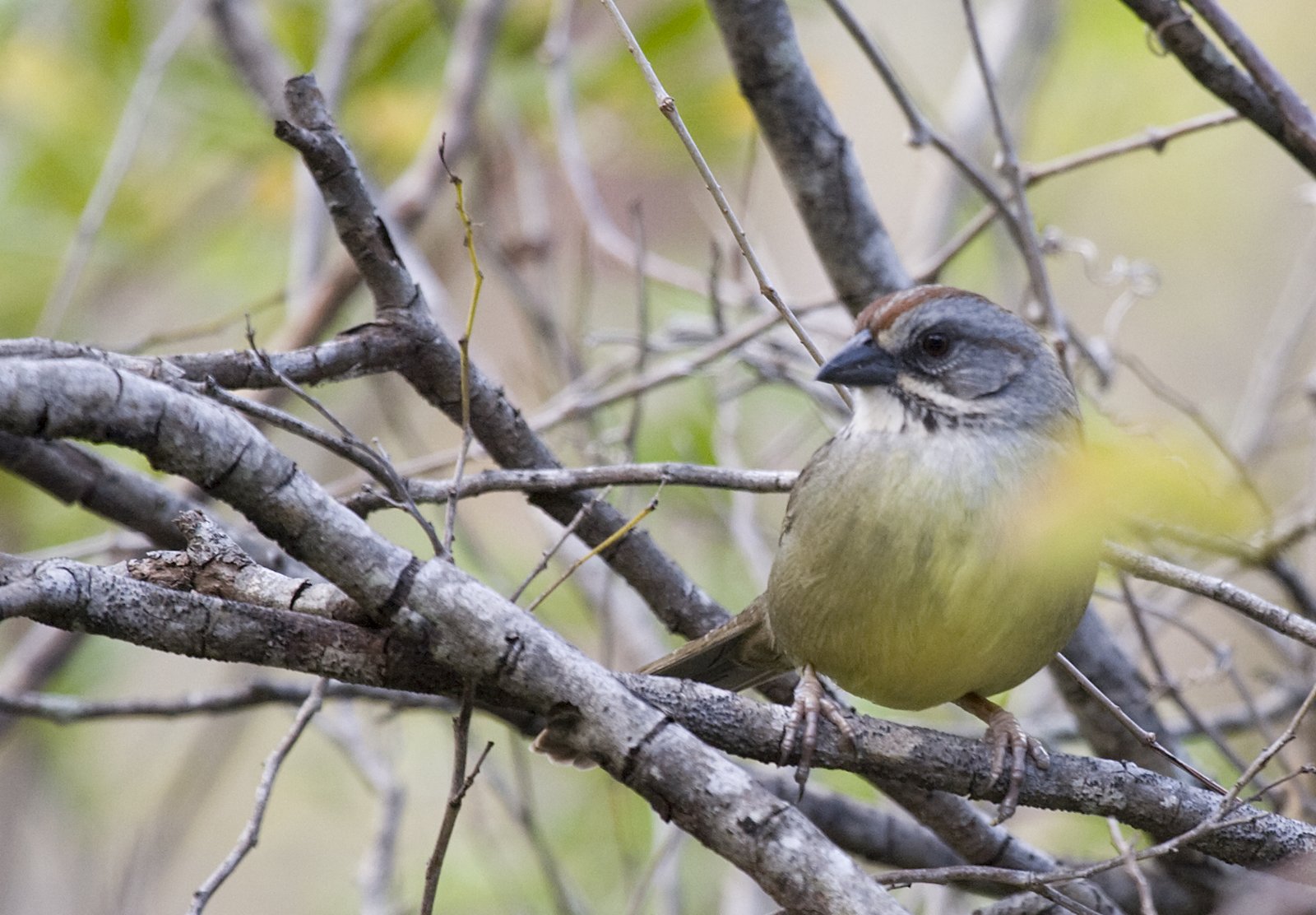
16–17 cm, stocky, with a thick, dark conical bill and a fairly long tail. The crown is rufous, the supercilium and sides of the head grey, with a blackish malar stripe beside the white throat. The upperparts are olive-grey with faint dark streaks. Breast and flanks are grey to olive-grey, the belly washed yellowish; there is a yellow patch at the bend of the wing. The sexes are alike. Young birds are duller, with less rufous on the crown and a faintly streaked breast. The three subspecies differ slightly in their grey and yellow tones.
Confusion species
Little confusion in Cuba. Yellow-faced Grassquit Tiaris olivaceus and Cuban Bullfinch Melopyrrha nigra are much smaller and lack the rufous crown. Savannah Sparrow Passerculus sandwichensis and Lincoln's Sparrow Melospiza lincolnii, both rare winter visitors, are smaller and clearly streaked on breast and back.
Habitat
The nominate form lives in extensive sawgrass marshes with scattered shrubs and low trees in the Zapata Swamp. On Cayo Coco (subspecies varonai) it occupies coastal forest and scrub, in Guantánamo (sigmani) dry coastal thorn scrub with cacti. It forages on and just above the ground. The diet is varied: seeds, flowers, insects, spiders, snails and small lizards. The breeding season is thought to run from March to June.
Where the bird is most at home, classified by the vegetation types of the Caribbean.






Range and movements
Only in Cuba, in three separate areas: the Zapata Swamp in Matanzas province, Cayo Coco off the north coast of Ciego de Ávila (traditionally attributed to Camagüey), and a narrow coastal strip in the south of Guantánamo province.
- Resident
- dark = core range, pale = thinly spread
How and when to look
In the Zapata Swamp mainly around La Turba and Santo Tomás, where local guides know the sites; on Cayo Coco in coastal forest and scrub along the roads. Best in the early morning, when the birds call and perch at the edge of the scrub. Walking into the sawgrass off the paths damages the habitat.
Conservation status
Near Threatened according to the IUCN. The range is small and fragmented. Dry-season fires damage the sawgrass marsh, and drainage, agriculture and tourist development, including on Cayo Coco, remove habitat. The Cuban red list treats the species as Endangered.
Scientific name
Torreornis inexpectata | Barbour & Peters, 1927
Barbour & Peters described the species in 1927 and placed it straight away in the genus where it still stands. He introduced the genus Torreornis in that same work. Torreornis honours the Cuban naturalist Carlos de la Torre (1858–1950), with the Greek ornis 'bird'. inexpectata is Latin for 'unexpected', after the surprising discovery in 1927 of a previously unknown genus in Cuba. The specimen the first description was based on came from Santo Tomás, Zapata Peninsula, Cuba.