All species › Waders, gulls and terns › Sandpipers and allies › Black Turnstone
Position in the tree Birds Aves › Birds with a flexible palate Neognathae › All other modern birds Neoaves › Birds of the elements Elementaves › Cranes and waders Gruimorphae
Black Turnstone | Arenaria melanocephala
Zwarte steenloper | Vuelvepiedras negro
The Black Turnstone is a dark, stocky wader of the rocky shores of the Pacific, almost black above and white below, with short dull red legs and a short, pointed bill used to flip over stones and seaweed. It breeds almost exclusively in western Alaska and reaches the southern limit of its winter range in the guide area, along the coasts of Baja California and the Gulf of California.

Voice
A high, dry, rattling trill, skirrr, higher and drier than the call of Ruddy Turnstone; on take-off shorter, sharp notes in short series. Flocks on the rocks often keep up a continuous rattling.
Recording: Paul Marvin — CC BY-NC-SA 3.0 · converted to mono · xeno-canto
Identification
22–25 cm, stocky, with a short, pointed black bill and short, dull red to reddish-brown legs. In non-breeding plumage uniform blackish-brown on the head, breast and upperparts, sharply demarcated from the white belly. In breeding plumage, in spring, blacker, with a white spot between bill and eye, a white supercilium and white spots on the sides of the breast. Juveniles are duller brownish-black, with narrow pale fringes. In flight a striking pattern: white wing bars, a white wedge on the back, white shoulder patches and a white tail with a broad black terminal band.
Confusion species
Ruddy Turnstone Arenaria interpres uses the same rocks but is browner and paler, with a pied head, an irregular dark breast band and bright orange legs. Surfbird Calidris virgata is greyer and bulkier, with a thick bill with a yellow base, greenish-yellow legs and no white wedge on the back in flight. Wandering Tattler Tringa incana is uniformly grey, longer in leg and bill, and shows no white in flight.
Habitat
Rocky shores with surf, seaweed-covered rock platforms, cobble beaches, rocky islets, breakwaters, piers and harbour jetties; adjacent mud and sand only where rocks are nearby. It flips over stones and seaweed and prises off barnacles, small snails and small crustaceans. At high tide flocks rest on higher rocks, often together with Surfbirds and Ruddy Turnstones.
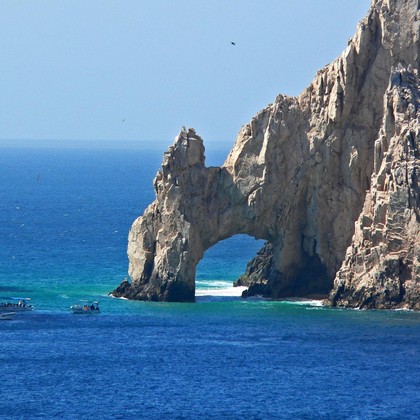
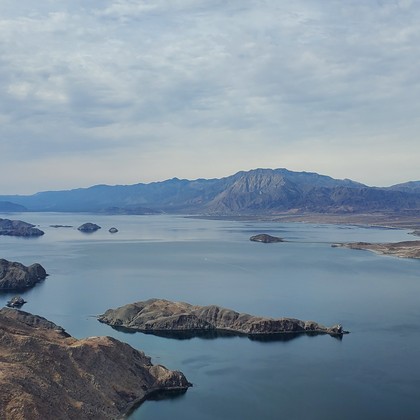
Where the bird is most at home, classified by the vegetation units of Mexico and Central America.
Range and movements
Winter visitor along the Pacific coast of Baja California and in the Gulf of California, along the coasts of Baja California Sur and Sonora and south to Sinaloa; very scarce further south and absent elsewhere in the guide area. Most numerous along the northern west coast of Baja California. Outside the guide area the species breeds almost exclusively in western Alaska, mainly in the Yukon–Kuskokwim Delta, and winters along the rocky Pacific coast from southeastern Alaska to California.
- Winter visitor (c. Oct–Mar)
- dark = core range, pale = thinly spread
How and when to look
Breakwaters and rocky headlands along the west coast of Baja California and harbours on the Gulf of California, around low tide. Against wet, dark rock the birds only stand out when they move; on take-off the flock shows the black-and-white flight pattern.
Conservation status
Not threatened. Almost the entire population breeds in one small area in Alaska and winters along one coastline, so oil pollution and disturbance at a few sites could affect a large part of the species. Counts along the west coast of the United States point to a decline.
Scientific name
Arenaria melanocephala | (Vigors, 1829)
Vigors described the species in 1829 as Strepsilas melanocephalus; because it was later moved to another genus, the author and year stand in brackets. The genus Arenaria was introduced in 1760 by Brisson. Arenaria is from Latin arenarius 'inhabiting sand', from arena 'sand'. melanocephala is Greek, from melas 'black' and kephalē 'head', after the black head and breast. The specimen the first description was based on came from the northwest coast of North America.