All species › Pelicans, herons and ibises › Pelicans › Brown Pelican
Position in the tree Birds Aves › Birds with a flexible palate Neognathae › All other modern birds Neoaves › Birds of the elements Elementaves › Tropicbirds and waterbirds Phaethoquornithes › Core waterbirds Aequornithes
Brown Pelican | Pelecanus occidentalis
Bruine pelikaan | Pelícano pardo
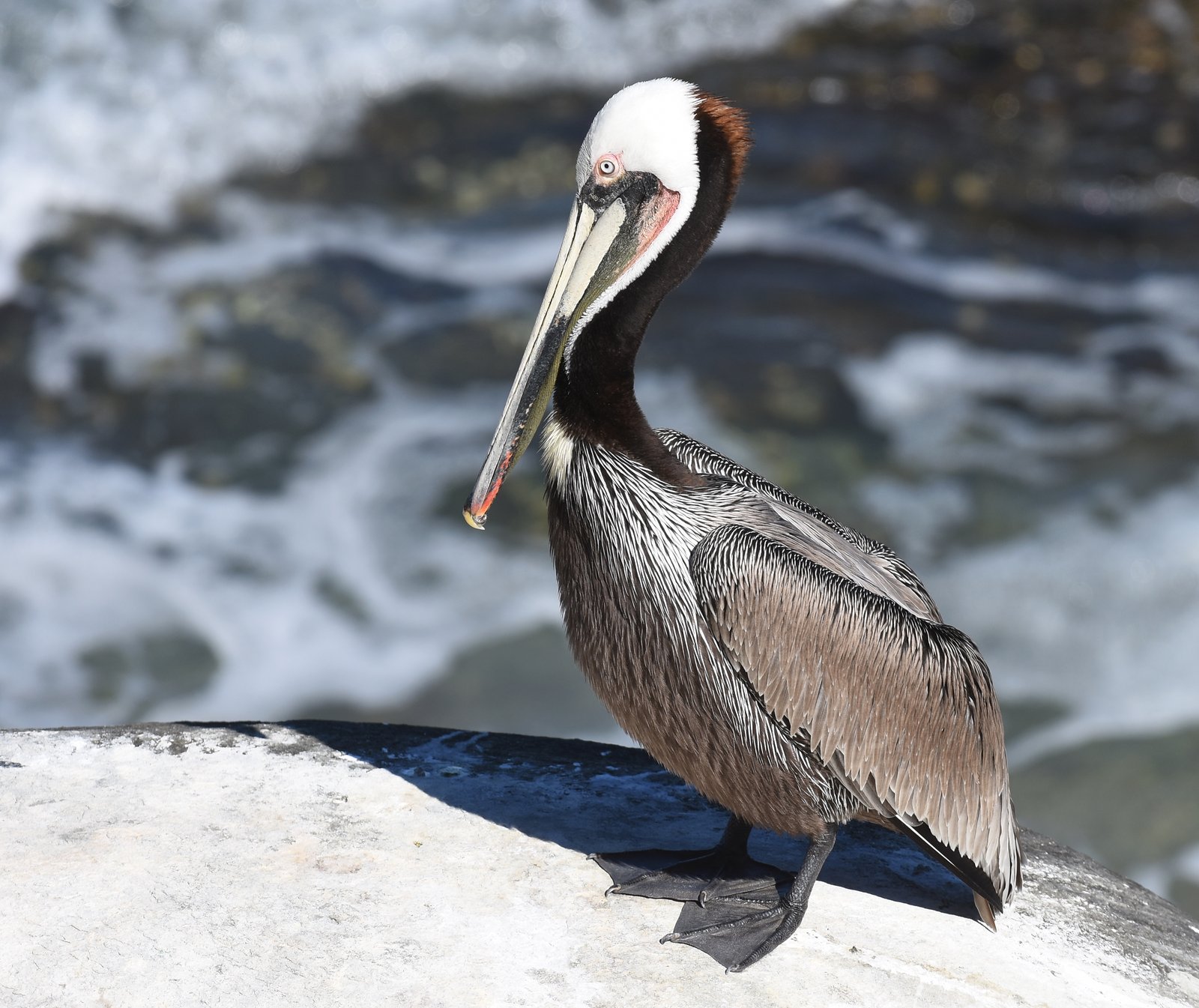
The Brown Pelican is a dark sea pelican that fishes by plunging bill-first into the sea from some height. In the guide area it can be seen along almost the entire Pacific and Caribbean coast, on mooring posts in harbours, over bays and in lines low over the waves. The largest colonies are on islands in the Gulf of California and off the Pacific coast.
Voice
Adults are almost silent away from the colony. At the colony they give low grunts and groans; chicks in the nest beg with shrill squeals.
Recording: Isain Contreras Rodríguez — CC BY-NC-SA 4.0 · converted to mono · xeno-canto
Identification
100–137 cm, with a wingspan of around two metres. The body is grey-brown, the upperparts streaked silvery grey. The bill is long and flat, with a dark pouch. Outside the breeding season the head and neck are white, the crown yellowish. In breeding plumage the hindneck and nape are dark chestnut, separated from the white head by a white stripe along the side of the neck. Birds from the Pacific coast of Mexico (P. o. californicus) are larger and have a bright red pouch in breeding plumage; birds on the Gulf and Caribbean coast have a dark pouch. Juveniles are uniformly grey-brown on the head, neck and back, with a pale belly. It flies with the head drawn back, alternating a few beats with long glides, often in lines just above the water.
Confusion species
American White Pelican Pelecanus erythrorhynchos, a winter visitor in Mexico, is larger and white with black primaries, and fishes while swimming in groups rather than diving. Young Brown Pelicans can recall Brown Booby Sula leucogaster at a distance, but that is much smaller, with a slender, pointed bill and a sharply demarcated white belly. Magnificent Frigatebird Fregata magnificens is slender, with long, angular wings and a deeply forked tail, and does not land on the water.
Habitat
Coastal waters, bays, shallow lagoons, estuaries, mangroves, beaches and harbours; rarely far out at sea and rarely inland. It fishes by diving bill-first into the water with half-folded wings from a few metres to more than ten metres up, scooping up the fish with its pouch. In harbours it begs at fishing boats. It breeds in colonies on islets, in mangroves, shrubs or on the ground.
Where the bird is most at home, classified by the vegetation units of Mexico and Central America.






Range and movements
On the Pacific side along the whole coast, from Baja California and the Gulf of California to Panama, with large colonies on islands in the Gulf of California, on Isla Isabel off Nayarit and in Panama, among other places, on the Pearl Islands. On the Gulf and Caribbean side from Tamaulipas through Veracruz and the Yucatán Peninsula to Belize, Honduras and Panama, but generally less numerous there. Outside the guide area along the coasts of the United States, in the Caribbean and along the coasts of northern South America; on the Pacific side south to Ecuador.
- Resident
- dark = core range, pale = thinly spread
How and when to look
In almost every harbour and fishing port on the Pacific coast, such as Mazatlán, San Blas, Puerto Vallarta and Panama City, where the birds wait on posts and boats for fish scraps. Diving is best seen over shallow bays when shoals of small fish come to the surface. Breeding colonies are sensitive to disturbance and are best viewed from the water at a distance.
Conservation status
Not threatened. In the United States and north-western Mexico the species crashed in the 1960s because of DDT and has since recovered. In the guide area the colonies are vulnerable to disturbance, food shortages in warm El Niño years and mangrove clearance; birds become entangled in fishing lines and nets.
Scientific name
Pelecanus occidentalis | Linnaeus, 1766
Linnaeus described the species in 1766 and placed it straight away in the genus where it still stands. The genus Pelecanus was introduced in 1758 by Linnaeus. Pelecanus is the Latin form of the Greek pelekan 'pelican', which itself derives from pelekys 'axe'. occidentalis is Latin for 'western', after its occurrence in the New World. The specimen the first description was based on came from Jamaica.