All species › Nightjars › Nightjars and nighthawks › Eared Poorwill
Position in the tree Birds Aves › Birds with a flexible palate Neognathae › All other modern birds Neoaves › Birds of the elements Elementaves › Nightjars and swifts Strisores
Eared Poorwill | Nyctiphrynus mcleodii
Mexicaanse poorwill | Tapacamino prío
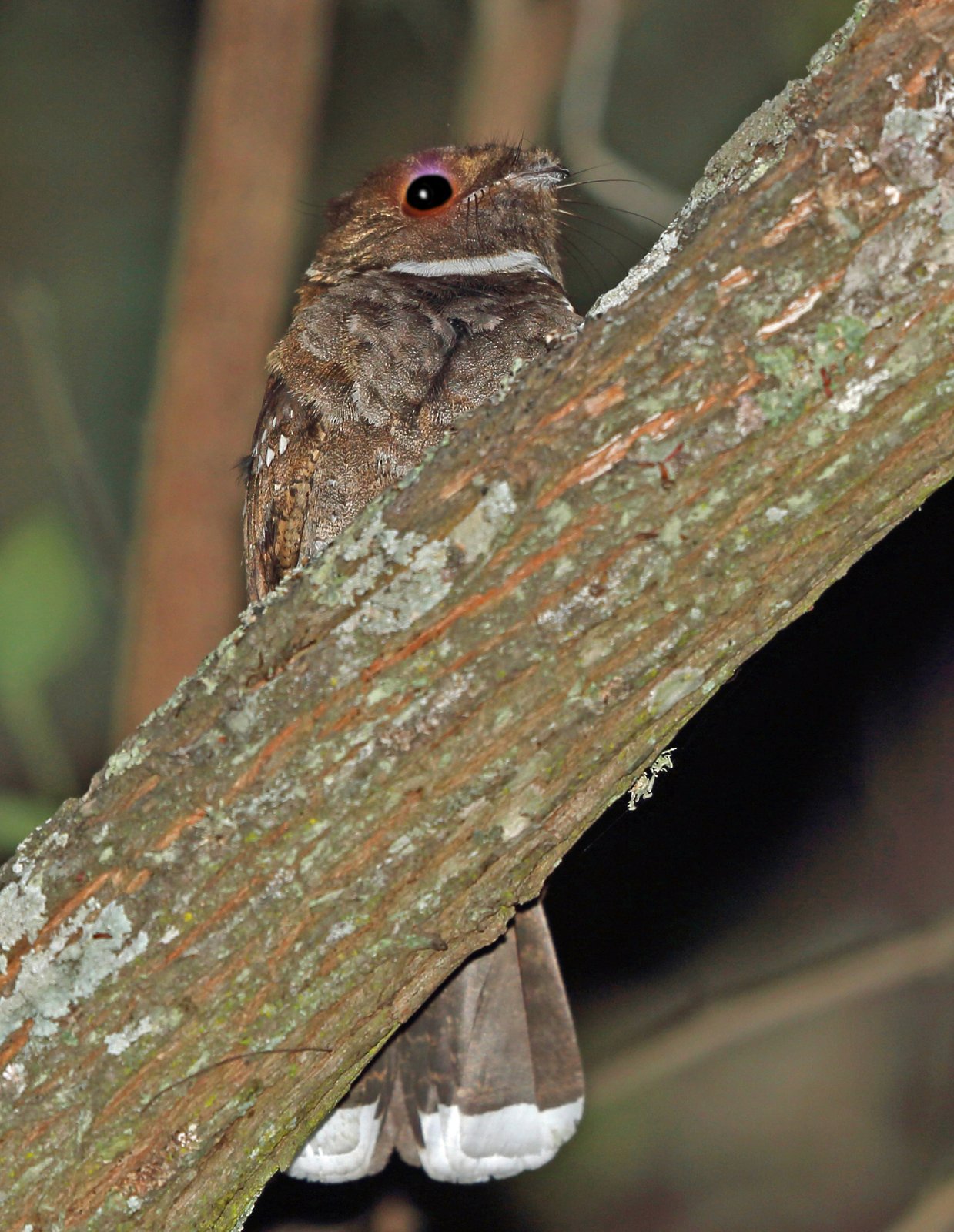
The Eared Poorwill is a small, dark nightjar found only in western Mexico. It lives hidden in dry forest and pine-oak woodland on the slopes of the Sierra Madre and is almost always heard first. On either side of the crown it has elongated feathers, which can give the head a horned profile.
Voice
A short, sharp, upslurred whistle, roughly preeyo or peeyoo, repeated at intervals of a few seconds. Heard mainly in spring and early summer, at dusk and on moonlit nights.
Recording: David Ruíz Domínguez — CC BY-NC-SA 4.0 · shortened to the first 60 s, mono · xeno-canto
Identification
19–21 cm, with a fairly long, rounded tail and short, round wings without white. The plumage is finely spotted and vermiculated grey-brown to rufous-brown, with elongated feathers above the ears. A narrow white band crosses the throat, and the belly is spotted. The outer tail feathers have white tips, conspicuous in flight and when flushed. The female is more rufous, with less white in the tail.
Confusion species
Common Poorwill Phalaenoptilus nuttallii in the north-west is greyer, with a shorter tail and a black throat above the white band. Buff-collared Nightjar Antrostomus ridgwayi and Mexican Whip-poor-will Antrostomus arizonae are larger and longer, with a buff or brown collar and no ear tufts. Pauraque Nyctidromus albicollis is larger, with a white wing band. The species does not overlap with Yucatan Poorwill Nyctiphrynus yucatanicus.
Habitat
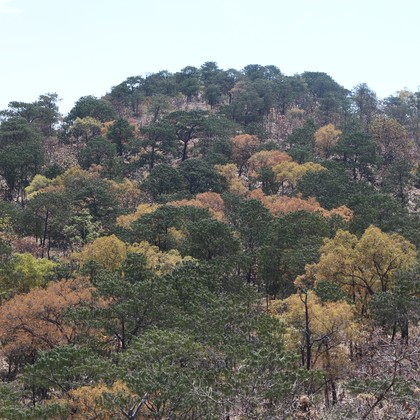
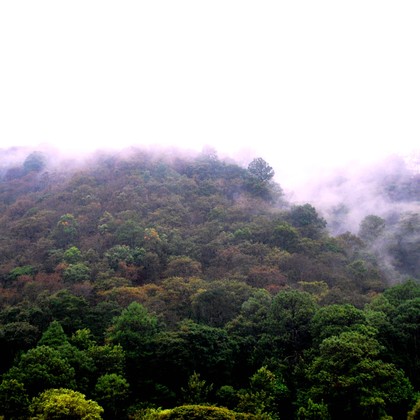
Dry forest and semi-deciduous forest on slopes and in ravines, and open pine-oak woodland above, in the foothills and lower mountains. It hunts from a low branch or from the ground for moths and other insects. The egg is laid without a nest on the ground, among leaves or stones.
Where the bird is most at home, classified by the vegetation units of Mexico and Central America.

Range and movements
Only in Mexico, on the Pacific slopes of the west. From southern Sonora and Sinaloa through Durango, Nayarit, Jalisco, Colima and Michoacán south to Guerrero and western Oaxaca. Owing to its secretive habits the distribution is incompletely known.
- Resident
- Summer visitor (c. Apr–Sep)
- Winter visitor (c. Oct–Mar)
- Passage (Mar–Apr, Oct–Nov)
- dark = core range, pale = thinly spread
How and when to look
Well known are the night excursions in the hills around San Blas and Tepic in Nayarit, where the birds are searched for by call in spring and found with a torch on a low branch or the ground. In Jalisco they are also reported from the hills inland from the coast.
Conservation status
Not threatened. A Mexican endemic with a fairly small range. Clearance of dry forest and pine-oak woodland reduces its habitat.
Scientific name
Nyctiphrynus mcleodii | (Brewster, 1888)
Brewster described the species in 1888 as Otophanes mcleodii; because it was later moved to another genus, the author and year stand in brackets. The genus Nyctiphrynus was introduced in 1857 by Bonaparte. Nyctiphrynus is Greek, from nux, nuktos 'night' and phrunē 'toad': 'night toad', after the wide gape and nocturnal habits. mcleodii honours the American collector Richard Randall McLeod, who worked in Mexico from 1883 to 1888. The specimen the first description was based on came from Sierra Madre of Chihuahua, Mexico.