All species › Nightjars › Nightjars and nighthawks › Yucatan Poorwill
Position in the tree Birds Aves › Birds with a flexible palate Neognathae › All other modern birds Neoaves › Birds of the elements Elementaves › Nightjars and swifts Strisores
Yucatan Poorwill | Nyctiphrynus yucatanicus
Yucatánpoorwill | Tapacamino yucateco
The Yucatan Poorwill is a small, dark nightjar of the Yucatán Peninsula and adjacent parts of Guatemala and Belize. It lives in dry and semi-evergreen forest on limestone and is almost only detected at night, by its call.

Voice
A rolling, somewhat burry whirr or prrr-eeo, repeated at intervals of a few seconds, mainly at dusk and in spring. Also short, hard calls when disturbed.
Recording: Paul Driver — CC BY-NC-SA 4.0 · converted to mono · xeno-canto
Identification
19–21 cm, with a fairly long, rounded tail and short, round wings without white. The plumage is dark brown to rufous-brown, finely spotted and vermiculated, with pale spots on the scapulars and elongated feathers above the ears. A white band crosses the throat. The outer tail feathers have white tips, conspicuous when flushed. The female is slightly more rufous, with narrower white tail tips.
Confusion species
Yucatan Nightjar Antrostomus badius is larger, with a longer tail and a buff collar on the nape. Pauraque Nyctidromus albicollis is larger, with a white band across the primaries. Chuck-will's-widow Antrostomus carolinensis, which spends the winter in the area, is much larger and more uniformly brown. Eared Poorwill Nyctiphrynus mcleodii is very similar but occurs only in western Mexico.
Habitat
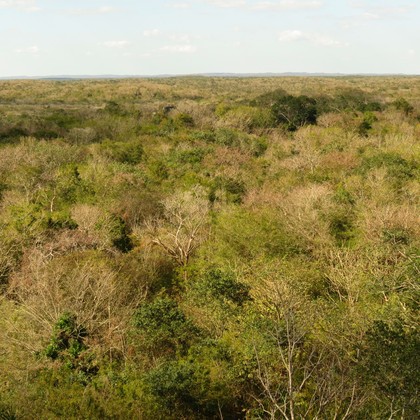
Low to medium-height dry and semi-evergreen forest on limestone, with clearings, trails and forest edges; also older secondary forest and scrub. It hunts from a low branch or from the ground for moths and other insects. The egg is laid without a nest on the forest floor.
Where the bird is most at home, classified by the vegetation units of Mexico and Central America.


Range and movements
On the Yucatán Peninsula in Mexico, in Yucatán, Campeche and Quintana Roo, and further in Petén in northern Guatemala and in northern Belize. Found only in the guide area.
- Resident
- dark = core range, pale = thinly spread
How and when to look
On night walks along trails and forest edges around archaeological sites such as Calakmul and Cobá in Mexico and Tikal in Guatemala it is regularly heard and found with a torch on a low branch. In northern Belize the birds can also be searched for along forest tracks.
Conservation status
Not threatened. The species has a restricted range but is fairly common within it. Forest clearance for agriculture and tourism reduces its habitat.
Scientific name
Nyctiphrynus yucatanicus | (Hartert, 1892)
Hartert described the species in 1892 as Caprimulgus yucatanicus; because it was later moved to another genus, the author and year stand in brackets. The genus Nyctiphrynus was introduced in 1857 by Bonaparte. Nyctiphrynus is Greek, from nux, nuktos 'night' and phrunē 'toad': 'night toad', after the wide gape and nocturnal habits. yucatanicus refers to the Yucatán Peninsula, where the species was described. The specimen the first description was based on came from Tizimín, Yucatán, Mexico.